FYI

Don't forget to refer to my Contents page for a more convenient reference to past articles.

For More L.A. La Land, visit my writing/art/film appreciation site on Facebook at Quoth the Maven and follow me on Twitter @ Blahlaland. :)

Showing posts with label Pat O'Brien. Show all posts

Thursday, May 2, 2013

STAR OF THE MONTH: Ann Sheridan - Biography


The "Oomph" Girl: Ann Sheridan
Before Ann Sheridan was a movie star in Hollywood, she was living in Denton, TX as lil’ Clara Lou, the youngest of five children, who possessed a surprising blend of Scottish, Irish, and even Cherokee blood. Clara Lou was one of those fortunate children born with a special gleam in her eye. Where she looked, she saw opportunity and a world for the taking. She was not greedy by any means, just enthusiastic about what each new day would bring. With her solid Southern roots and strict family morals, Clara Lou mixed in her own optimistic and loving attitude to mature into a young woman of great spirit and responsibility. Childhood friends would remember her as a girl always ready to pick a mop, broom, or hammer and help out.

She preferred male company from the beginning, if only because the gents' had more freedom in their fun. She liked riding horses, shooting tin cans, and working on cars (a hobby that would follow her to California). "Lulu" spent most of her time daydreaming about being a big band singer! People took life too seriously, she believed. All these standards for decent behavior or expected ways of life were a bore. Naturally, Clara Lou’s wishes to be a stage performer were not appreciated by her family, who was very religious. Though she maintained that she was always close to her family, one picks up on the veiled references to some unforgotten tensions in her past. In addition to lacking her parents’ support in her wishes, Ann would later remark again and again on the hypocrisy of religion and hypocritical people in general. Though, out of respect to her kin, she never went into specifics, she made no secret of the fact that finding a way out of Denton was a desire that had been burning in her belly from an early age. Though she was going to school to become a teacher-- majoring in art-- she longed for escape, for freedom, and a life without guilt or judgment. She wanted to be herself.

Ann gives good cheesecake

While the folks may have voted “No” on singing, at least one member of her family was pro-Clara Lou. In 1932, her sister, Kitty, learned that a little Paramount contest was in the works, searching for new talent. They were using the upcoming film Search for Beauty as a flimsy excuse to drum up publicity and interest in their studio. Clara Lou had heard of the "Search for Beauty" contest—young beauts with good gams looking for a chance in the spotlight. She thought it was ridiculous! Imagine her surprise when she learned that she was a finalist, because Kitty had secretly entered her in the contest! Not only did Clara Lou earn a part in the film, she got herself a contract too-- which was not something many of the other finalists could boast. After Clara Lou's ride to Tinsel Town, she never looked back. She had found her new home. It wasn’t all gravy, however. After her blink-and-you’ll-miss-it appearance on the screen, she worked hard to get somewhere in the business. While other winners of the contest faded into the back-drop, fell prey to Hollywood’s dangers, or packed it in and moved home, Clara Lou busted her tookus, taking any publicity photos asked of her, performing in whatever roles necessary, and building up her resume.

Despite her impressive, unlearned acting ability and out-of-this-world beauty, she couldn’t seem to get anywhere beyond silly supporting roles in B-pictures-- aside from her first leading role in Car 99. When she left Paramount in 1935, she was plucked by Warner Brothers. Nonetheless, after noticeable parts in The Great O'Malley with Pat O'Brien and San Quentin with O'Brien and Humphrey Bogart, her career still seemed to be going nowhere. "Ann"—who had officially changed her name at studio suggestion in 1934-- was mostly being used as a body double. She once cracked that she lined up to buy a ticket at the theater to see the back of her own head, her hands, or her legs on the big screen. Naturally, she started getting nostalgic, thinking that maybe Mom and Dad had had a little more sense than she had given them credit for. Maybe it was time to haul it in after all... Then, she got her big break!
Ann’s casting opposite James Cagney in Angels with Dirty Faces was a godsend! Not only was she working with the incredible Jim, a pro who took special care to teach her the ropes, but for the first time, her fast-talking wisecracks were on full display. Unlike other heroines—all sweet or all tough—Ann was a little of both. She was a woman, but she was a woman who could take care of herself. She didn’t need any guy for nuthin’, so if you want to make a move, Buster, you better have something better goin’ on than a nice suit of clothes. And she won’t take to lip, neither! Ann’s onscreen characters, who were reliable, sturdy girls were still not exactly "gal Fridays." She was there to lean on if she thought the cause was worthy, and only then would she give the hero her heart. She was a tough cookie, a quick thinker, and nobody’s fool—yet another strong female paving the way for pre-feminists. Despite this sudden burst in her career, she didn’t skyrocket the way she had hoped. BUT, she had made a great impression on the public, her co-stars, and everyone she had or would soon work with. Some directors initially thought that Ann didn’t give a damn about acting or the craft, because she was so easy-going, cracking up and playing pranks between takes. Then, they would see her at work and realize her incredible gift for simply being Ann unfiltered. Soon enough, she had several people fighting in her corner, and with her own right hook, she was about to take aim and knock the socks off Hollywood. In the case of Ann Sheridan, a little publicity gimmick went a long way.

George Hurrell became a great champion for Ann, using his
artistic eye to capture her beauty and personal texture
to put the "Ooooh" in her Oomph!

After Ann completed supporting roles as a naughty opportunist who blindsides John Garfield in They Made Me a Criminal and yet another naughty dance hall songstress in the Errol Flynn western Dodge City, notorious columnist Walter Winchell gave her an unexpected plug. While mentioning her underutilized talents, he chastised Warners for not giving her better roles with more "umph." That quip definitely got some eager corporate tails wagging, as they finally realized that they had a hot-cha-ching commodity on their hands! (It always amazes me when studio heads don't "know what to do" with pretty, talented actresses). Thus, publicity agent Bob Taplinger staged a rigged competition to decide who should bear the title of Hollywood's true "Oomph Girl"--which had a definite sexual connotation. To no one's surprise, Ann was crowned, though no one deserved it more. She, of course, took the label for what it was: a label indeed, one that would eventually become a stigma. After some advice from Paul Muni, an actor whom she respected, she took the joke in stride, determined to use the current media attention to improve her career, bargain for better roles, and hopefully show the world that she was more than just a "looker." In a nut shell, Ann took the biggest lemon of her life and made lemonade, but then that was just her style. What followed was a slew of some of the most beautiful studio portraits ever taken, magazine covers galore, and an incredible spike in her films' ticket sales as people lined up to see just what "Oomph" was.

Overcoming her "Oomph" was a hurdle, however. Ann seemed to be handed fairly ridiculous vehicles, which she was expected to sell based on her star power alone. It usually worked, but it was bad business to not give such a bankable star better writing and better scripts. Ann's laid-back demeanor didn't do her many favors either, as she initially didn't fight for the parts she should have had, (though she would show more gumption in business later). For the most part, she was handed hackneyed remakes of previous successes by Bette Davis, Joan Blondell, or Ann Harding. When she received the Harvard Lampoon Award for "the actress least likely to succeed," it fed her willful side but also put a chink in her confidence. She held her chin a little higher when Princeton claimed her as their own in retaliation, made her honorary editor of their own journal-- The Advocate-- and staged a picket outside the Lampoon! Great fans and solid, soulful performances in City for Conquest and King's Row earned her increasingly good reviews and critics became more and more impressed with her. Playing against type, she also showed her sharp, comic edge as a Hollywood diva opposite a surprisingly vanilla Bette in The Man Who Came to Dinner

With good pal Bogie in It All Came True.

With Ann's acting, it was all about timing. That was her gift, whether she was performing in a drama, screwball comedy, romance, or dark masterpiece. No one could spout off one-liners and comebacks like Ann, who gave sass with as much ease as she could shoot a pistol. She also knew when to let a moment land, playing with the emotions behind the words. Ann was never poetic about her art. She admired actresses of acclaim like Bette Davis (like everyone else), but she was both savvy and perhaps a bit too self-deprecating about her talent. She knew she wasn't a studied character thespian, and she knew she didn't have the exotic appeal of glamour goddesses like Garbo and Dietrich. She believed she was a capable lead who knew how to deliver her lines and did her best. This pure, unadulterated honesty of Ann's all-American appeal is exactly what singled her out from her contemporaries and made her a comfortable soul-mate for her fans. Additionally, she would consistently be on Hollywood's "best dressed" celebs lists. So, yet again, Ann played the star and enjoyed the act, but beneath it all, she was still the gap-toothed Clara Lou. She adhered to the rules, enjoyed the fame, but colored outside the lines by simply staying true to herself and never losing touch with what life was all about: happiness. 

Making beautiful, kooky music with Jack Benny in
George Washington Slept Here.

Meanwhile, Ann's un-teachable rhythm thrived when she was teamed with Jack Benny in George Washington Slept Here. As WWII raged on, Ann was very vocal in her support of the call to arms and very loyal to the men fighting the battles. She entertained troops overseas, danced with them at the Hollywood Canteen, and took part in the all-star war-morale film Thank Your Lucky Stars. Unlike other actresses, Ann wanted her roles to age as she did. Thus, in keeping with her own maturity, she continued turning heads with her dramatic performances in the films like the strange and fascinating noir, Nora Prentiss, or her "realistic and poignant interpretation," The Unfaithful. Still, there were many projects in which she was slated to appear that never took shape, mostly due her choice of daring material that made the censors sweat and were consequently scrapped. Though she finally won a long overdue pay bump with script approval, she was all but ignored by the studio and treated like an old, reliable mare who would loyally carry them to victory. She was not given the attention her career deserved. Finally, in 1949, Ann bought out the last remaining months of her Warners contract and began freelancing. And hallelujah, because she was teamed with Cary Grant in one of the funniest comedies of all time! I Was a Male War Bride turned out to be the perfect blend of chemistry and comic ping-pong. It was a slick casting decision, for what other woman could strong-arm the ever-dapper Cary into donning drag and get away with laughing at him at the same time!? It is unfortunate that the duo never made another film together. Unfortunately, it was while filming that Ann developed a chronic bronchial infection that would come back to haunt her.


With Cary Grant in the gender bender triumph, I Was a Male War Bride.


Now pushing 40, Ann began to work primarily in radio and television. She also spent much time in her beloved Mexico and nonchalantly took a three year hiatus from work as if she were just out for a brief walk. The world of acting is cruel to women. The age of 41 is the unspoken beginning of the fade-out for most film actresses. Ann understood this and took it in stride. One might suspect that in this period of her life, Ann might slow down and start building a family, but Ann's private life was as atypical as her BS-detector was spot on. She had a brief marriage to actor Edward Norris in the '30s, which ended primarily due to his own jealousy over her rising career as his own stalled. (Ann probably told him to cut the crap then packed her bags). Interestingly, they remained friends, and Norris would hint at his silly regrets later. In the '40s, Ann had a lengthy love affair with her complete opposite: the ever-serious and properly tuxed George Brent. They wed... and were divorced a year later.

Perhaps Ann's most lasting relationship was that with elder press agent Steve Hanagan. They never married, and while some suggest that this was due to his surprisingly invested mother's interference, it is also more than possible that Ann had decided by then that she just wasn't the marrying kind. They eventually split, and Steve passed away not much later, bequeathing Ann the bulk of his estate-- which turned out to include more debt than anything else. As ever, Ann paid for everything without complaint. Hints at the source of Ann's relationship troubles can be gleaned from her early upbringing. Her resultant need for independence and a life without rules certainly clashed with the standard ideals of "wivelihood" (new word).  In theory, the idea of eternal love was alluring; in reality, Ann perhaps found it too difficult to entirely give herself to anyone, nor could she tolerate being a trophy wife. She wanted to be loved-- no one as warm and giving  as she could not but hope for some of the same in return-- but whatever secret fears or mistrusts she carried within, seemed to hamper all of her liaisons.

With soon-to-be real life husband in Honeymoon for Three.

Her friendships on the other hand... those were things that Ann did well!!! As in her childhood, her best buddies were always men. She and Errol Flynn were thick as thieves when working together during Dodge City, Edge of Darkness, and her last Warners film, Silver City. Most particularly, she was good friends with Humphrey Bogart, who was not the easiest guy to charm. The rapport that she was able to build with these rapscallions is revelatory of her true self. Ann was a straight-shooting, salt-of-the-earth gal. She cared more about her poodles, which she eventually raised in droves, than she did about anything that highfalutin Hollywood seemed to be interested in. She was simple, direct, and honest. There was no feigned innocence or diva tantrums or skirt chasing when she was around. More likely, there were pranks and laughs and the old eye roll, particularly when she started filming yet another stinker: "Well boys, this is gonna be a train wreck, but we may as well enjoy it!"

She had female pals, of course, but very few. She is often mentioned in the same breath as other notorious party girls like Ava Gardner and Lana Turner, and one can imagine that they were one Hell of a trio. With Ava's sad and bold sensuality and Lana's rebellious Hellion in Prima Donna poise, Ann was the more rational and practical one. It has been said that she could "toss back a few," but just how many is unknown. Suffice it to say, she was not the type to sip wine. Whiskey was probably more her speed. Yet, despite whatever late night appearances she may have made with whatever rag-tag pals that came into the picture, Ann never believed in the version of life that she was presenting to the public. She would go have fun, take the glitz for what it was, then go home and de-oomph. Unlike Lana, for whom celebrity was an ongoing performance, Ann never really gave a hoot about it all and didn't allow people who were caught up with the glam come into her inner space.

As Ann got older, she took parts as they came: a supporting role in the musical version of The Women-- retitled The Opposite Sex-- and acclaimed performances in Woman on the run, Steel Town, and Just Across the Street. Continuing radio and television work, she also met a new paramour, Scott McKay, while taking a stab at stage work. A fan of Soaps, which were a personal guilty pleasure, Ann worked for a season on "Another World"-- during which she married Scott, probably under studio pressure-- as her tendency to live with lovers "in sin" was not kosher with the public. Then, she received the great honor of being offered a series of her own: "Pistols 'n' Petticoats." Unfortunately, it was during this period that Ann became gravely ill. She learned that she was suffering from terminal cancer of the liver and esophagus. Suddenly, that nagging cough that wouldn't go away, her difficulty swallowing, and her increasing weight loss, made sense. Her past bronchial infection and years of chain smoking certainly hadn't helped matters. Still, Ann pressed on, continuing her role in the series despite the great pain it caused her. Shooting had a taxing and tiring effect on her body, yet she filmed 25 episodes under these dire circumstances-- without complaint and always with a smile on her face. Unfortunately, she would not live to finish the first season. While lying peacefully in bed in San Fernando, Ann passed away on Jan. 21, 1967. It is said that in her last words, she looked at her husband Scott and said, "I'm going to be all right." However, this may have been more of a good-bye than her mere stubborn gumption. Finally, the ever-fighting Texan girl was totally and completely free.

Ann resembles Clara Bow a great deal in her younger photos.
While she possessed Clara's sense of fun and adventure,
she also has the dangerous edge that makes her
vulnerability in photos like this fascinating.

Ann is one of those performers who is too rarely discussed. She isn't on the short list of cinematic heroes, where the Tracy and Hepburns' and Garlands and Hayworths hold center stage. Yet, Ann was all right with that. She didn't need the entire world; she just needed her own small piece of it. She still possesses a certain corner in the field of film with the usual tough, Warner dames, but her particular, impenetrable space is very unique. She commendably kept up with the gangsters, the crooners, and the hams, side-stepping, singing (beautifully, btw), and mugging with her own equal cocktail of guts and glamour. Her sleepy, heavily-lidded eyes still peep at you when flipping through the old, classic picture books, where she doesn't entice so much as make her own statement: "Here I am, like it or not." Her assertive photographs seem as equally erotic as they are visible shrugs. She is half in and half out, but she is still the one directing the camera's gaze. Whatever she's holding back remains undetected to the naked eye. Yet, this somehow makes her photos even more potent. Watching her performances is like meeting up with an old friend, whose cozy voice always makes you feel better. Life seems easier when Ann's around, even if watching a taut thriller. With "Annie," you're safe. At the very least, you're enjoying yourself. As she herself said, "What's the use of living if you can't have fun?"

Wednesday, November 23, 2011

BITS OF COINCIDENCE: Part VII

More close encounters of the celeb kind. Enjoy!


James Cagney's many talents would help pave his 
way to Hollywood.


In 1921, James Cagney and his girlfriend Willie Vernon were traveling around with different vaudeville troupes trying to save enough money to start a life together. There were highs and lows, but Jim was a determined guy devoted to doing whatever it took to earn money to keep himself and his family back home afloat. If that meant taking a job outside the entertainment business, he was fine with it. However, Willie always pushed him to pursue his stage talents, even if it cost them the extra dough. Every once and awhile, Jim would get a lucky leg up. One such opportunity was taking a gig with a trio that had just lost it's third member. Thus, the group Parker, Rand, and Cagney was born. Unfortunately, the comic trio did not fare well and reviews were poor. Apparently, the writing and gags were old hat and not very funny, which is perhaps why the original member had ducked out. Originally, the group had been called Parker, Rand, and Leach. James would later bump into Archibald Leach after both men had gone Hollywood and the latter had changed his name to Cary Grant. One wonders if they ever laughed over their shared stage mishap.


The young Archie Leach, after he had become the more 
polished Cary Grant.


Jim may have never gotten to Hollywood at all had it not been for the help of another famous fellow. It turns out that Al Jolson (left) owned the rights to the smash play, "Sinners' Holiday," in which both Jim and pal Joan Blondell had had success. Jolson was impressed with their performances. When he worked a deal with Warner Brothers to have the play produced into the film Penny Arcade, he urged Jack Warner to see the staged version himself and check out the new talents before he went about making casting decisions. Jack agreed and was impressed. He wound up giving both Jim and Joan contracts with Warners and they appeared in the same supporting roles in the film. Jack would both enjoy and regret his decision, since Jim would prove to be one of his biggest moneymakers, but also one of the largest thorns in his backside. Interestingly, Al Jolson would be indirectly responsible for getting Jim's good friend Pat O'Brien a movie contract with Warners as well, because Jack also happened to go and see Pat's latest play when he was in town at this time.


Joan and Jim break into the biz in Penny Arcade.


In the entertainment industry, it's all about who you know. Grace Kelly (right) was very fortunate that, in addition to her own strength and determination, she had an "in" in the theater world through her playwright uncle: George Kelly. After studying drama and appearing in her 31-second film debut in Fourteen Hours, Grace was ready to start treading the boards for real, and after a few roles in various plays, she was looking for a part to showcase her range. Luckily, a plum role fell right in her lap via producer Grant Gaither in New York. Gaither had worked with George Kelly in the past on his hit play "Craig's Wife," so when discussion began about casting a beautiful ingenue to play the role of a society girl who becomes a nightclub singer in Gaither's latest production "Alexander," Grace's name came up. She was quickly cast and went to work at the Albany Playhouse. Sadly, the play premiered to modest reviews and didn't run long. One bonus that came out of the play, aside from the experience, was the chance to spend time with a famous co-star: Leatrice Joy, the silent film siren. The two got along well, and Leatrice certainly saw in the young actress a bit of herself. In a way, she certainly felt that she was passing the torch to Grace, whose fame would later far surpass her own former but equally impressive glory.


Leatrice Joy defined what a star beauty was before 
Grace Kelly cornered the market.


Every good parent understands the importance of introducing art to their children. This is why, despite the unbalanced nature of Norma Jeane Mortenson's mentally ill mother Gladys, one can give her kudos for trying to bring music into her little girl's life. After losing her two older children when they were taken from her by her husband, Jasper Baker, Gladys projected a lot of animosity against her "illegitemate" daughter, whom she blamed for her wreck of a life. But, at times, Gladys had moments of clarity and displayed her love for the only person who truly loved her, and she worked diligently at several jobs to be able to afford a nice home for the two of them. Having lived in a topsy turvy world where she spent a lot of time with random relatives and babysitters, Norma Jeane was excited to finally be living with her mother, who continued to run hot and cold. In one of her warmer moments, Gladys bought a white baby grand piano for Norma Jeane and paid for her to receive lessons. The little girl was not a natural, but it gave her and her mother great pleasure to know that she was tickling the ivories of an instrument that had once belonged the movie star Fredric March. Eventually, Gladys went broke, lost the house and the piano, and Norma Jeane was farmed out once more. When she grew older, Marilyn Monroe hunted for the piano, which represented to her one of the happiest and most innocent periods of her life. In time, she found it (see left). Billy Wilder too privileged from Marilyn's limited knowledge of the instrument: the scene in The Seven Year Itch, in which Marilyn plays chopsticks, was the only one she completed in one take. Today, the piano belongs to Marilyn fan and songstress Mariah Carey, who has stipulated that upon her death it be placed in a museum.


Little did Fredric March know, his musical appreciation 
effected more people than himself.


The premiere of Cecil B. DeMille's infamous religious masterpiece The King of Kings was-- in keeping with all things Cecil-- stupendous. Debuting at the newly built Grauman's Chinese Theatre (as it would have appeared at the premiere, right), the pre-show was as jaw-dropping as the film itself. An intricate series of prologues were staged, depicting infamous scenes from the Bible. In total, 100 performers were cast to put the production together, and each scene depicted a different tableau from the scriptures, chronologically leading up to the tale of The King of Kings. All of the famous glitterati were there, including Mary Pickford, who pressed the button to open the curtains. So incredible was the production, that the actual film didn't begin until well after 11pm. One avid film-goer would remember the experience vividly, even after he later rose in the ranks of filmdom himself. Watching then as a young, 12-year-old boy, Gregory Peck, a pharmacist's son, was enraptured by the ornate splendor. He would recall the costumed, Mandarin ushers, the scent of the incense, and the plush carpeting leading to the screen. He could easily see why the fanfare cost $5,000,000 all said. Such an experience only inflamed the secret desire in him to be in the film business. His original plan to become a doctor would be brushed aside in the hope that one day he too would enjoy being a part of such a rich, heart-wrenching piece of artistry. Wonder if he ever thanked Cecil for the sign from God?


Gregory Peck would ditch the medical books for the stage.


Growing up in Jamestown, it was apparent to several local people that Lucille Ball (left) was destined to be an entertainer. It was especially clear to her mother, who encouraged Lucy to enroll at the prestigious Robert Minton-John Murray Anderson School of Drama. Of course, this was also probably done to keep the young girl out of trouble and keep her focused on her future-- after all, she was hanging around with thugs. It took a lot of hard work, and scrimping and saving for Lucy to afford a spot at the notable academy, which was also the only one of its kind. Previous generations hadn't been "taught" how to act; they had simply taught themselves when traveling the vaudeville circuits. Lucy's experience was limited, but it was her same natural, self-taught ability and her limited vaudeville experience that landed her a spot in the exclusive school. Earning her spot, she was on a high when classes began in Manhattan, but her confidence quickly dwindled. The competition was fierce, and Lucy came off as an unstudied, uncoordinated ham. The teachers' criticisms were harsh and very damaging to her self esteem. Her former assurance in her abilities disappeared, particularly because all the attention at the school was going to another talented ingenue, who had both students and faculty alike astounded by her passion and abilities. With all eyes on Bette Davis, Lucy had little chance of success. When cuts were made after the first term, all but 12 of the original 70 students were sent home. Bette made it; Lucy did not. While Bette would consider her courses there a mere stepping stone on her way to fame and notoriety, Lucy would consider the whole thing a serious hurdle between her and the prosperous life she finally found after decades of struggle. She would later state, "All I learned in drama school was how to be frightened." Luckily, she later taught us all how to laugh.


The eyes have it: even as a young woman, Bette's 
determination was obvious.

Tuesday, November 1, 2011

STAR OF THE MONTH: James Cagney


James Francis Cagney


To his fans, he is the eternal gangster; to his friends he was "the faraway fella'." His reputation on film is that of a man toting guns and intimidating enemies, yet he won an Oscar for his portrayal of song and dance man George M. Cohan in Yankee Doodle Dandy. Passionate and intense in his craft, he was warm, well-read, and private in his personal life. There is little, if anything, negative that someone could say about James Cagney the man, and while one could certainly make incriminating statements about the characters he played, even this would be done with a knowing and respectful intonation: even Jim's crooks were somehow likable. James Cagney-- who preferred 'Jim' to 'Jimmy'-- was a successful actor because he knew where to draw the line between fact and fiction, between right and wrong, between business and nobody's business. Along with his troupe of pals, jokingly called the "Irish Mafia"-- Spencer Tracy, Pat O'Brien, Frank McHugh, Ralph Bellamy, and Robert Montgomery-- Jim would help to define not only what it meant to be a man in depression-era America, but what it meant to be an American full stop. Whatever road he led us down, we would follow; we trusted him even when his characters were mistrustful, because beneath it all, we knew that Jim was being honest. It would be easy to merely reiterate the stories of Jim the film heavy, Jim the original hood, and, of course, Jim and that grapefruit... But there was much more to the man than that. So much, in fact, that his conflicting screen image and the salt of the earth guy he truly was are nearly irreconcilable and very, very hard to articulate. Here goes nothin'!


Jim in one of his personal triumphs: Yankee Doodle Dandy.


Beverly Hills was a long way from James's impoverished youth in the Lower East Side of Manhattan. His alcoholic but warm-hearted father's premature death would have a devastating effect on him-- the second born of what was to become the 5 child brood of James and Carrie Cagney. Jim's memories mixed the bitter and the sweet: his father's jokes, pitchy singing, and friendly rough-housing were too co-mingled with the patriarch's painful migraines and intense physical spells that sent him wailing like a banshee. The breadwinner of the family was lovable but undependable, and a great deal of the financial hardships fell on the determined Carrie and her children. Luckily, where James Sr. was weak, Carrie was strong. The family rock, she coached all of her children to be fighters, to use their heads, and to live right and honestly in the land that had afforded them so many privileges-- even when those privileges were difficult to see. An unspoken truth among the siblings was that the shy but sturdy Jim was her favorite. When he showed talent in drawing, she hoped that he would go on to become an artist. He didn't shrink from the idea, but he had trouble deciding upon his life path. He always seemed to be off on his own, moving through the world without really being a part of it, which was fortunate, since most of his friends got sucked into a life of crime. In his youth, he witnessed pals being arrested and men dying in the streets. While not immune to these tragedies, Jim's familial love and natural optimism pulled him through. Quiet but resilient, he could be counted on in neighborhood fights when there was a wrong to be righted or a smaller kid that had to be defended, but he never started brawls. He finished them. He preferred reading or daydreaming about living on his own farm, splendoring in the earth, and riding horses. The city boy was a country bumpkin at heart.


James put his childhood bouts to use as a boxer in City for Conquest.

Early in life, Jim considered becoming a boxer. With his mobile dexterity and fancy footwork, despite his short stature, he packed quite a wallop. However, Carrie put the kibosh on that rather quickly by challenging him to a duel of fists with her-- she wanted her son tough not dead. Jim instead transferred his physical prowess to a more graceful outlet: dance. His introduction to stage performance was a bit serendipitous. He wound up taking on a role in a play for his brother Harry when he became ill. His natural ability, straightforward delivery, and knack for actually listening to the other actors, made him stand out-- even if he did talk a little too fast. Later, that would become one of his trademarks. Jim graduated from a theater doorman (a job through which he absorbed a true appreciation for the art of performance) to a vaudeville performer uneasily. He loved life on the stage, but he was mostly concerned with finding work that paid. After he met and fell in love with Frances Vernon-- who had a crush on the "cute, quiet, red-headed boy"-- he realized that he could have both. The second strong woman fighting in his corner, Frances, whom Jim called "Willie," pushed him to hone his abilities and embrace his potential. Her belief in him would keep the two of them going when Jim was ready to give it all up to become a doctor, like two of his three brothers. After he and Willie were wed, they started performing in a vaudeville song and dance act together, performed separately when money was needed, and even temporarily opened a dance school to stay afloat. While their professional union ended, the marital one lasted until Jim's death.


Jim and Jean Harlow in a The Public Enemy, a big break for 
both of them.


Hollywood entered Jim's life, or vice versa, when he had some success starring opposite lifelong friend Joan Blondell in the play "Penny Arcade," which was made into the film Sinners' Holiday at Warner Brothers. Jim wasn't sure about Tinsel Town and figured he would make one picture and return to the stage, but he was offered a contract and took it. He and Warners would endure a hot and cold relationship for their remaining years together, not because of Jim's vanity or temperament, but because he quite simply didn't need the fame or the BS that went along with it. He only wanted to work. When Warners started giving him lousy roles, or when he saw the sharp contrast between his hefty box-office revenue and his minuscule paycheck, he would simply revolt. With his crafty and business-savvy brother Bill acting as his manager, Jim was able to play the Hollywood game his own way. By sticking to his guns, he would usually get what he wanted, while maintaining his artistic, personal, and professional integrity in the process. This did not always make Jack Warner happy, but he couldn't argue with receipts. This sense of genuineness and innate goodness is what drew audiences to Jim. While Sinners' Holiday was his introduction, he would really burst on the scene in The Public Enemy, using the mannerisms and character traits he had witnessed on the streets of New York to pepper his performance with a startling authenticity that had critics raving. Nasty, selfish, and unapologetic, Jim still managed to be somehow adorable. His approach to his characterizations gave audiences room to breathe and enjoy the fantasy without becoming too emotionally entangled. There was always a glint in his eye, as if to say: "I'm serious about this, but don't take me seriously." With his charm, good looks, and comedic edge, he was quickly tagged as a fan favorite and would hold the title of one of Hollywood's top leading men for the majority of his career.

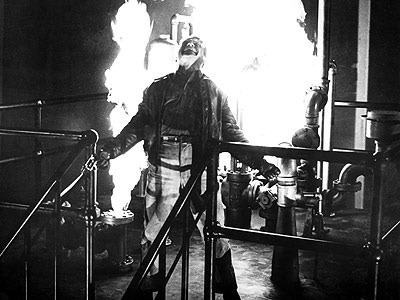
Jim returned to his gangster roots for White Heat, because he found the 
character so compelling. This sequence is one of the most famous 
in film history.

Jim is best remembered for these early hoodlum roles, but he portrayed a wide-array of faces over his career. Often cast as a low-class, wise guy with an eye for the ladies, his role in 'G' Men would help to expand his horizons. Playing the role of a guy from the slums who made right and devoted his life to fighting crime, audiences caught their first glimpse of a character much closer to Jim himself. While he slowly edged away from his bad boy roles in films like Angels with Dirty Faces, he would return with a vengeance in the demented, Oedipal role of Cody Jarrett in White Heat. In between, he delivered performances with great humanity, humor, and color in City for Conquest, West Point Story, and The Oklahoma Kid. He was deeply honored to be able to portray one of his childhood heroes, Lon Chaney, in his biopic The Man of a Thousand Faces-- a title that also described Jim himself. But who was he off screen? His costars would remember him as a giving, devoted, and easy-going guy who wasn't afraid to stand up to a dictatorial director and was equally nurturing of new talents. The friends he had, he kept for life, and new ones knew that they were safe under his wing. He did his part in the war effort, doing radio broadcasts and making tours to support the troops, and as he aged he became more and more devoted to land conservation. His love for the outdoors and nature made it important to him to save the pure patches of green as yet untouched. Politically, he was open-minded, starting out left-wing (and at one point even being accused of membership in the Communist party) only to end up a seasoned conservative along side pal Bob Montgomery. Fluent in Yiddish, he enjoyed tossing in a line here or there in his favorite language, whether among friends or in his films. He too would add little mannerisms into his acting roles that had belonged to his father, which would induce his mother to nostalgic tears. Above all, family came first, and he remained close to his siblings and mother for all his years, even helping sister Jeanne when she began pursuing acting. In his work, he played as long as he could, and when he grew old and tired, it was Willie who pushed him to get back into the ring, where she knew he was happiest. 


As dastardly as some of his characters, Jim too possessed a certain poise and an 
elegance that not only made him attractive to the opposite sex but 
enabled him to pursue more varied roles.

James Cagney... What is there to say? As I sit here, writing and deleting what is certain to be a disjointed memorial, I find it difficult to describe who Jim really was, what he represented, and the legacy he left behind. A cinematic icon, he has been an influential force in the careers of film Gods like Eastwood and Scorsese and has left an indelible imprint on the history of film. Throughout his life, he presented vastly different portraits of what it meant to be an American, and as a man who considered himself a true patriot, this is perhaps the best compliment anyone could pay him. From the gritty realism of his gangster portrayals to his embodiment of the ultimate portrait of liberty in Yankee Doodle Dandy, Jim was both sides of the coin and 100% American tender. In later life, as his health failed, he enjoyed time on his farm (the one he had always dreamed of) and painting. Always a positive person, while he shirked the ballyhoo and public attention, he always remained grateful to his peers for their respect, and befriended many young fans who were curious about the aging icon and his unparalleled career. Jim passed away peacefully and with a wink (literally) on March 30, 1986. Having seen many of his friends go before him and seeing the world of Hollywood change around him, the straight shooter-- who could make no sense of the new "method" style of acting-- felt it was the proper time to take his final bow. He would remember his youthful vaudeville days with Willie as the happiest of his life and the enduring hardships of his youth as the most impactful, but it was his Hollywood years that remain with fans. In those years, he lent us his strength, passion, charisma, and swagger, and showed us that there is no moment in life so brutal that you can't handle it with equal parts guts and grace.