FYI

Don't forget to refer to my Contents page for a more convenient reference to past articles.

For More L.A. La Land, visit my writing/art/film appreciation site on Facebook at Quoth the Maven and follow me on Twitter @ Blahlaland. :)

Wednesday, August 11, 2010

TAKE ONE, TWO, THREE...: The Three Faces of Ev-il...


When Tony Curtis was released from the US Navy at the end of WWII, the 20-year-old was determined to pursue his dreams of acting. After learning that there were some openings at the Dramatic Workshop, where he would be acting alongside soon-to-be-legends like Walter Matthau, Harry Belafonte, and Bea Arthur, Tony was ready and raring to go. The only problem? He would have to audition to be accepted. Because he was too nervous to perform a scene with dialogue, Tony opted to re-enact the great metamorphosis scene of Robert Louis Stevenson's Dr. Jekyll and Mr. Hyde. This, in addition to the compelling light and dark sides of Mr. Curtis's own nature, served as my inspiration for this week's post.


~     ~     ~


The story of and legend of Dr. Jekyll and Mr. Hyde has been retold in many different ways and many different mediums. In cinema alone, the list of films that have been directly adapted from Stevenson's original novel are countless-- from Abbott and Costello Meet Dr. Jekyll and Mr. Hyde to Dr. Jekyll and Ms. Hyde. Though the tale being repeated ad nauseum should have expectedly grow cold by now, just as the evolving mythology of the vampire continues to peak our interest, this horror story keeps going strong. The themes of good and evil, human versus animal, and cerebral versus sexual, remain relatable topics. Sex sells, now more than ever. However, it was in the past that it presented itself more seductively, more interestingly, and more violently. In time periods of more strict moral behavior, and more stringent cinematic codes,  filmmakers had to be very crafty to divulge all of the facets and dangers of suppressed human sexuality with honesty and without suffering from the censors' scissors.


Watching the following three adaptations, it is interesting to witness what the audiences of the times must have: the slow unfolding of hidden yearnings, the unleashing of one's inner beast, the acknowledgment of those thoughts, feelings, and compulsions a proper, puritanical society teaches us to suppress. Witnessing the metamorphosis onscreen must have come like a rush; a welcome release and catharsis on a society ready for change, indulgence, and ecstasy. However, the horror too remains. The horror of what it is to look at the baser nature of ourselves and recognize only a monster-- one that lives within all of us, and one that we must constantly seek to control. Heavy duty stuff, but sometimes it is only through the most extravagant means that we see the clearest truths.


Below I briefly discuss the J and H films of 1920, 1931, and 1941. Instead of recapping the varying plot-lines, which are essentially exactly the same, I shall point out the ways each film manages to distinguish itself and the essential factor within each film that makes it unique. All of them are superb, and all should be seen, if only to compare the different interpretations of presentation and performance, but in the three following categories, each movie takes a turn standing above the others and holding its own: The Doc, The Women, and The Film.


THE DOC:


It probably comes as no surprise that one of the most lauded thespians in American history should hold the title for one of the greatest performances of all time. Despite the fact that Fredric March took home the Academy Award in 1941 for his performance of the good/bad doctor, it is John Barrymore's interpretation of the scientist-gone-mad that maintains a well-deserved notoriety. Barrymore (left in "Hamlet" in 1922) was the perfect man to cast in the role of the intelligent and innocent doctor who is slowly manipulated onto the path of darkness. For one, his reputation as a great male beauty, aka The Great Profile, made his transformation into a gruesome, egg-headed monster even more horrific. To see John in his prime-- young and fresh, before alcohol and ravaged his mind and body-- gives you a better idea of why the ladies had such great affection for the man who was Beau Brummel. More importantly, the Barrymore legend of acting talent is no overstatement. This guy is good. There is a reason that he, his brother Lionel, and his sister Ethel, were so revered in their time. "Pretty," Johnny may have been, but he wasn't afraid to get ugly, and the self-same torments and demons he possessed within his soul, which plagued him his whole life and drove him to self destruction, he equally wore proudly on any stage. He never failed to rip himself open and martyr himself before movie cameras at his most demented, pathetic, and destroyed. Inside all genius, there is madness, and it is precisely John's gifted madness that made his work on the 1920 film so breathtaking.


To this day, John's initial transformation scene of Dr. Jekyll to Mr. Hyde is a moment that every actor remains enthralled by. The main reason is that no makeup is used. The cameras role without stopping, there are no special effects, it is simply John, clutching his throat, crumpling in agony, disappearing below his counter, and arising a totally different animal. He pulls a Lon Chaney, but without a makeup bag. The effect is astounding, mesmerizing, and terrifying. This one, uninterrupted moment more fully communicates how simple it is for all of us to give in to our own private monster-- how closely he lives beneath our skin. John does not disappoint for the rest of the film in his characterization, though he does have a little help from the makeup department as the story progresses. His Mr. Hyde (right) is diabolically sinister and physically repulsive. Whereas in Rouben Mamoulian's '31 version, Fredric March's Hyde is interpreted as primitive and ape-like-- a throw-back to our inner-caveman-- and the Victor Fleming '41 version gives us a Spencer Tracy with mad, emphasized eyes and teeth, John's Hyde is somewhat of a conundrum. His elongated, egg-domed head protrudes under a greasy mat of gnarled hair, and his hunched walk resembles a slinking, twitching insect. Indeed, when the transition begins to overtake him in a later scene, a tarantula is seen, super-imposed, closing in on his bewitched and transfixed body. The fact that his appearance is so inexplicable makes the terrorizing of his chosen victim Gina, the always superb vixen Nita Naldi, all the more repellent and despicable. 


While Fredric and Spencer both deserve kudos for what they brought to their characterizations, they can't touch Barrymore on this one. So, if it is the performance of the Doc you are most looking for, reach for 1920. You won't be sorry. Just scared!


THE WOMEN:


The casting of the women was a very important part of all three films. In casting the dancing girl/prostitute Ivy (or Gina as she was in the 1920 version), a girl had to be chosen whose overt sexuality could penetrate and disturb even the most self-controlled and moral of men. She had to be the epitome of desire, provoking and drawing forth a lust for which the doctor would purposely concoct a potion to release. But too, the actress needed to evoke sympathy from the audience, for the burden of being an object of insane desire becomes a punishment that eventually kills her. It's the old "hooker with a heart of gold" scenario-- no lady of the night was born on the street. The choice to use the sexy and scintillating Nita Naldi as John's counterpart, Gina, (I'm wondering if the writer cleverly left the va- off the beginning of that one) is no shocker. Nita was the epitome of feminine sexual danger at the time. Miriam Hopkins (left) as Ivy in the '31 version is also something to behold. In fact, her initial meeting with the as yet untainted Dr. Jekyll, when she tries to seduce him in her bedroom, is still quite jaw-dropping. When she raises her skirt and places his hand on her leg, it makes one hot under the collar even decades later. Miriam was a fascinating and truly gifted actress, too often forgotten among her contemporaries. It was just this type of envelope-pushing role, which deviated from the normal expectations of chastity and womanhood, that made her all the rage in the pre-code era. (If you get the chance to see her in The Story of Temple Drake or Design for Living, take it).


However, it is 1941 that wins the award for the superb exploration of the temptations of female sexuality. Not only did he cast the gloriously tragic and inhumanly beautiful Ingrid Bergman as Jekyll's temptation, Ivy, but Fleming also cast hot to trot Ms. Lana Turner as his luscious fiance, Beatrix (both right with Spence). At first, you may think that Fleming got these roles reversed-- that Ingrid would have served the film better in the prim and lovely fiance-next-door role, and the effortlessly sexy Turner should have been the target of Hyde's passion. This too is what I believed at first, but somehow the unexpected decision works. It is precisely Jekyll's repressed desire for his beautiful fiance Lana that fuels his need to make the sensual and vulnerable Ingrid his prey. In fact, the two women resemble each other greatly in the film. Neither of them have ever looked so gorgeous. With long, curly hair, soft lips, and ripe figures, they are practically interchangeable. The naive and youthful innocence of Lana, whom Spencer's Jekyll must be chomping at the bit to wed and bed, bears little difference from Ingrid's interpretation of Ivy-- except the price of sharing Ivy's bed is much cheaper than a wedding ring. In this version, Jekyll gets the girl of his dreams the right way, and Hyde gets the girl of his dreams the wrong way. The fantasy sequence in which Jekyll envisions himself as Hyde, driving a chariot pulled by these two women-- naked nonetheless-- speaks volumes. He sadistically lashes at them with his whip, urging them to go faster and faster in a physical representation of man's ultimate orgasm- the final unity of the Madonna and the Whore.


The Sadistic Dream Sequence


So, if it's the ladies you want to look at, turn your peepers to Victor Fleming's 1941 version. Ingrid Bergman is her usual magnificent, multi-layered self, giving great depth and pathos to her role of the broken woman, and Lana, whom I think is often underrated for her talents, is equally intriguing and sensitive in her portrayal of the suffering fiance.


THE FILM:
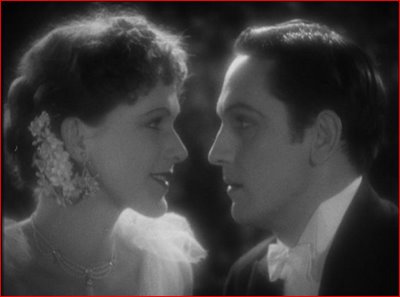

As you have probably guessed, the final trophy goes to Rouben Mamoulian for his adaptation of Dr. Jekyll and Mr. Hyde in 1931. Despite the triumphs of both the silent and '41 versions, Mamoulian's direction of the middle film is both technically and narratively the most intriguing. A very smart move on his part, in order to better meld his audience with the protagonist/antagonist he created a series of point-of-view shots. When Jekyll (Fredric March) sits with his fiance Muriel (Rose Hobart) on a bench (left), we get direct to camera close-ups of both faces, which are smoldering with desire. As Muriel looks out at the audience enticingly, we more fully understand the lust churning in Jekyll's loins, which he is obviously struggling to keep suppressed. But she too is a mammalian creature, who yearns for her chaste lover as much as he yearns for her. The countdown to the wedding day thus becomes painfully long and unbearable, and the viewer is totally on Jekyll's side when he decides to indulge in his hidden animal, unleash the beast, and make Miriam Hopkins's sultry Ivy his unwitting prey. These POV shots become equally compelling once Jekyll becomes Hyde, seeing himself for the first time and living as him for the first time. Again, the audience moves with the camera, walking heavily in the shoes of their own dark and devious natures. It makes the film both thrilling and horrifying in that we are forced to personalize the experience.


The makeup used for Fredric is also unique. While at first he seems just plain ridiculous, looking like a goofy monkey and in no way passable as human, his appearance serves a purpose. It seems hard to buy that any woman, prostitute or not, would sleep with a being so obviously ape-like, and we have to use suspension of disbelief when Miriam is raped by the monster much more than we have to with the equally hideous portrayals of Barrymore and Tracy. I mean, this is just plain bestiality! But, that is Mamoulian's point. By tapping into suppressed desires and caged violent tendencies, Jekyll is getting in touch with his most animal, ungoverned, and unevolved self. His primate features recall that of the caveman, or perhaps even the missing link, who did not woo with wine and roses but simply clubbed a female over the head and had his way with her guilt-free. While modern man is sophisticated in ways of the heart, while he can love, feel pity, relate to other creatures, Mamoulian suggests that the baser nature remaining deep at our core can not, or rather will not, do the same. The absence of responsibility and emotion, existence based purely on the instant satisfaction of the "id," is the closest man can get to freedom. But, as the film points out, he must sacrifice his humanity to get it.


What finally makes this version a bit superior to the others is the fact that it was made at the right time. The years 1930-1934 were a very rich and enticing, albeit brief, period of film-making before the production code was enforced and the censors (via Will Hays and Joe Breen) went haywire. Stories were bolder, dialogue was more risque, and it was the last dance of the freewheeling twenties before the depression set in with full force. Thus, the themes of sex and violence are more freely explored, expressed, and enlarged upon than in the other two versions. With a little more wiggle room, Mamoulian was allowed the ability to go further than Fleming and silent director John S. Robertson had. The effects remain impressive as well, with Fredric March's transformation realistically being implied through a compilation of shadowing and the brilliant, twisted elasticity of his face.


Jekyll, regretting his decision!


In the end, it is hard to go wrong with the tried and true story lines of our horror history. Despite their macabre and frightening nature, we still look forward to witnessing new visualizations of old nightmares in every generation... possibly even every other week. It's like meeting an old friend. The beauty of J and H, in addition to other horror flicks, seems to be that it allows us to live vicariously through the malevolence of others, exorcising our own less savory compulsions and even letting go of pent up fears. Any of the previously mentioned versions deserve a gander and will allow you for a while to indulge in your inner Hyde while safely returning to your (I hope) more peaceable Jekyll side afterward. It's nice to know, after all, that when you just can't hide your Hyde anymore, you can always pop in an old video and let him out again.

Wednesday, August 4, 2010

STAR OF THE MONTH: Tony Curtis


Tony Curtis was told by a number of people, including the legendary Billy Wilder, that he was the "best looking kid in show business." A good 60 years or so after his hey-day, the title may still apply. Tony's beauty and charisma made him stick out like a sore thumb in Hollywood. While he isn't normally revered as one of the top actors in cinematic history, his career, the people he has worked with, and the classic movies that he has made, keep him forever cemented in our memory. You can't look anywhere in the final days of the studio era without bumping into him! This kid loved to work, and he took every opportunity he could to chase his dreams and expand on them. Starting out in silly B-movies, he crawled his way up the ladder to more established and respected roles, rubbing elbows with some of the most famous and lauded talents of his generation, thus making himself one of them. Despite the prejudice he sometimes felt due to his Jewish background, (and the jealousy over his good looks), Tony lived the high life, partied with the best of them, and starred in film after film, determined to prove himself as a good actor. He is a true testament to what a little grit and determination will do! And he did it with style.

 
 Tony with first wife, Janet Leigh

As per usual, it wasn't always wine and roses. The man that Tony would become grew from the insecure and isolated boy he was in his youth. After witnessing the constant fights of his parents and suffering the physical beatings of his schizophrenic mother, Tony would learn to take care of himself. Victimized in his home life, he swore that he would never play the patsy again. When picked on by neighborhood kids, Tony learned to throw a punch; in love, he would search for the perfect nurturer, while refusing to be pinned down himself or forced to play the subservient male he saw in his own father. He spent his youth swinging his fists, hellbent on finding his freedom and getting the heck out of the Bronx-- but he always carried its mettle with him. An early means of escape and detachment came from the movies. Despite whatever pains he was dealing with, including the shocking death of his younger brother Julie, Tony could always disappear in cinema. After joining the Navy at the age of 16, Tony served his time, grew into a man, and pursued his dreams as a Hollywood superstar. Despite all the cards stacked against him, he succeeded far beyond his expectations.

With Sidney Poitier in The Defiant Ones

Tony became the symbol of the American dream: a boy from humble upbringings living a fairy tale life at the top. Married to beautiful actress, Janet Leigh, his career grew and grew, and he lavished in the fame. His boyish quality, the little scalawag he could never quite outrun, followed him to Hollywood, and his audiences loved him for it. The guys copied his duck-tail haircut, and the girls swooned at his cocky pout. But one can only outrun his demons for so long. Tony wanted too much out of life. He overcompensated for the privileges and love he had been denied in his youth until he found himself sinking under the weight of his own desires. One minute he was hanging with Frank Sinatra, starring in films like Some Like It Hot, and living the high life; the next, he was divorced (several times), struggling to find work, addicted to cocaine, and drowning in the sea of depression he had tried for so long to avoid.


Luckily, the fighter came out swinging again. At the ripe old age of 85, Tony has triumphed. Embracing and overcoming all of the obstacles and faults within himself, he has beaten his addictions, found solace in his love of painting, and lives to tell the tales of his crazy life in the movies. He regrets none of it. Filling people in on his romances with Marilyn Monroe and Natalie Wood, he has become our touchstone to the past; a living link to the glamour of the studio days, which have long since passed. The guy simply won't quit, and we don't really want him to! A lifetime of struggles and an unstoppable passion have given him a life full of accomplishments and us a list of classic, American films: The Defiant Ones, The Sweet Smell of Success, Operation Petticoat, Spartacus, and of course, Some Like It Hot. In the long list of roles he's played, the only character more fascinating is the man himself. This month, let's tip our hats to the Manhattan boy with the deep, blue eyes. Sit back, salivate, enjoy!


* We lost Tony a mere two months after this article was written. He died of cardiac arrest on Sept. 30, 2010. Rest in Peace, sweet Prince. We'll miss you.

Friday, July 30, 2010

HISTORY LESSON: FUN FACTS ABOUT EARLY HOLLYWOOD III

It's been awhile since I've gone historical, so here are a few new ones for you that I have picked up!

In the early days of Hollywood, before movies had made it out west, the only real celebrities to gawk at were artists, writers, and politicians. As I referred to in a previous post, the first noteworthy personality to settle down in La La Land was the painter Paul de Longpre. The second would be author Frank L. Baum (left), whose  children's stories about Oz had taken the nation by storm! Frank came to H-town in 1911, and he and his wife Maud bought a home on the corner of Cherokee and Yucca that they named "Ozcot." Frank would rise in the morning, work in the garden, and after lunch he'd get to work on his next book. The first one finished at 'Ozcot' was The Tik Tok Man of Oz. Little did Frank know that his novels would become the source of one of the greatest movies to ever come out of Hollywood! But The Wizard of Oz of 1939 was still a loooong way off. In fact, this masterpiece would not be the first time Baum's stories were immortalized. The earliest surviving version was made in 1910: The Wonderful Wizard of Oz. Because no records were kept at that time to authenticate its cast and crew, it is uncertain who took part in it, but Otis Turner is sometimes implicated as the director. Other Oz silents include: Dorothy and the Scarecrow in Oz, The Land of Oz, and John Dough and the Cherub of 1910, which are sadly considered lost, and The Patchwork Girl of Oz, The Magic Cloak of Oz, and His Majesty, the Scarecrow of Oz of 1914. The more familiar version came about in 1925 as The Wizard of Oz, directed by and starring the great, and too often forgotten, comedy legend Larry Semon as the Scarecrow, Oliver Hardy as the Tin Woodsman, and Dorothy Dwan as Dorothy! Who knew!?

Oliver, Dorothy, and Larry- Oh My!!!

Another noteworthy name around town at this time was that of Doctor Schloesser. Real estate remained the  big business in the area at this time, and Schloesser was eager to try his hand at the booming market. He was hard to miss: pudgy with big, red lips, dressed in a whalebone girdle that made him creak when he walked, and usually adorned in a fancy frock coat and white gloves. He bought and sold different properties, making huge profits, and built the astounding "Glengary Castle" at the corner of Franklin and Argyle. The two marble lions decorating the entrance were especially impressive. The home was a mixed throw-back to medieval times, and its extravagance can be likened to a more diminutive San Simeon, (William Randolph Hearst's notorious abode). When movies began shooting out in California, Schloesser made some extra money by renting out his illustrious home to filmmakers who needed a set that looked deserving of a millionaire. By that time, the Doc had moved out... and across the street to a bigger castle, which he dubbed "Sans Souci." A true character and social anomaly, when he finally sold "Glengary," newspapers would write, "Hollywood has given up trying to understand Dr. Schloesser." Haha!

It was only a matter of time before filmmaking made its way out west, however its first appearance was modest. It wasn't until 1910 that the first movie theater opened in Hollywood, "The Idle Hour." It was located at Hollywood and Hudson, and it was little more than four wooden walls, a screen, and some benches. The second theater would open about three years later between Hollywood and McCadden: "The Hollywood Theater." In response to this competition, "The Idle Hour" revamped its appearance, recognizing that movies were indeed big business, and reopened anew as "The Iris." It got its floral name from the fact that it stood where De Longpre's lush garden was once located, as well as its obvious filmic reference. This theater was also notable for possessing the first "ornamental electric lighting." Lemon groves and pepper trees were quickly being cut down as new buildings and real-estate developments continued to crop up. Slowly but surely, movies were coming to Hollywood.

And now, the moment you've all been waiting for! The first official film made in Hollywood! No, no, it wasn't The Squaw Man, whose production I refer to here. That was the first "feature film," made in 1912. Ironically, many of Squaw's scenes were shot on the land that would later become home to the Forest Lawn Cemetery of the Hollywood hills. This land would help to give birth to film and in due time serve as a deathbed to some of its greatest stars, including Bette Davis, Charles Laughton, and Buster Keaton. However, the first movie was made two years earlier in 1910. It was a short, shot in one day, at-- once again-- De Longpre's garden. This little gem, Love Among the Roses, would prove to be prophetic, for it would be directed by and star two of the biggest names in Hollywood history: D.W. Griffith and Mary Pickford. The first major film celebs in the first Hollywood film??? At the time, they weren't quite so prestigious. DW was a struggling filmmaker in a society that didn't consider movies a grand profession, and little Mary was but 15-years-old. But times were changing, and these two were unwittingly paving the way to the future. 

Mary, after she became Queen of the Movies

(Update: new research has revealed that D.W. Griffith's In Old California actually dates further back than Love Among the Roses, making it the first Hollywood film).

Wednesday, July 21, 2010

HELP: Who the Hay?

Hello my dear Cinephiles! I have a quickie post for you with regard to a photo a friend sent to me. We are trying to find out the film the following shot was taken from as well as the actors. A third party sent it to my pal claiming that it was Rudy Valentino, but clearly it isn't. (Those two couldn't even be fraternal twins). It is looking to me like it could be a foreign silent film... I'm gonna keep digging, but if you have any guesses to help us out, we would really appreciate it. Thanks!

History's Mystery:

???

Wednesday, July 14, 2010

MENTAL MONTAGE: With a mug like that?!

The empire of Hollywood was built to meet public specifications. We've been spoon-fed love stories, crime capers, and whatever plot seems to suit our current appetite.  Keeping us happy can be quite a racket, and the best of the best like Louis B. Mayer and Adolph Zukor have made millions off predicting our next craving. However,  changing attitudes make the American mind difficult to read, and more than one box-office flop has been made when the big-wigs guessed incorrectly. Just as certain films become surprise hits, different stars also unpredictably climb to fame. Certain actors that were never supposed to make it still manage to capture our attention. When Meryl Streep auditioned for 1976's King Kong, she overheard Italian producer Dino de Laurentis say to a colleague: "She's ugly. Why did you bring me this thing?" Little did he know that this brainy lady could speak his language fluently and understood the jab. While Dino predicted that Meryl didn't have the looks to charm the infamous ape, she still managed to become the most beloved and respected American actress of her generation. Here are a few more cases of the Man in Charge being Wrong as Hell.


When Douglas Fairbanks (left in The Three Musketeers)came out to Hollywood in 1915, the established thespian was placed in very prestigious company. Now working with The Triangle Film Corporation, he was in the prime position of being directed by D.W. Griffith, Mack Sennett, and Thomas Ince. However, the first filmmaker, who was working out of his Fine Arts Studio at 4500 Sunset Blvd, was less than thrilled to be dealing with the overly energetic actor. Griffith would say of Doug: "He's got a head like a cantaloupe and can't act." Now, Doug was never referred to as classically handsome, but his manic charisma endeared fans to him nonetheless, and he went on to star in some of the most epic and technically accomplished films of the silent era. Griffith must have changed his mind about Mr. Pep, whom he later teamed up with to form the independent studio United Artists (along with Chaplin and Mary Pickford).


Fred Astaire received a similar response from a studio executive. When trying to pave his way in the film industry, Astaire struggled. Despite his extreme talent, he was slight of frame and did not possess those typical, leading man looks. No one saw his potential. After an early screen test, the jury was in: "Can't act. Slightly bald. Also dances." The money men were looking so hard for stars that they failed to see one in their midst! No matter, Freddy would do all right. What he lacked in stature, he made up for with indescribable, incalculable presence... And moves!


Some of the handsomest men of their day were also originally flooded with negative feedback. Clark Gable (barely recognizable in the left photo) is still referred to as the "King of Hollywood." Even today, women find themselves falling in love with him. During his hey-day, he could and did have nearly any woman that he wanted, but no one would have predicted that when he first started out. An awkward, Ohio boy, he was a bit of a physical anomaly. "Attractive" wasn't the first word used to describe him, especially with his two gold-plated front teeth, which he constantly had to paint white! When making a screen test for Little Caesar, Darryl F. Zanuck was underwhelmed: "His ears are too big. He looks like an ape." With a little help from the miracle workers at MGM, who fixed Clark's teeth, gave him polish, and cut his hair to hide his protruding ears, Clark would have the last laugh.


Even Rudolph Valentino was shunned when he first arrived on the scene, and today he is revered as one of the most powerful sex symbols of all time. Rudy's problem was a little more complex. Due to the bias against different immigrant groups, including the Irish, Chinese, and Italian, Rudy of Castellaneta was not the prototypical American dreamboat. Italians for the most part, with their darker skin and features, were seen as untrustworthy, even insidious. This made it hard for Rudy to break into the pictures, and he was originally cast in villainous, unsavory roles-- thieves, con artists, and charlatans. No one expected much from him, including (once agan) D.W. Griffith, who said: "He's too foreign looking. The girls will never like him." Seems like D.W. should have stuck to making stars of his women; his taste in men couldn't have been more off! It was exactly Rudy's "foreign-ness" that would make him a huge, dangerously sexual superstar.


The women had a lot to put up with in regard to their appearances, of course-- probably much more than men. In addition to being sized up by studio moguls, who were more concerned about going to bed with an ingenue than casting her in a movie, young women in Hollywood were pinched, powdered, bleached, stuffed, and pushed in front of the cameras with scanty wardrobe. Many were completely made over once the star system was in full effect, becoming unrecognizable transformations of their former selves. There were some sassy ladies that resisted it though, including the following:


Jean Arthur was never comfortable with her appearance. When sizing herself up with other leading ladies of the day like Rita Hayworth and Marlene Dietrich, she felt she didn't quite measure up. Perhaps this was one of the reasons she began dyeing her naturally brunette hair blonde. Studio magnate Harry Cohn was inclined to agree with her reservations, declaring: "D'ja see her face? Half of its angel, and the other half horse." Thankfully, the horse-side must have been invisible to the camera, because audiences never saw it, nor did David O. Selznick, who was madly in love with Jean for quite some time. Despite her insecurity, Jean dug in her heels and decided to prove that she was just as much of a woman as the next hot body. Not only did she refuse to go to bed with the notoriously lustful Cohn, but she made him eat his words. Jean's earthy, soft, and natural beauty became part of her eternal appeal.


Another feisty lady that refused to be bullied was the Irish spitfire, Maureen O'Hara. When first landing in Hollywood after having some success in London, there were a lot of grumblings from the higher-ups. It may come as a shock, since Maureen seems like such a classic beauty, but at the time a lot of argument circled around her nose, which was considered too big. It was delicately suggested that she get a nose-job to make her face more palatable to the movie camera, and thus the movie-going public. This time, it was Maureen who would have the last say: "My nose comes with me. I've got a big square face, and I need my big nose. If you don't like it, I'll go back where I came from." With that kind of passion and strength, it is no wonder that her hot-tempered Mary Kate Danaher of The Quiet Man was so believable. The nose stayed with Maureen, and Maureen stayed in Hollywood, thank Heaven!


The prey of the Hollywood racket seems to come in three categories: the Pawns, the Players, and the Rebels. The metamorphosis of Norma Jean Baker to Marilyn Monroe, both body and soul, still raises the question, "What Price Fame?" Marilyn was sadly a pawn. When Norma Shearer was refused the lead in The Divorcee by her own husband, because she wasn't "sexy" enough, she proved her sensuality by having sultry photos taken. Irving Thalberg readily recanted his refusal, and Norma got the role and the Academy Award as a result! Norma was a player, and she loved the game. As for the rebel category: one actress arrived in Hollywood with a gap between her two front teeth, which she refused to fix. It was part of her and who she was. Instead, she wore a cap in her mouth for all of her films and publicity photos. This was her way of showing that while the cameras rolled, she was Ann Sheridan of Hollywood, but on her own time, she was plain ol' Clara Lou from Texas. 


Ann Sheridan... Ain't nothin' wrong with that.


At the end of the day, it didn't matter how gorgeous a person was or how many categories they hit on the list of Movie Star Must-Haves. The "X-factor" wasn't found in a face, it was found buried within-- that uncanny quality that radiated from certain blessed individuals and reached out to their audiences. This is why, while people may have wanted to shun Valentino, Fairbanks, or O'Hara at first, they were forced to bow down in humility when the public showed them their error with box-office receipts. Jean Harlow was more than her luscious curves; Gary Cooper was more than a pretty face. Clara Bow may have risen to fame by winning a magazine beauty contest, but she wouldn't have maintained her status if not for having "It." It is only in believing in the long-shots and the unique individuals that true gold is found. People want to be shown something they've never seen before. I mean, you've seen one Barbie Doll, you've seen them all. But Clark Gables? They don't come around every day...


There's the Clark we know and love!!! Haha.


Friday, July 9, 2010

PERSONAL NOTE: Confessions of a Gravehunter


I have decided to take a segue into the macabre this week, if you find graveyards macabre that is. I personally do not, but that shall become obvious throughout the following article. With Rudy as my inspiration for the month, I began thinking about his grave site at the Hollywood Forever Cemetery, and how ardent fans still make their pilgrimages to see him every day. There is a mystifying quality to his crypt in the Cathedral Mausoleum, and legend has it that the ghost of the notorious "Lady in Black" still pays him visits as well as Rudy himself. It seems a bit odd for a ghost to haunt his or her own grave, if we indulge for a moment in the suspension of disbelief to give ourselves over to the idea of an afterlife, but cemeteries seem to be hot beds for unruly and restless spirits. Instead of reiterating the countless stories of specific hauntings, I thought that I would share with you a few of my own experiences. Having turned over nearly every stone in every cemetery in Los Angeles, I have more than one odd experience under my belt. Believe me or not, here are some of the best:


WESTWOOD MEMORIAL:


I'll begin with the most entertaining story. Westwood Memorial is one of the strangest cemeteries that I have come across. It is tucked behind a couple of skyscrapers in the middle of the city, situated in such an unlikely place that I drove up and down the street looking for it several times before realizing its less than obvious locale.  Once I found it, I was amazed at how small it was and yet how many of our fallen stars have landed there: Marilyn Monroe, Dean Martin, Natalie Wood, Jack Lemmon... I could go on, and on, and on. The nice thing about it is that it is an accepted tourist destination, so no one really minds if you're there taking pictures or just roaming around. You can't help but star gaze, after all, for every step you take lands you on someone famous.


One day I was there making a final trip to round off my list of the famous interred. It was a nice day, and I was listening to my ipod, which I normally never do at cemeteries, but this one is so lax it seemed appropriate. It turned out to be a fortunate decision. As I strolled around with my ipod on "shuffle," I came to Burt Lancaster's grave. After taking a moment to pay my respects, I snapped a shot and reached for my trusty list to see who was next. Right as my eyes hit the name "Carl Wilson," the song Good Vibrations came on my ipod. I froze for a second, with an "Oh my God" look on my face, and then I looked down. I was literally standing right on his stone! Needless to say, my eyes were bulging. I was quite tickled. I felt like this Beach Boy was just saying "Hi." Coincidence or not, the memory always makes me smile.


MOUNTAIN VIEW CEMETERY:


Now, despite the fact that I have become a sort of cemetery navigating expert, I can't deny that I quite often get lost, turned around, or just generally confused when covering new ground. Some of these graveyards are massive, and when visiting a new one I generally spend hours looking for just one person like a needle in a haystack. (Sometimes I think someone is playing games with me. Not cool). Sweating in the sun, climbing hills, searching for numbers and plots that don't seem to exhist... It gets quite exhausting. I'm pretty used to it by now and come prepared for every scavenger hunt, aware that it may take me all day, if not a few trips, to see everyone I want to see.


With this in mind, I made my trip up north to Mountain View. There was only one person on my list buried there, Superman George Reeves (right). For this reason, I delayed visiting for some time. It was a bit of a drive up to Pasadena, so I always found some excuse to put it off. One day, for no particular reason, I thought, "What the heck." So, into my car I went. All I knew was that he was buried in a mausoleum there. That's it. I expected to waste oodles of time bugging my eyes out for one little name but tried to focus on more pleasant thoughts. Now, in addition to getting lost in cemeteries, I must confess that I get lost in general. I get lost on my way home, on the way to a friend's house, on my way to places I've been a million times before. It's a problem-- driving in circles is kind of a curse with me. I expected as much with my drive up to Mountain View.


Thus, when I arrived unscathed, in record time, with not a wrong turn, I was a bit surprised to say the least. It was literally like I was driving to a place I had been a million times before. "Strange," I thought to myself warily. Once I pulled into the gates of the graveyard, I got a little intimidated. So much ground to cover, so little time. So, I thought, "Right or left?" For the Hell of it, I went right. I drove a pace and saw another side street to the right. "Should I take a chance and turn, or keep going?" I decided again to turn. There, behind the trees, was a mausoleum. I wasn't sure if it was the one I was looking for, but I thought I'd go for it. You gotta start somewhere.


I walked inside, and again wondered, "Right or left?" Both hallways looked menacing and long, so I decided to change it up and go left. As I strolled down the hallway, not a few steps, I saw something move beside me.  I jumped, like an idiot, only to realize that it was my own reflection in the mirror lining the wall. Catching my breath and laughing at myself, my eye was then attracted to something behind me in the mirror. Looking closer, I realized that it was an urn. An urn that said "Superman" in reverse. Gulp. I slowly turned around, and right before my eyes was the final resting place of George Reeves. Holy Moly. I didn't know what to do, so I just said, "Hi, George." This was one guy who really wanted to be found. Never have I ever been drawn so effortlessly to a grave.


HOME OF PEACE:


Despite the occasional "spooktacular" event like the aforementioned, cemeteries in general do not frighten me or ruffle my feathers. In fact, there has only been one cemetery that I can remember having a very foreboding presence. That was the Jewish graveyard, Home of Peace. This place serves as the eternal napping location of two Stooges, Curly and Shemp, and the illustrious Warner brothers. (Jack, needless to say, has his own large and separate plot outside the family crypt). The grounds of the cemetery didn't bother me, and I found it quite interesting that several of the graves were buried under  elevated, cement slabs. (I don't know if that is a normal practice within the faith or is purely a choice of the cemetery, but I am interested to know).


The real danger, I would soon discover, seemed to be lurking in the mausoleum. I went inside to see the Laemmle family crypt and a few others. I didn't feel too bad immediately upon entering, but then I was close to the door. However, the farther back I went into the building, the more I began to feel incredibly claustrophobic. I felt as though I were being watched, and so paranoid did I become that I began thinking crazy thoughts like, "They don't want me here..." I decided to pick up the pace a little, got a few shots, and saw that the last name on the list was Louis B. Mayer himself. Of course, he was interred allllll the way at the back of the building. Great.


I mustered the courage to take a quick run, and I do mean run, to the back, where I found his crypt. I didn't feel well at all. I can't say for sure that it was Louis the whole time that was following me around or making me ill at ease, but I know that the moment I locked eyes with the picture of him on his marble slab was the climax of my discomfort. This voyage was an early one of my ventures, so I knew little of LB other than that he was a big studio mogul. Strange as it sounds, though, my instinctual feelings were telling me: "I don't like this guy." After learning more about him and how he used MGM as his personal brothel, I can justify where those feeling were coming from, but then again, maybe I was just over-excited and making a mountain out of a mole-hill. I got my picture and ran like Hell. Real or imagined, that is the one cemetery I have never returned to.


*** I have had similar experiences when I am strangely affected by a particular grave either positively or negatively. Another example similar to the LB experience was when I met the devious Bugsy Segal in the Beth Olam Mausoleum. I referred to this event in my previous article on Elizabeth"The Black Dahlia" Short. However, occassionally, I have a happy meeting with a deceased friend. The first time I came to the Douglas Fairbanks, Sr. and Jr. monument, I was filled with a profound sense of happiness. I felt oddly right at home. I have returned there several times to sit, relax, and say "hi" to the Dougs.


GLENDALE FOREST LAWN:


This has got to be the most frustrating cemetery in creation! Everyone is there. Everyone! But, the majority of them are locked up tight in the Great Mausoleum where no mere mortal is ever allowed to tread. For this reason, Norma Shearer, Jean Harlow, Gable and Lombard, Wallace Reid, Lon Chaney, etc, ad nauseum, continue to evade me. Despite this, it is nice to go inside to see the jaw-dropping Last Supper Window and know that you are surrounded by the remnants of greatness, even if you can't see them.


On the grounds, which are more expansive than you can imagine, you can easily find Jimmy Stewart, Alla Nazimova, Spencer Tracy, and Errol Flynn.  However, there are some gardens that are restricted and though the Freedom Mausoleum is open to the public, all of its corridors are roped off on the main floor. It seems like such a waste that such places are forbidden, and all those who martyred themselves from the public are now guarded from their fans like precious jewels. Ironic, considering how hard most of them fought to achieve their fame. 


Now, a normal person would shrug her shoulders at such obstacles and give up; say "Oh, well. What does it matter?" Not I. Oh, no. Not by a long shot. What follows goes down in history as one of the craziest series of events in my life.


My umpteenth voyage to FLG began almost apathetically. I had just finished researching the great Mary Pickford (left), and I was dying to go pay my respects, but I knew that she was locked away tight, so making the trek to Glendale seemed pointless. Still, I decided to go. At least I knew that there were still plenty of peeps I could visit while there who were out in the open. Armed with nothing more than hope, and oodles of time, I went.


Upon arriving, I had become more determined. I started with the Freedom Mausoleum. Clara Bow is a favorite. I had been able to crane my neck down the hallway to peek at her resting place before, but had not gotten close enough for a good look. Suddenly, I felt empowered, as if Clara were saying, "Go for it, honey." I decided that this was my chance, caution be damned! So, peering around to see if there were any cameras or guards watching, I hopped the iron rope down her corridor and snapped a shot of her. And Alan Ladd... and Jeanette MacDonald, (you get the idea). Quick as a flash, I returned to the main hall, acting calm and casual of course-- "Who me? I was here the whole time." I sauntered down a bit to the alcove where Dorothy Dandridge was interred and re-enacted my previous shenanigans. Now, I was a bit nervous, because this whole time I had heard two men talking downstairs rather loudly. I thought, "Crap, I hope that's not security." Still, I finished my feat and voila! Victory!


Notice the shaky camera work, haha!


Done with the upstairs, I figured I would take a chance and wander downstairs, hoping that the gentlemen whom I'd heard conversing so animatedly were guests and not employees. But, as I hit the middle of the staircase, the voices suddenly stopped. Silence. It was like they had heard me coming and didn't want to be rude by continuing their noisy chat. Curious, I continued down, expecting to see or pass someone. There was no one there. I peered down the hallways and didn't see a single soul. Where had they gone? I would have heard the large doors open and close if they had exited, not to mention the fact that their voices would not have stopped so abruptly but would have audibly receded as they distanced themselves from the area. I got chills. Had I mistakenly witnessed a post-mortem convo? I like to tell myself that it was Chico (below) and Gummo Marx-- both buried below-- hamming it up, but that's purely my imagination. I only wish now that I could remember what the voices had been saying. Could have been explainable; could've been paranormal. Who knows?


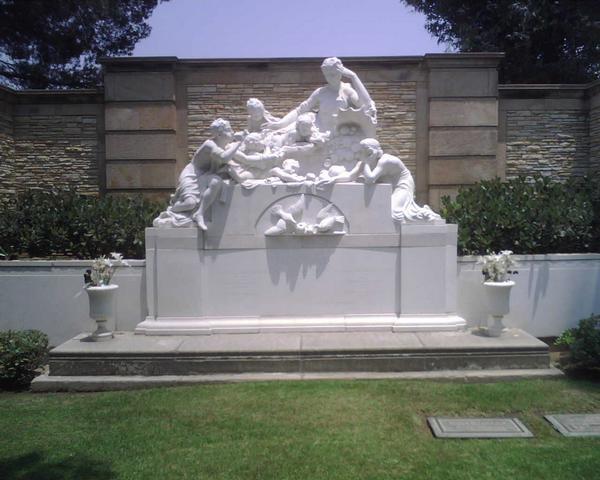
Now, my favorite part. Riding high off my Freedom Mausoleum experiences, I felt like I was invinceable. I was surging with energy, feeling like something was cosmically locking into place. The cemetery, and its residents, were my friends today. It is hard to explain, but I felt a synchronicity, which gave me a little more courage when I headed over to see little Mary. When I made it over to her nook by the David statue, the best I hoped to accomplish was catching a glimpse of the original movie queen's grave over the surrounding wall. I rounded the corner past the Miracle of Life sculpture and froze in my tracks. The door to the garden, normally locked and bolted, was wide open! As it turned out, they were mowing the inner lawn that day. God bless coincidence, (though, I personally prefer to think that Mary was with me that day, guiding me to see her). Not wasting a second, I ran inside, crouched down, and got a shot of the elaborate bacchanal of a stone that housed Mary Pickford and her brother, sister, and mother. I was beaming! Then I realized, hey... Isn't Bogey in here too??? Worried that a groundskeeper would appear at any moment, I moved fast. I found the location of Humphrey Bogart's ashes, snapped a shot, flashed a grin, and decided not to press my luck. Out I went, having accomplished every possible goal I could have imagined!


Now looking back at all of these little adventures, I think that I was simply carried away, let my imagination run away with me, and created epic "hauntings" in my mind. I had probably experienced nothing more than my own nerves. Had you asked me at the time, though, I would have sworn on a stack of Bibles that I had encountered other-worldly presences while roaming around the haven of their afterlives. Sometimes, the feelings I receive are positive, as if the people I admire are somehow communicating with me and accepting me as one of their own. Other times, I feel unnerved and desperately in need of an escape route. Either way, I get chills.


I don't claim to know what happens to us when we die, and there are plenty of times that I think I should have my head examined for any of my obsessive delvings into the past, which clearly seem to go too far. But, I cannot deny my own instincts. It only makes sense that in voyaging into the past, coming to know so many different personalities, and literally walking the streets were they lived, died, and lie, that some hint of who and what they were would reach out to me. If you spend the majority of your life looking for ghosts, you are bound to find at least one. I feel proud to say that more than one has found me.

Friday, July 2, 2010

STAR OF THE MONTH: Rudolph Valentino


Rodolfo, Rodolfo... Would "Valentino" by any other name have smelled so sweet? "Guglielmi" doesn't have quite as nice a ring to it, but that most beloved of all silver screen faces still retains his dear perfection nonetheless. Pardon the poetic waxings, but that is the Valentino effect, isn't it? Despite his 80+ years of absence, Valentino and the romance surrounding him remain just as contagious, scintillating, and provocative as ever. He seems a fitting choice for July, as our temperatures start to rise with the escalating summer weather. What is it about this guy that will not fade away? What it is about us that refuses to let him???

Perhaps more than any other star of his era, Rudy represents the majesty and poetry of the silent screen. Despite the fact that his career and life were cut short after a mere 31 years, despite the number of flops he made and the way he was personally attacked by the scrutinizing public, he remains more famous and familiar than most of his contemporaries. Garbo and Chaplin are two other survivors, but their hefty careers and iconic personae serve as explanation. Rudy had only a handful of hits, yet his name and face will spark a look of recognition in almost anyone's eyes. While even greats like Gloria Swanson and Thomas Meighan leave many scratching their heads, Rudy is an answer before there's even a question. His "stamina" is partly the result of chance. Rudy burst onto the scene and established the dark, male hero during the roaring twenties when people were finally ready for change. The first film star of his kind-- ethnic, Italian, dangerous-- he paved the way for the others who were to follow, but maintained his notoriety as the first. This is a fact that many forget today, and for which Rudy, who had to suffer his share of prejudice and bigotry, should be respected for.

With good pal Nita Naldi in Blood and Sand

But there is much more to it than that. That is purely circumstantial. The meat of the matter is that Rudy had a special and romantic quality that made him and his performances infinitely palpable and intensely poignant. Audiences couldn't help but be effected. This emotional and adventuress young man developed into a sensitive and dedicated actor, whose success was a product of the fact that he wasn't afraid to feel and feel deeply. Whether suffering the pangs of love, incensed with anger, or indulging in a boyish joviality, the screen radiated his depth and warmth, and the world lavished in it. So powerful was his effect that in addition to pulling throngs of women to him like moths to a flame, so too did he attract the unmitigated rage of the male populace. The jealousy of the male ego spawned a plethora of negative public attacks on Rudy and his masculinity, so that over time he would be falsely remembered as a "sissy" and a "pink powder puff." I guess guys can be just as catty as girls...

The truth is, Rudy-- despite rumor of his sexuality and whatever side of that argument you choose to take-- was "all man" as they say. Rudy was an overachiever, feeling and doing all things at 100%, whether it was sculpting his body, evoking powerful emotions, or eating his famous spaghetti. He was an athlete and an aesthete, a stallion and an artist. It only makes sense then that in his death, he should be remembered in all of these different ways, whether adored or abhorred. His refusal in life to be just one thing or settle into one definite role left us with a catalog of faces and identities to grapple with. In his death, we still argue over who Rudy was, and the controversies surrounding him-- his sexuality, his marriages, his sordid past-- only add to the mystery about him. His enigmatic nature and confounding persona echo throughout our past and present and indefinitely will do so in the future. But who would want to live in a world without him? 


Valentino is love: love's avenger, love's captor, love's captive, and love's martyr. Yet we are the ones still held prisoner. The sheik, the toreador, the bandit, and the eternal romantic hero, he lives forever in a world of silent beauty. Fittingly, the silent era died right after he did. After all, no kingdom can survive without its King.