FYI

Don't forget to refer to my Contents page for a more convenient reference to past articles.

For More L.A. La Land, visit my writing/art/film appreciation site on Facebook at Quoth the Maven and follow me on Twitter @ Blahlaland. :)

Wednesday, September 15, 2010

MENTAL MONTAGE: Blondes Have More Fun


Ultimate Blonde Comedienne Carol Lombard takes 
a mischievous peek in Mr. and Mrs. Smith.

Grace Kelly (left) is most often remembered as being refined, classy, and chic. But so too did this lady have a naughty sense of humor. When Alfred Hitchcock initially tried to get her goat with his dirty jokes, Grace quipped back something to the effect of: "I heard worse things than that when I was in convent school." When she got close to people, she really let her guard down and showed her sweet and fun-loving side. Truth be told, she loved a good prank, and she played with the best of them!


The most infamous joker she went mono e mono with was surprisingly Alec Guinness, an English actor who was also known for his regal aura. The two chummed up on the set of The Swan (right) and became good friends. When Grace learned that Alec was receiving very "forward" fan letters from a girl named Alice, she saw to it that he was continuously paged by an "Alice" at his hotel. Alec's face probably filled with fear until he saw the look on Grace's. The two also engaged in a a decades long battle of "Where's the Tomahawk?" The duel started thus: Alec was given a little tomahawk by a friend, and as a gag, he tipped the hotel concierge to slip it into Grace's bed. Grace's initial surprise led to a continuous game. The two soon began swapping the weapon back and forth. Grace would hear that Alec was in town, and she would pay the bellboy at his hotel to place the tomahawk in his bed; Alec would learn that Grace was passing through his neck of the woods, and he would have a mutual friend hide it somewhere in hers. Sometimes, years would pass before the tomahawk would strike again, but it always did. Every once in awhile one of them was greeted with the surprisingly humorous prop, and had a good laugh over it. Where it ended up, or who was the last to receive it is unknown, but it was a good way for two friends to to send a little token of remembrance, despite the years that passed between them.


Grace also tried to help out ol' friend Jackie-O back when she was Jacqueline Kennedy, (see two classy ladies left). It seems that John was a big fan of Grace's, which is no surprise knowing his penchant for blondes. When he underwent a dangerous lumbar fusion surgery in 1954, Grace wrote Jackie and asked if she might pay a visit at the hospital. Jackie thought it was just the thing to brighten the recuperating politician's spirits, but she added a twist. The scheme was to have Grace enter John's hospital room dressed as a nurse! Grace arrived completely in character and performed to a T. Perhaps a little too well, actually. In addition to the fact that John was heavily sedated, Grace was a bit too convincing in her costume. He didn't know that the kind nurse helping him was a famed movie star! Grace left. When John became a little more clearheaded, Jackie told him of the shenanigan, and he kicked himself for missing the experience of a lifetime!


Speaking of John and his blondes... Marilyn Monroe also had a funny bone, and she too wanted to pull a fast one on her husband, Joe DiMaggio  (newlywedded, right). Unfortunately, like the above gag, it didn't pan out. This time, she asked for Maureen O'Hara's help. It turns out that Joe had a school-boy crush on the flame haired vixen, so to tease him, Marilyn asked Maureen if she would take part in his birthday party. The idea was that Maureen would hide in a large box, which Marilyn would then give to Joe as a present with the following stipulation: "Now Joe, after I give this, I don't ever want to hear about Maureen O'Hara again." Maureen would then pop out of the gift, leaving Joe quite stunned. Maureen resisted the idea, but eventually the persuasive Marilyn coaxed her into it. For some reason-- scheduling perhaps-- they never went through with it. Too bad for Joe.

Maureen O'Hara: proving red-heads 
could also get a laugh.

Another blonde who liked to have a little fun was Hot Toddy, Thelma Todd (left). When she was first signed at Paramount at the young age of 19, she was put in the studio acting class with other young hopefuls, such as Buddy Rogers. Now, between lessons on speech and performance, these youngsters got a little stir crazy. Here they were, hoping to become famous movie stars, and instead it was like being in boarding school. In the midst of the talkie revolution, studio execs really wanted to make sure that their new gents and ingenues could move cinema into the next generation, and classes on diction and pronunciation were becoming tiring. Thus, to break out of the old, starched routines, the kids decided to have some laughs. Rumor has it that Toddy was always the leader when it came to their pranks.

One example involved the illustrious legend of the silent screen, Gloria Swanson, then one of the biggest movie stars in the world, and the reigning Queen of Paramount's Astoria studios. One night, Thel' and the gang decided to toy with the famed vixen. They went to the set of her latest film, Stage Struck, (in which she was playing a waitress), and tampered with the props, which they moved around and glued down-- plates, trays, chairs, doors, everything! The next day, when Gloria arrived to the set, she started going through the scene only to realize that she couldn't move anything. Doors refused to open, silverware was stuck on the counter... From the rafters, she thought she could hear the faint sound of chuckling. Instead of getting riled, the Grande Dame calmly pulled director Allan Dwan aside into a private convo, then left the set. No more work could be done until the situation was corrected anyway.


Gloria S: Don't mess with this!

Thelma was right proud of this silly victory... until Gloria got her revenge. The next day, Thelma and her class of jokesters were called to the very same set and asked to perform scenes from the script... while Gloria critiqued! Suddenly, the laughs turned to gulps. Thelma herself was given Gloria's role. Gloria simply sat smirking-- pen and paper at the ready to give her review. Revenge was sweet. In the end, no one held any grudges. It was all in fun. In fact, Gloria probably saw in Thelma a younger version of herself. Earlier, when the gushing young actress first met her idol and told her she hoped to work with her one day, Gloria cautiously advised, "Just don't let them get to you dear. Keep them at a distance and let them think you've got steal claws and sharp fangs." If only Thel' had taken the advice...


But back to the funny business. Errol Flynn (right) was a legendary prankster. (Granted his hair was light brown, but for the sake of this article we'll say that it was dirty blonde). The number of gags he pulled on his pals is endless. One unwitting recipient of his boyish hi-jinks was Anthony Quinn. The two were scheduled to do a radio show for the Red Cross. Before Tony arrived, Errol spoke to the fellas in charge of the broadcast and asked them to play along with his scheme: pretending to be on the air when in fact the show hadn't begun. When the fake show commenced, the boys began reading through the script when Errol suddenly let out a string of obscenities that would make a sailor duck and cover. Anthony's mouth dropped open in shock! He was used to Errol's foul mouth, but he was surprised that he cut loose on "live" radio. He was even more surprised when Errol accused him of the foul language, saying, "Why Tony! Why did you say that?" Anthony of course protested, "No, no! It wasn't me!" Errol then repeated the game, each time becoming more filthily verbose and condemning Anthony for his language. "Shame on you, Anthony" he'd say, at which poor Tony would simply shake his head vigorously in protest and look around at the tech boys for help. He prayed that they'd cut the power, but he was stuck! When the show was over, Anthony returned home, sure that his reputation was ruined. The phone started ringing off the hook: Hedda Hopper, Louella Parsons, and his father-in-law Cecil B. DeMille condemned him for his behavior, (all coaxed into the gag by Errol). Finally, Anthony got a final call from his mischievous friend, who simply said, "Gotca, Tony!" He could do nothing but laugh.

Anthony Quinn, laughing it up.


Olivia De Havilland constantly fell prey to Errol's pranks, (they sit together, left).  One day, while on the set of The Charge of the Light Brigade, she went into her dressing room to change. She opened a drawer in her bureau and pulled out a piece of clothing, but was startled when a long, dead snake rolled out. She let out a terrified shriek, dropped the clothes, and ran from the room! Off in the distance, watching with glee, Errol nearly fell over laughing. Olivia never did find out if the snake he'd planted was real. Errol would again pull a fast one on her when she, on a separate occasion, went to her dressing room to change. This time, when she put her feet into her shoes, she found that she was unable to walk away. Errol had nailed them to the floor. Olivia, impassioned and fiery as she was, would become livid at these unprofessional actions, but Errol's boyish good humor and charms would always win her back over. She just couldn't stay mad at the boy.


Carole Lombard: Beauty that's Bananas!

The mother of all blonde pranksters is, of course, the Queen of Screwball comedies, Carole Lombard. It seems that there was no one in Tinsel-Town untouched by her ploys. Her gags were always light-hearted and full of fun, bearing no malicious bent at all. She just loved to make people laugh, and she was enough of a ham to pull off many elaborate tricks with great pomp. Carole is responsible for getting Hitchcock to make his only official, full-fledged comedy, Mr. and Mrs. Smith. He enjoyed her bawdy, racy humor and she his, so having the chance to work together seemed perfect. However, Carole had heard the infamous quote Hitch had uttered that "All actors should be treated like cattle." Thus, when filming began, she had three cows brought to the set, one labeled for each actor: herself, Robert Montgomery, and Gene Raymond. 


Carole and Bob Montgomery on Mr. and Mrs. Smith.

There were no lengths Carole wouldn't go to. When she was invited to a ball that requested all invitees to show up in white, she came in an ambulance; when she hosted a dinner party, she gave it a medical theme and had the meal served in bed pans. When eating breakfast out with married co-star Bing Crosby during We're Not Dressing, she got up to leave and said, "Oh by the way, Bing, I left my nightie in your room last night. Could you please get it back to me. Thanks." She winked and walked away, leaving Bing completely stunned and embarrassed in front of the other diners, who now thought that he and Carole had had a roll in the hay! They had not, but Carole loved to set tongues wagging.


Clark and Carole: Two hams have some fruit.

She loved most to toy with husband, Clark Gable. When they first started dating, Carole learned that Clark loved collecting cars, so she sent him a present: a broken-down and deteriorating model-T covered with hearts. But this time she had met her match. Gable showed up at her front door with the car and tempted her into a joy ride in the comic vehicle. After they were married, Carole toned the jokes down a bit, but her cooky side always remained. The duo hosted occassional, absurd parties, including one in which everyone invited had to pick up an instrument and play while Carole conducted. Because few had any musical ability, the noise was atrocious, but the hilarity ensued. When Carole tragically died in her 1942 plane crash, it was her incredible joy, generosity, and sense of fun that was left behind. Thanks to her films and the tremendous and uproarious stories about her, the comedy continues.

Thursday, September 9, 2010

HISTORY LESSON: Hitch's Battle of the Blondes


It is impossible to discuss the career of Grace Kelly without equally discussing Alfred Hitchcock and his place in her life. He himself would say that he did not discover Grace, but rather saved her from a stale career full of bland roles and stunted professional progress. He saw in a Grace a potential that was not being utilized-- her subtly insinuated yet powerful sexuality. Once he put it to use before the movie camera, her image was forever changed. She suddenly became elegant yet smoldering, refined yet dangerous, mysterious yet alluring. However, Grace was not the first blonde in Hitch's life, nor would she be the last. There is a long line of women who have been either idolized, terrorized, or bewildered by the iconic director, but there are only two that stand out as his all time favorites: Ingrid Bergman and Grace. Comparing the two and their relationship with the smitten director sheds some light on the maniacal genius himself as well as the public's perception of the two beautiful actresses and their eternal place in celluloid history.

Grace and Ingrid are the only actresses to each appear in a Hitchcock picture three times. Hitch had a tendency to use his men more often than his women. He found ideal vessels of sexual courage and social deviance in Cary Grant and Jimmy Stewart, not to mention the bit players he used over and over like Leo Carroll and John Williams. But the women? Maybe one picture, maybe two... He could never find the right woman to both marry to the role at hand, inflame his secret desire, and-- frankly-- put up with his questionable behavior. Nita Naldi was too overtly sexual, Madeleine Carroll was too professional, Theresa Wright was adorable but too innocent... Grace and Ingrid possessed certain qualities that made them perfect fits. They remained Hitch's trusted friends and allies, yet were smart enough to maintain enough distance and independence to keep from getting caught in his web. Most importantly, they both entered his life at the right time: before he completely went off the deep end, and his obsession with his leading ladies turned to madness-- can I get an "Amen" for Tippi Hedren!

The first obvious commonality was their legendary beauty. Both women were arguably at the peak of their careers when they worked with Hitch-- extremely gorgeous and widely adored. He knew just how to present them to make them look their best. He put special attention into wardrobe and color, particularly with Grace, and in them he created the most flawless images possible. They were also equally talented, proving to be strong in their convictions to their characters but also very open and cooperative with Hitch's very specific ideas. Having kind natures helped them to patiently adhere to his shot-by-shot instructions without complaint, and because they trusted in his judgment, so too did he come to trust them when they posed objections. Normally, he wouldn't take advice from anyone, let alone an actress, but with Grace and Ingrid he took into consideration their own ideas, wardrobe suggestions, actions, etc. It was a rarity indeed. This give and take was a phenomenon rarely repeated with other performers under his tyranny.

In private, the same professionalism and genuine sentiment the women had on the set was presented off camera as well. They both indulged Hitch in his school-boy crushes, accepting flowers and invitations to dinner (with him and the Missus), enduring long conversations in which they diplomatically confided in him the personal matters of their lives and listened to his own opinions on art, travel, and above all food. Ingrid in particular would recall the feeling of being trapped in her dressing room at the end of the day, barraged with Champagne and forced to undergo a lengthy tete-a-tete when all she wanted to do was go home and rest! They were both "ladies," tolerating while not inviting his advances so as not to appear rude. Equally light-hearted, they both got and accepted his raunchy jokes and limericks, proving that while they were classy, they were also far from prudish.

Most importantly, they were unattainable. At least by Hitch. Both women had rocky love lives, often clouded by rumors of extra-marital affairs. Hitch loved indulging in the scandalous stories of their lives, which he followed closely in all the papers. But while they were both human, sexual creatures, prone to flaw or being swept away by romance, so too they maintained their pristine images: Grace- ever composed, ever in control, never showing her cracks, and Ingrid- perpetually vulnerable and innocent, never stained by her private indiscretions (at least until Roberto Rossellini). Hitch found these women fascinating-- wolves in lamb's clothing. He likewise found their inner eroticism much more exciting than the explicit sexiness of someone like Dietrich or Monroe. As he himself would say, when it came to sensuality, he liked to "find it out," and the search and questioning with regard to Grace and Ingrid was intoxicating. But as much as he yearned, these two divas remained on pedestals, never to be touched. They symbolized to him the perfect women: sexual dynamos that somehow came off smelling like roses. They had class and carriage, and so, in his mind's eye they remained unsullied by whatever alleged infidelities they did or didn't do. Onscreen, they emerged as perfect visions of femininity-- adored and dreamed, but never had.

 Ingrid with Greg in Spellbound, her first Hitch piece.

But too, these ladies had differences, most particularly in the way Hitch chose to present them. A lot of this had to do with simple timing. Ingrid came first. She was Hitch's first true "love" and thus the unwitting recipient of his school boy crush. His adoration of her was therefore less invasive, more distant and adoring. She was the graceful and beautiful goddess of his dreams whom he admired from afar. Thus, in his film-making, he would reach out to her, embracing her with his camera, which delicately loved and cradled her. With Ingrid, he lived out fantasies of being the in-control male hero. She is often portrayed as a weak, broken woman or a victim. In Notorious she is a recovering alcoholic betrayed by love; in Under Capricorn she is a sick woman terrorized by the thin line between truth and insanity. In all of her Hitch films she is a martyr for love, submitting herself to complete torture at times for the man she desires. Whether she is knowingly venturing into danger by falling for possible mad man Gregory Peck, suffering in a tragic marriage to Joseph Cotten, or whoring herself for and in spite of Cary Grant, she is always trapped in romantic limbo-- enraptured, frightened, and at the mercy of her attackers. Behind his camera, Hitch was her savior.


Ingrid, lost in love to Cary in Notorious

Ingrid is always captured in an embracing light, inviting viewers to wrap their hearts around her. Despite her characters' flaws, her weakness and innocence always beckon to even the coldest of hearts. Ingrid meekly evades, enticing us to follow her further into her destructive journey, using mystery and compassion to reel us in. As Donald Spoto points out in his book Spellbound by Beauty, Hitch didn't love anyone with his camera like Ingrid. That being said, no one gave love to Hitch's camera like Grace Kelly.

Originally, Hitch had wanted Ingrid to star in his first collaboration with Grace, Dial M for Murder, however, Ingrid was in professional exile after her torrid affair with and marriage to Rossellini. She was on the Hollywood blacklist and thus was hiding out in Europe to avoid an American hate-fest. Knowing this information provides a clear explanation for Grace's first adventure with the "Master of Suspense." Her role in Dial M is very different from her future Hitch parts because it was specifically built for someone else. Her place within it is precarious. She does, of course, an incredible job, but Grace Kelly as a victim is hardly as believable as Grace Kelly as an impassioned heroine. Hitch saw this. Grace was contained, proper, but not mild. Her strength always wins out over her placidity. She isn't as acceptable as an un-savvy adulteress being  framed by her malicious husband as Ingrid would have been, who was led blindly by love numerous times. Grace was never prey to ignorance. Grace is, however, entirely believable as a woman who would bravely stab an intruder to save her own life. After making this film with her, Hitch knew he had found someone with guts, and he was ready to put her to use.

Thus, Hitch realized that his old, suffering female storylines amidst dangerous men would not do. He built Grace from the ground up in her next two pictures, Rear Window and To Catch a Thief. The end result was something quite different from what he had produced with Ingrid, who was already an established star when Hitch found her. Ingrid's "type" was already known to audiences, so Hitch merely played with an established image when working with her. Her casting in his films would be similar to that of her roles in Gaslight or Intermezzo: A Love Story. Her extreme gift for tragedy and pain followed her from role to role. Grace, on the other hand, was brand new, untainted, and fairly unknown. People had seen her in her handful of movies- Fourteen Hours, High Noon, Mogambo -- but the world wasn't in love with her yet. Her primness and reserve had been firmly captured but not the passion underneath. Hitch utilized this "snow-capped volcano" and eventually kept audiences on the edge of their seats waiting for her to explode.

 Going in for the kill: a lady waits for no one.

His smartest move was making Grace the sexual aggressor in his films. Whereas Ingrid quietly willed the public to her with longing and sympathy, Grace would come right at ya'! Hence, her dreamlike and fantastical entrance in Rear Window (above) when she is first seen crawling toward the camera to seductively plant a kiss on the lucky Mr. Stewart. This is the great divide in Hitch's career: he would spend three of his films chasing Ingrid and another three letting Grace come after him. After losing Ingrid, he was betrayed in a way-- dare I suggest, brokenhearted. So, this time around, he would allow the object of his desires to make love to him and not the other way around. Grace was the personification of the sexual hellcat in white, and he willingly submitted himself as prey. When Grace shockingly pulls Cary Grant to her for an unexpected kiss in To Catch a Thief, or nuzzles a nonchalant Stewart in Rear Window, she is brazenly making love to not only her leading man, but her director as well.


 Cary, reluctantly receiving the attentions of Hitch's dreams.

In her Hitch movies, Grace is daring. She risks her life to retrieve the wedding ring of Mrs. Thorwald, she engages in an affair with a known burglar because it turns her on, and even in Dial M she engages in an affair about which she only feels kind of bad. The reason she got away with these erotic and questionable moral behaviors on the screen is because she carried them off with such ease. Her demeanor and delivery saved her from the "tramp" label, a fact Hitch loved. In her, there was a perfect marriage of the Madonna and the Whore-- the immaculate, immaculately dressed, dream girl.

Then, Hitch lost Grace too. But, while he was secretly offended that Ingrid had left him for another man, another director no less, and while he would say that he would forever mourn the movies that he and Ingrid didn't get to make, he was not upset with Grace when she left him for Prince Rainier III. Not overly, anyway. She had reached the pinnacle of all he could have wanted her to be-- a Princess, for God's sake! He would say that it was a role finally worthy of her. However, he did miss her, and he would spend the rest of his life trying to recreate her through Vera Miles, Tippi Hedren, and Kim Novak, who quite literally represented this yearned for metamorphosis in Vertigo-- a film about a man who is obsessed with recreating a former lover in the body of someone else. Grace saw the movie and thought it was brilliant... And sad.

 Classic Grace, far more interesting than the 'window.'

Both women forever remained ideals to Hitch, and as ideals they were able to escape him unscathed. (Ironically enough, they both evaded their most ardent lover by getting married to other men). In our minds, so too are they ideals. Ingrid is our feminine, vulnerable side-- a slave to desire-- and Grace is our calculating sex-kitten-- satisfying her own desires (with impeccable fashion, of course). It is perhaps fortunate that these ladies made no more movies with Hitch than their classic trios. Had they stayed longer, the lines between artistry and control, imagination and dementia, may have become blurred. As it is, their films remain clean, precise, tantalizing, and classic. We continue to love and be loved by them... and love being loved by them. This is why we remain transfixed by Hitchcock, for by interpreting his own fantasies, he equally painted vivid portraits of our own. We all love, we all fear, we all desire, we all go a little mad sometimes, and it was Hitch's mad love of I and G that enhanced and solidified our own attachment to them. But hey, it's a lovely way to go.

Wednesday, September 1, 2010

STAR OF THE MONTH: Grace Kelly


There have been so many beautiful women in cinematic history that it is difficult to choose the most beautiful of them all. Certain names, of course, are mentioned more than others: Garbo, Dietrich, Hepburn... Louis B. Mayer named Hedy Lamarr (really Hedwig Eva Maria Kiesler) after the fallen Barbara La Marr, whom he deemed the most beautiful woman in show business, (quite the compliment). Grace Kelly too remains one of the few whom we hold close to our hearts, with men admiring her beauty and women trying to emulate it. It is quite possible that we could give her a promotion from her "Princess Grace" status to make her "Queen Kelly," the most beautiful of all Hollywood beauties. Faces like this, after all, don't come around every day.


Grace was more than a pretty face,  however. Her exteriors merely amplified her inner light: a passion, kindness, and allure that could not be duplicated (no matter how hard Hitchcock tried, hello Vertigo). Her distance, manners, and class put her in a category all her own, and her talent made her deserving of her elevated position in the public eye. Placed high on a pedestal by her fans, she became the unobtainable Goddess, admired from afar and thus more desired than ever. Her collaborations with Hitch (Dial M for Murder, Rear Window, and To Catch a Thief) catapulted her to an even greater position of fame, yet still she remained separate, as if protected by a crystal pane of glass. In life, you always want what you can't have, and so the world fell in love with Grace, who always gave just enough to keep us guessing, keep us wanting, and keep us coming back for more.


Grace on the set of Rear Window with
Hitch. She was his #1 muse by now.

What is most interesting is that this was no publicity ploy or calculated business move. As shrewd as Grace was, she never lied to the public or put on airs to advance her career. Her alleged aloofness was genuine modesty and self-discretion. She may have concealed, but she never misled. The woman she appeared to be was her true self, or at least some portion of herself. There is always more that people don't see, and for a shy, private person like Grace, there was a lot more brimming underneath the surface than the general public would ever know. Elegant and passionate, Grace was also a fighter, but she never used her fists. Instead, she used cunning and style. She went against her family's wishes to be the actress she wanted to become; she went against Hollywood's pleas by saying "farewell forever" and marrying Prince Rainier III of Monaco. She leaned on no one, she asked for nothing, and everything she became she built with her own two, delicate hands. She is rarely given credit for this, seen as merely a pretty girl who got lucky because of her looks. True, her perfectly formed features opened many doors, but the number of "pretty girls" who crash and burn under the pressures of movie town prove that there was much more going on with Grace than her face.

Decadent and charming as she was, Grace was still picked on by the press and the public. Once you're on that pedestal, people love to tear you down. Most often, she was accused of bedding her co-stars, the majority of whom were married. She is linked to Gable, Cooper, and Milland, but only her affair with William Holden is substantiated. Some people claim that she slept with Hitchcock (please) or Bing Crosby, but though Bing fell in love with her on the set of The Country Girl, Grace did not return the sentiment. Everyone fell in love with her it seems; the poor girl couldn't help it! Her true focus was her work, and her diligence gained her a reputation in Hollywood as one of the most professional and unpretentious people in the business. After her struggles to gain complicated and interesting roles, she won herself an Academy Award for her pained and raw performance in The Country Girl, solidifying her reputation as a genuine artist.

 Grace was given her 1955 Oscar by William Holden, 
Co-star and acknowledged lover.

After taking hold of the nation, and the world, she made a handful of movies, and then she was gone. She fell in love with the Prince of Monaco, surrendered herself to a life of duty, family, and some say loneliness, and never returned. Hitch would try to woo her back with Marnie, she herself would make an unreleased short film in the '70s called Rearranged, but a comeback was never to be. She then suffered a brain hemorrhage while driving with her daughter Stephanie, causing her car to go over a hill into a precipice. She succumbed to the effects of a resulting stroke, was taken off life support, and out of this world. Though shockingly wrenched from our grasp, she would have remained as enigmatic and enticing as ever had she lived to be 150. Somehow, she was always ever present, as she is now-- like an ethereal, gossamer blanket enveloping us in her warmth. We miss her and we don't, because she has never left and never will.

Grace on her wedding day with hubby
Prince Rainier III of Monaco.

They say Hitch made her a star, and Rainier made her a Princess, but Grace did all right all by herself. Of all the Kelly siblings, she was voted least likely to succeed. She was the weak one, the sickly one, the quiet one... But it is always the quiet ones you have to look out for. Not satisfied with a ho-hum existence, discontented with her performances-- which she believed could have been better-- and constantly pushing for more in every way, Grace wouldn't stop until she had achieved all of her goals and become the woman she had always wanted to be, even if it went against the grain of every one else's expectations. We remember her as a fashion icon, a sultry adulteress, or a movie star, but I think of her most often as a rebel, and a most atypical one at that: one guided by kindness, generosity, fairness, and spirit. She brought change without ruffling feathers, she raised temperatures by merely raising an eyebrow, she altered cinematic history by simply doing what she thought was right and honest. The coolest Hellraiser you ever met, the snow-capped volcano: Grace Kelly.


Fascinating and Fashionable...

Wednesday, August 25, 2010

CAST AWAYS: Part Five

The go-getter in Tony Curtis was always looking for the next project. When he heard about a film being produced by a particular director with whom he wanted to work, or when he was very intrigued by a particular character, he had no qualms about contacting whoever was involved to add his name to the list of "Maybes." Even after he had established himself as a bankable star, he wasn't guaranteed every part he wanted. He still had to schmooze, ingratiate himself with the right people, and work to stay on top. From time to time, his efforts would be in vain. For example, when Tony heard that Blake Edwards was going to be shooting Breakfast at Tiffany's (1961), he thought he would be perfect for the male lead. The fact that he was good friends with Blake also made him assume that he would have a little extra pull in the casting office. However, things didn't pan out, and the role went instead to George Peppard (above with Audrey on the set). Makes ya wonder... Tony was fine with the rebuff-- it was the business after all-- but he would remark that Blake spoke to him less frequently after this unfortunate exchange, as if embarrassed that he had let his friend down. Tony recalled a palpable awkwardness on the later set of their collaboration, The Great Race.

Interestingly, this wasn't the only Audrey Hepburn picture that Tony hoped to star in. He would also push for the role of Audrey's cross-country love interest in 1967's Two for the Road. Audrey seemed up for the idea, but it turns out that it was her husband at the time, Mel Ferrer, who thought the casting wasn't right. If he was threatened by the handsome Tony's reputation with the ladies, he needn't have been. Tony and Audrey never had anything but a respectful friendship. In fact, had Tony starred in the role of Mark Wallace, history may have turned out a bit differently... As well as Audrey's marriage. For it was Albert Finney, (pictured left on the set with Audrey) the rugged, British actor that would wind up snagging the role and engaging in a heated affair with the graceful and alluring gamin. (Whoops, Mel). Tony was a long shot for this one anyway, since the role had already been offered to Michael Caine and Paul Newman.

Again, Tony shed no tears. He had at least been able to enjoy sharing the screen with the delightful Audrey in his brief but memorable appearance in the classic Paris, When It Sizzles of 1964. Tony's role in the fantasy sequence where Audrey is approached by a potential love interest, on a moped no less, was an uncredited favor Tony did for director Richard Quine. Quine needed to buy some time on the set, due to the fact that the film's male lead, William Holden (with whom Audrey had earlier had an alleged, tumultuous affair on the set of Sabrina), was coming down from one of his benders and needed time to recuperate and rehabilitate before filming could resume. So, Quine added a little scene that would give Audrey another actor to perform with in William's absence, and his pal Tony honorably entered to save the day. The moment is memorable and made all the more perfectly absurd due to Tony's presence, which was completely in keeping with the tone of the film.


Tony relaxes on the set with Audrey.


Just as Tony was surreptitiously intercepted from the lovely Ms. Hepburn, Grace Kelly would likewise be "plot-blocked" from James Dean, and both times by Elizabeth Taylor! Don't get excited, no cat-fights were involved. The two instances in which Grace was offered a role that later went to Liz were the results of timing, not conniving. The first example occurred when Grace was offered the lead in Giant (1956). Grace (right in High Noon) was intrigued by the role in the film, but MGM wanted to put her in The Bottom of the Bottle at her home studio instead of loaning her out to George Stevens at Warner Bros. Grace balked, refused to take on the role in the Metro vehicle, and as a result was put on suspension. She was not a woman apt to be told what to do. So, while Grace enjoyed some well-deserved time off, mocking the studio's ineffective punishment, Liz snatched up the role in Giant and subsequently ran away with it. It was a fated situation, for on the set Liz would become incredibly close with both her male co-stars, the tragic Dean-- with whom she built an understanding and closeness that few others on the set could accomplish-- and more importantly, Rock Hudson. Their friendship was lifelong, and it was Rock's later lost battle with AIDS that would launch Liz's steadfast activism toward finding a cure for the disease. She remains passionate about the cause to this day.


The final casting coup: Liz, Rock, and Jimmy


Item #2 was ill-fated from the get-go. The original cast of Cat on a Hot Tin Roof was to include James Dean and Grace Kelly-- and supposedly, Orson Welles as Big Daddy. The film had been in the works for several years, so by the time Richard Brooks finally got behind the camera to shoot the Tennessee Williams masterpiece, which was postponed until it ended its Broadway run on the stage, the original game pieces had already changed. Grace was married and living in Monaco, James had shockingly already died, and Orson was off being Orson somewhere. So, Liz stepped in opposite Paul Newman. I think we can all agree that this version of Maggie the Cat made the aforementioned 'Roof' much, much hotter! Though Grace's legendary use of restraint would have worked well in indicating the simmering, lustful boil beneath the beautiful surface of Maggie's character, Liz was far more openly sexual (feast your eyes, left). Grace was a sensual woman, equally capable of displaying eroticism, but her cries for sexual mercy would not have provided the carnal howl that Liz was able to produce. When she screams, "Maggie the cat is alive!" you know she means it, and you fear the fangs! (Well, maybe the guys don't). In the James vs. Paul category, it is hard to say who would have proved a better haunted and drunken golden boy. Paul had a few years on Jimmy, so his maturity certainly added to his understanding of the character. He is so perfect in the role that it is hard to imagine even the incomparable Dean showing him up. It also turned out that Burl Ives, (now best remembered for his renditions of Christmas songs), would play Big Daddy instead of Orson. Paul had fortunately already gotten to work opposite the eccentric master Welles when they co-starred in The Long Hot Summer earlier that year.


The true testament of sex appeal: when it still works on crutches


 Getting back to Jimmy (looking extra sexy, right), it may have been East of Eden that made him a star, but it was Rebel without a Cause that made him a phenomenon! Imagining anyone else racing around in that red windbreaker feels like sacrilege. Don't even try it; it will hurt your brain! However, the first name thrown onto the table of discussion for the role of Jim Stark was one of Jimmy's own idols: Marlon Brando! However, by the time filming was finally to commence, Marlon was pushing thirty and hardly seemed the right man to take on the role of a teenaged, angst-ridden boy. So, Nicholas Ray found his muse of adolescent torment in the smoldering and enticing Dean, who had the magical power of being at once both vulnerable and dangerous: the perfect, modern dreamboat. It all worked out according to plan. Just as Marlon seemed built for his infamous, star-making wail, "Stella!" in A Streetcar Named Desire, James was destined to cry out, "You're tearing me apart!" in Rebel. And that my friends, is why we let fate do the dirty work.

Friday, August 20, 2010

BITS OF COINCIDENCE: Part Three


One of the things that made Tony Curtis such a committed film actor was the fact that he was an avid movie fan. From boyhood, he sought escape and enjoyment in the seats of the local movie theater. Everything about Hollywood seemed delicious to him: the artistry, the fame, the money, and-- of course-- the women. Imagine his incredible pleasure when years of dreaming and unshakable determination brought him to Los Angeles via the US Navy on his way to Pearl Harbor (his left pic is a later studio headshot). Setting foot in the Hollywood Canteen that night in the early 1940s must have felt like entering the Garden of Eden! (Or should I say, Allah)? Star struck and agog at his surroundings, Tony was especially taken with Gloria De Haven, the sumptuous actress generously making an appearance at the Canteen for the boys that night. 

The brief encounter would prove to be a mere preview of things to come, for it seems that Ms. De Haven could sense the star power in the handsome young officer. Even decades later, Tony can remember the intense and exciting feeling he had when he and Gloria briefly locked eyes from across the room. It was a memory that would keep him warm during the time he spent cooped up in a submarine headed for Guam. Just as the eternal dreamer was able to take his childhood aspirations for filmdom and make them fact, so too did he take this split second with Gloria and turn it into something a little more substantial. The two would be reunited on the set of So This Is Paris in 1955 after Tony had become a legitimate Hollywood actor. Oh, and they would have a heated affair too. The tryst was brief but well-remembered. Tony still recalls Gloria as one of the two co-stars he ever really fell for. (The other was Suzanne Pleshette).

Tony sure could pick 'em!


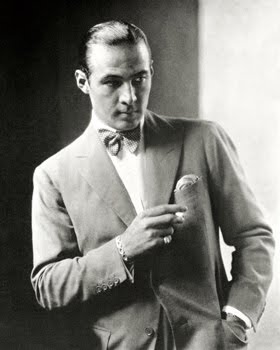
Tony wasn't the only actor to be flabbergasted in the presence of a movie starlet. Before Rudolph Valentino (looking dapper, right) became the epitome of male sexuality, he was just a struggling actor trying to get by in NYC. One day, he "got by" Mary Pickford, who was dining with her mother at a Manhattan restaurant. Rudy was stunned to see the world's most famous woman a mere stone's throw away, but instead of being tongue tied, he walked right over. He earned brownie points by introducing himself to Mary's mother Charlotte first, and then politely turned his attention to the screen's first diva. Mary was very gracious in accepting his sincere compliments for her work and then patiently gave him advice on how to advance his own career. He clearly listened, and years later Mary probably struggled to reconcile the screen's hottest heartthrob with the humble young fop from her memory. After Rudy had established himself as an actor, the two began running in the same circles. Rudy was a frequent guest at the illustrious Pickfair, although Doug Fairbanks never took too much of a liking to him. Doug liked to be the center of attention after all, and the handsome Rudy was one Hell of a scene stealer.

Little Mary


Rudy was one actor who could return the favor. Just as Mary had been friendly to him when he was a nobody, so too would Rudy always treat those around him as equals. He would emulate the kindness bestowed upon him by the mega-movie-star by lavishing it upon other hopefuls that he would meet in later life. For example, while filming The Sheik, the newly famous Rudy, riding high off the success of The Four Horsemen of the Apocalypse, took note of the many young extras on the set. Most of them were starting out in the business, nameless and faceless, and probably completely starstruck by his presence. To make them feel at home, he allowed several young ladies to take a turn riding his horse as he led it around the set. Two of his riders? An 8 -year-old Loretta Young and her sister Polly Ann, both dressed head to toe in Arabian garb. It made their day! (The three Young sisters are pictured left: Loretta, Polly Ann, and Elizabeth-- a trio of lookers).  Years later, Loretta would remember fondly watching a jovial Rudy ambling around with his guitar and singing between takes. It was quite an experience for a smitten young girl.


Loretta, age 14, during filming of Laugh, Clown, Laugh


 Not all meetings between stars are quite so pleasant. Some are just downright awkward, such as the next case. For some time, Jean Arthur and Greta Garbo were vying or the title of "Most Elusive Lady in Hollywood." Fittingly, the two had never met. Jean (right) was sympathetic to Garbo's plight, feeling that on some level she understood her need for privacy and personal space. She even respected her for it: "Her belief that only her work is important to her public. I feel that way, too." What Garbo felt about Jean is unknown, (as is pretty much everything else that went on in Garbo's head). Feeling an unspoken camaraderie with her Swedish counterpart, Jean volunteered to deliver a package to Garbo on behalf of a mutual friend. After all, Garbo was renting a house nearby. It seemed neighborly. Jean was nervous to finally come face to face with the Great Garbo but was also honored-- and a bit excited-- at the chance of an introduction. 

In typical Jean fashion, her knees began to shake as she approached Garbo's temporary abode, but she mustered up the courage to ring the doorbell. A servant let her in, and she waiting anxiously in the front hall. She looked up to see the devastatingly beautiful Greta floating cautiously down the stairs. After sputtering out an explanation for her presence, Jean quietly handed over the package and watched as Greta turned away and opened it. Inside was a huge diamond pin! Jean's eyes were as big as saucers! After a few seconds of silence, Greta turned back around, looked at Jean and said, "Vy don't you mind your own bizness." She then turned and made her way back upstairs. Shell-shocked, Jean equally turned on her heels and ran out the door. She never had a meeting with Garbo again!

This less-than-inviting gaze is
probably similar to what Jean encountered that day!

Happy weekend! :)