FYI

Don't forget to refer to my Contents page for a more convenient reference to past articles.

For More L.A. La Land, visit my writing/art/film appreciation site on Facebook at Quoth the Maven and follow me on Twitter @ Blahlaland. :)

Wednesday, July 11, 2012

MENTAL MONTAGE: The "Goodies"


Bette would wield her riding crop mightily in
Jezebel.


James Cagney believed that any actor worth his salt knows how to pepper his performances with "goodies"-- little bits of physical business that add flavors and layers to his characterizations. Subtle movements, ticks, or off-beat choices can take a flat featured role and turn it into a scene stealer. In any case, the difference between an actor who uses 'goodies' and one who doesn't is the same as the difference between an actor who fills out a role and one who simply walks through it. Some of the greatest movie stars of all time possessed commanding presences and pretty faces, but the best of the best were the ones who added a little seasoning to their already palatable onscreen dispositions. Here are a few acting dishes served up hot, which in less adept hands could have left some of cinema's most classic scenes as bland as lima beans.

Bette Davis is recalled as a first rate character actress who, by the way, was one of the only women in history to maintain this station while becoming a movie star. Her attractive but generally imperfect features set her apart from her contemporaries from the get-go, but her talent was able to surpass industry expectations by making her a box-office queen. In other words, for once, substance won out over superficiality-- no easy feat in Hollywood. In addition to her natural command and hypnotic presence, Bette had dance experience working in her favor. While watching her films, one is particularly aware of the way she uses her hands. She often relied upon finicky, twitched movements in the fingers to communicate her characters' inner turmoil while maintaining an outward, stone-cold countenance. In time, her use of various techniques would become less focused, but particularly under the guise of William Wyler, she put her gift for physical communication to great effect. When working on Jezebel, for example, William wanted Bette to create a signature move to indicate who "Julie" was to the audience. This was a puzzle. How was Bette to impart Julie's willfulness, sensuality, and brazenness in one stroke? It turns out, in one stroke was just how she did it. So, the first time the viewer is introduced to Julie, she hops off a horse, grabs the train of her habit with her riding crop, and seamlessly lifts it up over her shoulder. Now we know that Julie is a force to be reckoned with: a lady with the grace of a southern belle and the cocky impudence more readily acceptable in men. After this swift move, Julie carries on with her obstinacy, walking right into a social gathering still in her riding breeches. Bette took an inconsequential moment and made it a monument. From her first appearance, her character is solidified, which makes her undoing throughout the remaining course of the film even more fascinating to witness. (Bette and William enjoy lunch between takes, left).

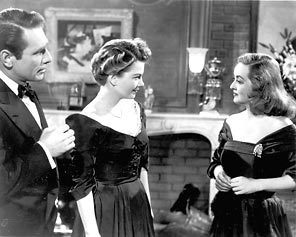
Another director Bette enjoyed working with was Joseph L. Mankiewicz, who was known for getting supreme performances out of his leading ladies... and then some. In Bette's case, it was all business, and there was indeed one particular bit of business in their collaboration All About Eve that quickly and effectively cut through the armor of her theater diva "Margot Channing" and got to the woman beneath. This is where Joe's genius into the female psyche came into play: the only thing more important to a woman than love... is chocolate. He put this knowledge to good use. During the pre-party scene, Margot is already feeling threatened by sickening sycophant Eve Harrington (Anne Baxter), who seems to be wheedling her way into Margot's love life and stealing the attentions of her lover, Bill Simpson (Gary Merrill). When Margot descends the stairs, she interrupts the laughing Eve and Bill, and her insecurity as a woman is even further enhanced (see right). Eve departs, and Margot and Bill bicker. Bette was concerned about this-- her first real confrontational scene in the film-- and asked Joe: "What can we do so that it's not just a talky scene?" Solution: during the ensuing argument, Margot keeps pacing past a jar of chocolates, eying them, reaching for them, and denying herself every time. Finally, as the fight reaches a crescendo, and Margot is left unfulfilled and without reassurance from her distracted lover, she gives in and pops a chocolate into her mouth: ahhh, comfort. Since Margot is also an actress, Bette's contribution of the chocolate dance is doubly effective. An actress's body and appearance is particularly important. Since Margot's fading youth and good looks play a large part in Eve's usurpation of her theatrical throne, this moment of chocolatey bittersweetness is all the sweeter in that it indicates Margot's almost accepted decline. If everything is going to Hell anyway, she might as well take a cue from Marie Antoinette: "Let them eat cake!" Or in this case, cocoa.

Spencer Tracy was the king of characterization. Another performer who maintained his stardom while giving his all as an actor, Spence gave his roles many touches that elevated them beyond robotic line-readings. So effective and underhanded were his character choices, that he often stole the scene right out from under his fellow co-stars, including Claudette Colbert, who recalled acting her heart out in Boom Town only to find herself overlapped by Spence's adept subtly. While her ego was certainly bruised, her respect for Spence only grew. Myrna Loy and Clark Gable would also recall another act of celluloid robbery on the set of Test Pilot (left). It should be said that Spence's acting intuitions were also working hand in hand with the welcomed spirit of hijinks and one-up-manship he and Clark enjoyed throughout their working relationship. Spence was well aware of the fact that he was playing second fiddle to Gable's obviously handsome leading man. BUT, that didn't mean that he had to let Clark steal his thunder. Thus, he devised a plot to draw more attention to himself. During a scene in which Clark and Myrna had a back and forth going, Spence ran an approved idea past director Victor Fleming. Instead of just sitting there like a bump on a log during the scene, he would crack nuts. So, Myrna would say a line-- "crack"-- and Clark would say a line-- "crack." This way, while Spence's BFF character would normally be overlooked, he managed to continually draw the camera's attention to himself. This act of acting genius was also star strategy... and it worked. There Spence was, doing nothing but cracking nuts-- and simultaneously busting Clark's balls-- and he managed to steal the scene. Thus, tawdry pages of dialogue became much more interesting and comical.  The only character anyone pays attention to in the scene is Spence. Nutty, huh?

Spence's lady love Katherine Hepburn would also enjoy a superb cinematic moment, though the thanks for this "goody" goes to her director, George Stevens. Kate wasn't known for being a sex-kitten. Her previous roles and her demeanor may have insinuated a certain amount of girlishness, but sensuality certainly wasn't listed as a top priority in her acting. This is all part of what established her unlikely "type" in the business, but when it came to Woman of the Year, it was sex in particular that Stevens needed to sell. In order to get the audience to believe the affection and attraction between Spence and Kate in their first film together, which had to sustain the entire plot of the film, Kate was going to need to loosen up a little. The chemistry of the soon-to-be real life lovers was already present, but just because Spence was falling in love with Kate, didn't mean the rest of America would. George got an idea! Because Kate's character, "Tess Harding," was supposed to be a brainy take-charge female-- like herself-- the casting was perfect. Yet, the crux of the plot is that underneath all of her smarts and her controlled exterior, there is still a warm-blooded woman. Thus, George decided that the first time Spence's "Sam Craig" sees Tess, he wants there to be a palpable turn-on moment to humanize the otherwise cold, scholarly lady. He asked Kate, therefore, to show a little leg (right). Kate was reticent, but when Spence opens the door to an eye-full of Kate's gam, the look on his face says enough to express what no screenwriter could put into words. From the get-go, Sam wants Tess, and now the audience knows why. With their relationship immediately sexualized, due to Tess's accidental burlesque, the audience can empathize and understand the couple's continuing erotic pull toward each other.

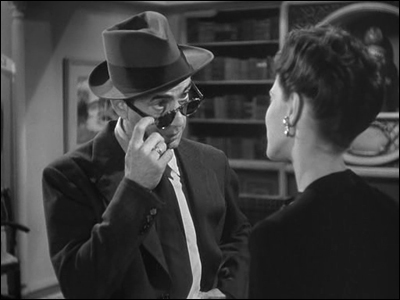
Humphrey Bogart was not known to be a "ham-bone." The closest he ever came to comedy was his turn as the curmudgeonly "Charlie Allnut" in The African Queen. However, cinema's favorite tough guy did allow his sense of humor to guide him in the right direction from time to time.  When shooting The Big Sleep, Bogie was set to do a scene in which his detective, "Philip Marlowe," goes to a used book store to hopefully loot information on his current case. Suspecting that the store is actually a front for less savory business practices, he decides to barge in and test the saleswoman's knowledge about literature. She, in turn, fails to impress, and Marlowe emerges just a little bit closer to solving the mystery. Yet, when rehearsing, director Howard Hawks wasn't satisfied. He wanted the scene to go differently, but he was finding it difficult to articulate just what was wrong with it. It was too "stale." Bogie suggested mixing it up a little. With that, he decided to do a little character acting. He flipped up his hat, put on some glasses, and trudged into the store, not as the hardened Marlowe, but as slightly nasal, totally prissy book snob. As he pulls his glasses down and interrogates the saleswoman on their stock-- of a third edition of Ben-Hur 1860 most particularly-- his mannerisms deliver just enough humor to lighten the heavy tone of the film for a moment and indirectly show us a softer, more affable side of the hard-boiled detective: "You do sell books, hmmm?" (see left). Two birds; one stone. The moment still stands out superbly and humorously from the rest of the film as a result-- you kinda want to see the pompous book-monger again.

Howard Hawks was always looking for creative contributions like these to add more life to his films. One of his favorite actors to work with was Cary Grant. Cary was an adaptable actor, always eager to try pretty much any suggestion in order to improve a scene. During the filming of His Girl Friday, Howard and Cary were looking for a way to relay the exasperation that Cary's character, "Walter Burns," is feeling in reaction to his stressful work at the newspaper in addition to the absolution of his marriage to Rosalind Russell's "Hildy Johnson" (right). Cary would go through the scene and repeatedly deliver his lines and bits of comedy without a mistake, but Howard wasn't satisfied. It was, in his words, "pretty dull." Again, there was something missing. He and Cary conferred, and Howard suggested a vocal goody. Howard had a friend who used to "winnie" like a horse in moments of perturbation. He wondered if Cary would find the same exclamation palatable for his character? He did. And so, when in the world of fast-talking newspapermen (and women) words were not enough, Cary would burst out with a high-pitched "neigh" of irritation. It became one of his trademarks, and he used it on other films when he needed to convey the same overwhelmed demeanor.


If any actor new how to round off a character, it was Lon Chaney. Most recalled today for his macabre and horrifying performances, earlier in his career he had a great deal of success portraying the underhanded "heavy." Due to his textured performances, his con-artists, bruisers, and deviants, were totally believable on the screen, making him an intimidating cinematic presence. As he was always committed to telling a story honestly, he had no qualms about portraying a villain through and through. In doing so, he lived out the dark sides of his audiences, which made them respond to him all the more heartily-- ironic considering how sinister he could be. One example comes in Outside the Law. At the beginning, Lon's "Black Mike Sylva" (left) is plotting with his accomplices, including Wheeler Oakman's "Dapper Bill Ballard," about his latest caper. At a local dive bar, they smoke, sip drinks, and plan away. When the game is set, the trio of thugs rise from the table, throwing down some dough for the swill. As they depart, Black Mike exits last and very stealthily swipes the tip from the tabletop and pockets it! In one swift movement, Lon has told the audience just how dishonest, selfish, and underhanded Mike is going to be. He spends the rest of the film living up to the reputation.


The Strange Love of Martha Ivers is a strange movie in cinematic history. A B-movie potboiler, it is more remembered today for being Kirk Douglas's first film as well as one of Lizabeth Scott's first performances. However, the majority of the plot revolves around Barbara Stanwyck's conniving "Martha" and her prodigal childhood sweetheart "Sam Masterson," played by Van Heflin (both right). Van must have realized from the beginning that this film was not of stellar caliber. A quickly made noir, the film was built to sell tickets not alter the shape of the universe. As such, the only way to amp up the quality was in the acting. Van layered his character with his usual dose of charm and masculinity, but to denote Sam's playful and restless side, he also contributed another gag. He would, throughout the picture, roll a coin between his fingers. It became his character's nervous, boyish habit, and at the very least added a little visual stimuli to a movie that turned out to be a bit of a snooze-fest. Van would recall that Barbara was delighted the first time she saw the trick. A seasoned pro herself, she appreciated Van's extra effort. However, after complimenting his digital dexterity, Babs looked him in the eye and said, "Any time you start twirling that coin, I'll be fixing my garter. So be sure you don't do that when I have important lines to speak." No, Babs wasn't going to fall for that gag-- no one was stealing the scene from her! Thus, Van kept his coin out of Babs's scenes, and she kept the audience's attention!

And so, these Hollywood hotshots took the acting road less traveled by... and that has made all the difference.

Wednesday, July 4, 2012

MENTAL MONTAGE: Movie Stars on the Radio


The body (minus the leg warmers) that inspired America to "do the
Jane Fonda..." and Mickey Avalon to write a hit song.


When it comes down to it, movie stars are nothing more than romanticized human beings: romanticized in their dramatic performances and romanticized in the public consciousness. They put themselves before the camera, and we place them on pedestals. And so, it is not really surprising that so many of our beloved celebrities become muses of song. In Byron's day, we would have read about some random, faceless damsel whom he was lusting over in one of his lyrical opuses. Today, instrumental inspiration often comes from a more obvious source, and so songwriters, rock-stars, and pop-idols reveal their own personal fanaticism by penning ballads and hit songs about the grand stars of cinema's bygone glory era. When these musical offerings are not straight-forward dedications to the Gods of Mt. Olympus, they are at least homages to the singular figures in our ever-growing pop culture.


Buggy Bette


The best celebs always have a trademark. For Harlow, it was her flaxen hair. For Flynn, it was his debonair mustache. For Bette-pop-eyed-Davis (left), it was her large, invasive peepers... (and perhaps a cigarette). Bette's luminous eyes did a great deal of her acting, taking her characters even in moments of stillness from anything from dewy wonder to murderous intent. As such, her baby blues inspired the lyrics to the 1974 Jackie DeShannon song, "Bette Davis Eyes," which described a dangerous coquette who knows how to use her sensuality to get what she wants: "She's precocious, and she knows just what it takes to make a crow blush." The song became more famous when it was re-recorded with minor lyrical changes-- crow became pro-- by Kim Carnes in 1981, where it became the #1 hit of the year. Bette was so flattered to be initiated into yet another generation of fans that she personally thanked Carnes for the "shout out." It meant a great deal to her that, years past her prime, she was still looked upon as the staple of female sexual power.


Jack White's Red-head


Alternative rock musician Jack White has enjoyed success in a number of realms: in various bands, in a solo career, as a music producer, and even as a film actor. His work is often interesting for its articulate yet untidy homages to different artists of the past. He makes no secret of his adoration for heroines like Loretta Lynn or Wanda Jackson, for both of whom he spearheaded new albums. His appreciation of the musicians of yesteryear is always apparent, and his respect blends mediums. Nursing a clear crush on the gorgeous Rita Hayworth (right), he made her the leading lady in the song "Take, Take, Take"-- his perspective on the draining and abusive side of celebrity. Released in 2005 on the White Stripes album Get Behind Me Satan, Rita Hayworth is described as being accosted repeatedly by an increasingly demanding fan whose obsession finally chases her away: "Well it's just not fair/ I want to get a piece of hair." The question both raised and answered is: "What price fame?"


Jack also pays a very direct homage to Rita's hubby Orson Welles in a Citizen Kane tribute. From the 2001 White Stripes album White Blood Cells, "The Union Forever" is totally comprised of pieces of dialogue from the Kane script. A seemingly impossible feat, White weaves the story of Charles Foster Kane (left) into a macabre translation of destructive capitalism and the ravages suffered by its most famous cinematic victim. "The union forever" is thus illustrated as a death sentence, and the painful life of isolation-- "It can't be love, for there is no true love"-- that Kane is left to suffer in his untouchable castle on a hill is sonically translated by White. In listening, movie fans can connect to the otherwise unrelatable character on a whole other level.


Hello, Norma Jeane...

Marilyn Monroe's (right) name pops up everywhere, so it barely joggles the mind anymore when she presents herself in song. However, the most famous and direct offering to Hollywood's sacrificed movie angel is Elton John's "Candle in the Wind." Released in 1973, Elton composed a cathartic release for a world still in mourning for the luminous star who died too soon. The song is particularly fascinating in the way Elton's empathy for the fallen idol and his poignant childhood memories reflect the powerful impact that she had and has maintained on the universal culture. Marilyn was as American as apple pie, but her beauty and vulnerability crossed over borders and oceans to reach people around the world. Few people can have such an amazing effect. Elton would alter the lyrics in 1997 to honor the death of another far-reaching woman, Lady Diana, after her equally shocking and affecting death, but the fact that Sir Elton's feelings of loss were as palpable for a starlet he never knew as they were for a close friend speaks volumes: "I would have liked to have known you,/ but I was just a kid."


In Thine Honor


The tragedy of Frances Farmer (right) has become one of the most famous cautionary tales about Hollywood: if you come here and try to maintain your independence, you will be lobotomized. I am hearing Marilyn Manson's "Beautiful People" in my head as I say this, as he has been known to make a commentary or two on celebrity (Hello, "Dope Show" and ass-less pants). But, a much less dramatic and equally tortured musician added his two cents to the Tinsel Town blood bank. Kurt Cobain continued the saga of fame's destruction with his own drug overdose in 1994. One of rock's most complicated and raw poets, his personal demons certainly found a soul mate in Frances, to whom he penned an ode in 1993's In Utero. The song "Frances Farmer Will Have Her Revenge on Seattle" not only explored Cobain's empathy for the destroyed muse, but reflected his understanding of her inability to compromise. At the time, his internal battle to maintain artistic integrity with the growing popularity of his band caused him to draw a connection between himself and the actress, who fought the same losing battle so many decades before. He would too lose his fight by succumbing to his addictions, but through his words, they both come out victorious, leaving an indelible mark on our cultural history: "She'll come back as fire, And burn all the liars,/ leave a blanket of ash on the ground." We're still burning.


Not Too Fast to Leave a Mark


James Dean (right) remains the poster boy for his generation and a symbol to every generation of youth that follows. He carries the torch of existential confusion, youthful rebellion, and the sort of obstinate bravery that gets us all through puberty. As such, he has influenced many people. Many would try to copy his look to replicate that James Dean cool, but The Eagles tried instead to synthesize his sound. Their 1974 offering "James Dean," from their album On the Border, is an example of a direct star tribute. There is no metaphor; there is no mystery in the lines. Don Henley et al simply wanted to write a song about pretty much the coolest person in their personal recollection. The impenetrability of Dean's bravado on the screen gave him a great power that many an adolescent wished to possess, hence the remaining fascination with his persona: "James Dean, you said it all so clean/ And I know my life would look all right/ If I could see it on the silver screen." Herein too does the band solve the mystery behind Dean's immortality: tragically killed in an auto accident in life, on the screen he still survives. Behind the shield of cinema hides the eternal elixir of life. Too fast to live, too famous to die.


Music in Silence


Not all the glory went to our more contemporary idols. Even in the days of silent films, movie stars were making a lot of noise. One of the crazes of the day was to write songs in honor of popular, current figures. In keeping with this mindset, the world's first movie star, Florence Lawrence (left), got her melodious comeuppance while at the pinnacle of her career. In the days of vaudeville, barber shop quartets, and fox trots, music had a very different personality from the one it bears today-- which is very schizophrenic at times. But, imagine an era where you could actually identify the instrument you were hearing-- I know, it's a long shot. While visiting with friends, one might hear a musician tickling the ivories to "Sweet Rosie O'Grady." A drunken night with friends might end with a house band encore of "And the Band Played On." In 1916, Carl Laemmle hosted a company party for the employees of Universal-- a masked ball no less-- to which his ace star Flo was invited. Imagine her surprise and delight when the MacDonald and Steiner Company's most recent hit, "Florence Lawrence," started echoing through the air and extolling the virtues of her "eyes like the violent, lips like the cherry." Had she any question that she was famous, it was quickly answered, and one can imagine she waltzed it up-- in between blushes, of course.


The Great Profile


Montgomery Clift was pretty (see right). Pretty talented, but also just really damn pretty. Before his tragic car crash, which marred his otherwise perfect visage, it was fairly well agreed upon that he was born with the right profile. Hence, The Clash's 1979 London Calling offering, "The Right Profile." The entire song is written about the public's agony, confusion, and even cold-heartedness after witnessing the movie star's altered appearance in Raintree County: "Monty's face is broken on a wheel/ Is he alive? Can he still feel?"  Monty's downward slide and addiction to pain pills and alcohol are also melodized, as is the hypocrisy of a world that turned its back on one of their prettiest people when he wasn't so pretty anymore. As the idol of Red River and A Place in the Sun, Monty had overcome the crutch of his good looks to bring forth great performances of depth and feeling. After his car crash, Monty in one respect found himself unbound-- as an actor, he was now able to pursue more character roles that would have been denied him in his pristine condition. But too, he suffered the ego blow of his fall from grace when he lost his face. In his life, he became both beauty and the beast, a point that The Clash illustrated with their typical howling and hard-hitting rhythms. 


Quick Hits:


As Lon Chaney (right) is "The Man of a Thousand Faces," it is fitting that he too become "The Man of a Thousand Songs." Countless numbers have been written for the sad actor whose continuing pain and influence never seem to wane. He has been mentioned or directly written about in songs from multiple artists: from Vetiver, to Garland Jeffreys, to Rob Zombie-- not to mention the hit from The Hollywood Revue of 1929, "Lon Chaney's Gonna Get You If You Don't Watch Out!" From Lon's martyrdom to his grotesquerie, he continues to inspire like-minded sufferers, freaks, and idolaters. Over 80 years after his death, his growing legion of fans hold tightly to his memory, as if hoping that he will emerge from the grave and perhaps in turn wear their faces too when they become too heavy. At the very least, these different musical artists return the favor by taking turns wearing his.


When John Ford's The Searchers hit theaters in 1956, he probably hoped at best to have made a great film. Little did he know that it would become an instant classic and the movie that future filmmakers like Steven Spielberg would look to as the prototype of perfect filmmaking. The success of the flick centered around the layered and complicated performance of John Wayne (left), whose hardened, prejudiced cowboy reflected the political unrest of a society undergoing change. His stubborn behavior was clearly indicated in his constant retort: "That'll be the day..." By the film's end, the day of reckoning did come... and so too did Buddy Holly's hit "That'll Be the Day," which was lyrically if not thematically inspired by the film and Wayne's performance in it.


This one remains nameless, but the song "The Second Time Around," which was penned by Sammy Cahn and Jimmy Van Heusen in 1960, was dedicated to one very special lady. While the song made its debut via Bing Crosby, it was more heavily associated over the years with King Crooner Frank Sinatra. This is not just because Frank recorded and performed the song himself many times, but because it was through him that Van Heusen met Shirley MacLaine (right), an often forgotten female member of the infamous Rat Pack. Van Heusen fell in love with Shirley, who unfortunately was married to Steve Parker. While he pined, poor Jimmy wrote the ballad for his lady love, whom he prayed would leave her husband. She did, but not until the '80s. Jimmy didn't get Shirley, but at least Frank got a hit out of it.


And the bands play on...

Sunday, July 1, 2012

STAR OF THE MONTH: Bette Davis


Bette "the Diva" Davis


I think I first heard the name Bette Davis from my mother's lips. Ma loves Bette. For certain, the first of Bette's films I saw was Hush, Hush Sweet Charlotte. Thus, at tender age, I was able to derive two things about her: she was awesome, and she was scary. The first verdict was based upon the fact that what was all right with my mom was all right by me; the second, by the fact that I had watched this brassy, caustic, and intense female push a stone onto Olivia De Havilland and Joseph Cotten's heads with a smirk on her face. As you can see, I was introduced to the Bette of later years: withering, bitter, tough, and a bit unsettling to look at. What is interesting is, despite her hostile outward appearance and demeanor, I still loved her too. Bette Davis didn't take sh*t from nobody! At least, that's the persona she projected. It would take me a long time to unlearn the cinematic, boastful tricks she used to deflect from her true nature. It would take time to undo the caricatured performances she gave from All About Eve onward-- which were both self-congratulatory and self-lacerating-- to find the supreme and gifted actress underneath. The conundrum of Bette Davis is her own seemingly willful undoing, as if she chose to go from an accomplished artiste to a hell-bent monster. If we can agree on anything about Bette Davis today, it is usually that she was a total "Bitch." But this is more than the result of a post-WWII reaction to her ambitious, self-serving tendencies-- far from what men were looking for when they came home. It turns out that 'bitch' Bette became the greatest and longest-running performance she ever gave.


The romantic beauty in her youth.


Ruth Elizabeth Davis was born on April 5, 1908. As a youngster, she changed her name to "Bette," because its sounded more glamorous. This was befitting, because in her youth, she was a true Yankee Princess. No, a Queen, who was doted on and always got her way-- or else. Her father, Harlow Morrell Davis was an extremely intelligent and successful law student who became head of the Patent Department at United Shoe Machinery Corp. Her mother, Ruthie Favor, was a passionate and artistic woman who had left a life of performance behind to become a wife and mother. Both adored "Princess Bettina." Everything was perfect in Lowell, MA-- until the divorce. Harlow's busy work schedule and his wife's increasing dissatisfaction with family life led to the male party's infidelity. Soon, Harlow was married to his former nurse, Minnie Stewart-- who had taken care of him during a bout with asthma-- and Ruth was raising two daughters, including the younger Bobby Davis, on her own. Bette never forgave her father for his transgressions, nor truly forgave her mother for losing him. Any mental proclivities that Bette had toward order and control were thus turned up full-throttle, as she sought to find balance and comfort in an undependable world. Her constant attention to detail and cleanliness make some believe that she suffered from an undiagnosed case of OCD her entire life. Such a theory is not unfounded, as both her mother and sister suffered mental and emotional breakdowns that led to their temporary stays in sanitariums. As she went through life with less money than her friends and the embarrassment of living in a broken home, the anger and resentment Bette felt manifested itself against her sister Bobby-- who was a shelled turtle beside Bette's she-wolf-- and her mother, who seemed to go out of her way to please her constantly emotionally distraught and insecure eldest daughter.


The result was a willful young woman accustomed to unquestionable appeasement. It was Bette who wore the pants in the family. Ruth worshipped her, and worked her fingers to the bone to give her eldest daughter whatever she wanted, as if to make up for her botched marriage and thus botched life. After she got work as a photographer, Ruth created in Bette a little Narcissus, taking romantic photo after romantic photo of the pre-Raphaelite-like beauty with large, intense eyes and glowing skin. As Bette blossomed, she became popular at school, where she used her feisty personality to win people to her side. She too enjoyed charming the opposite sex and pitting them against each other for her affections. It was her way of proving that, while she had lost Harlow, she could have any other man that she wanted. Revenge was sweet, but beneath the assertive, sensuously charged veneer was an insecure little girl putting on a great show. So intense was her need to keep the performance going that she never learned to relax, to settle down, to be herself. The world was her audience, and if she broke character for even a second-- if she let her vulnerability show-- she would lose her power and thus her sense of safety. The incredible stress she put on herself resulted in earth-shattering fits of anger and unstoppable crying jags. She once, in a fit of hysteria, even bit her own mother!


Part of Bette's genius laid in her ability to take chances. Her willingness to play
 the homely old maid in Now, Voyager is an example of this. Here she is with
Claude Rains prior to her character's astonishing make-over.


Finally, Bette found release. After Ruth had moved the family to Newton, she took Bette (Bobby remained always in the shadows) to see "The Wild Duck." Starring in this Henrik Ibsen play was none other than Peg Entwistle, the woman who would later end her life by leaping from the Hollywood sign. In this moment, Bette saw none of that despair nor the tragedy that was to come. She saw only Peg in all her glory: a fully fleshed-out, complicated, emotional woman who captivated her audience. Peg's acting transcended acting. It was being. This is what Bette wanted. Mostly she wanted to openly be emotional with the excuse of it being in character. She vowed to play the same role of Hedvig in "The Wild Duck." It was a promise she intended to keep, and then some. The pressure fell on Ruth to enroll her daughter in acting class. Since she had already encouraged Bette in artistic pursuits, including a tenure at the exclusive dance academy Mariarden, the idea was definitely not unpalatable to the senior lady, but the money was. As always, Ruth made it work. The idea of having her beautiful daughter succeed where she had failed was perhaps the only fuel keeping her going. Riding on an exultant high, Bette landed at the John Murray Anderson-Robert Milton School with a ferocious appetite that propelled her quickly to the top of the class. So lauded were her sensitive and courageous classroom performances that she was awarded a full scholarship for her second term. Despite her glowing status at the Academy, she took a risk and dropped out, pushing herself immediately into the world as a working actress. There was no question of failure, for Bette's mindset only received signals of success. This thinking, they say, is the thinking of winners. She went on to perform in stage successes like "The Earth Between" and, of course, "The Wild Duck." Then came the call to Hollywood that would change everything...


Universal and Warners struggled with how to cast Bette. They tried to 
glamorize her, not realizing that her "glamour" was 
her intelligence, singularity,  and strength.


It is possible, had Bette never come to Hollywood, that she could have gone on in this same brazen, inexplicably blessed fashion. Had she never come to Hollywood, perhaps she never would have started questioning or doubting herself. Her career may have soared continually instead of burning out mid-flight and ending in a battle of self-destruction. Hollywood breaks hearts, and indeed it would even break the unbreakable Bette Davis. Having spent her life as the toast of every occasion, lauded for her beauty and talent, she landed in Tinsel Town only to be told that she was "ugly," awkward, giftless. Her first screen-test for Samuel Goldwyn was a disaster. For any other girl, this would mean defeat. For Bette, it meant war. After David Werner called her back to Universal after seeing her perform in "Solid South" (this Yankee often found herself in Southern Belle roles), she landed a three month contract with the studio. The casting department fretted: What to do with her? She's not conventionally beautiful... She's not conventionally anything... Each snipe cut her to the quick, but more than ever, Bette needed to prove to herself that she was better than anyone else, if only to show her father-- who objected to her career decision-- that she didn't need him or anyone else. It was power that she was after. Though her ego was severely damaged by this un-Christian greeting from the City of Angels, Bette was determined to get to a place where she could tell everyone to go to Hell. She would find that place on her throne as the leading lady of Warner Brothers.


Bette takes the graceful, feminine ideal to school and wins
the world over with her earthy, real, and flawed 
performance in Of Human Bondage.


After a series of bit parts that took her nowhere, Bette was signed with Warners in 1931. After making over twenty films, she would finally reach success in what remains one of her finest performances. In fact, at the time, it was deemed "probably the best performance ever recorded on the screen by a U.S. actress ." Her elusive, selfish, and at times repulsive take on W. Somerset Maugham's anti-heroine Mildred in Of Human Bondage was a sensation. Never had acting been so raw or unapologetic. Other actresses had shied from the intense and unflattering material. Bette latched onto it with desperation, knowing that it was her last chance to prove her mettle. To stand out in Hollywood, she was thus agreeing to be just what they thought she was: ugly. It was a gamble that worked. Her stature on the lot and in Hollywood in general climbed after this film, leading to critically acclaimed collaborations (and an affair) with William Wyler in Jezebel and The Letter. Nominated five years in row for her work, after an initial snub for Of Human Bondage, Bette would take home 2 trophies for Dangerous and Jezebel


An unlikely starlet, her appeal to women in particular-- who were craving an escape from societal expectations and gender shackles-- made her one of the biggest names in entertainment. She used her intelligence, abandon, and amazing understanding of physicality to inject pathos into her roles in Now, Voyager and Dark Journey. She was the actress other actresses wanted to be. With her strength, she was the woman other women wanted to be. The champion of "women's pictures," Bette's harshness projected a realism that gave her soul sisters comfort. Her atypical features too gave her a place with the common women of the world, who were elevated by Bette's uncommon ability to translate their secret pains, fears, and yearnings. One watches films like Old Acquaintance or Marked Woman today and still willingly absorbs the Bette Davis punch. She is solid in her shoes, unapologetic, authentic, flawed, human, and not to be trifled with. To see a woman take charge so naturally was a much needed breath of fresh air, making Bette the female answer to Warner's typically male-heavy gangster films. She was a social gangster.


Bette tests Henry Fonda's loyalty and her own sexual powers over
him, and suffers the consequences, in Jezebel, one of her 
greatest performances.


Yet, slowly over time, Bette's aim faltered. Her aforementioned 'punch' stopped smacking sense into the public and suddenly seemed to become self-inflicted. Some would say that the "actress" became a "star;" some could say money and not art became her agenda. In any case, Bette Davis seemed only to be playing Bette Davis after awhile. Always an unfalteringly strong performer, her technique dwindled and her characterizations suffered. Her formerly calculated mannerisms became little more than nervous ticks and old tricks. She wanted to maintain her power, but seemed to be surrendering it at the same time. Her well recorded disputes with Warner Brothers allegedly revealed a woman who wanted better opportunities, but in retrospect we see that she sabotaged every chance for elevation she received. She turned down interesting work and feigned illness to get out of compelling pictures, as if her faith in her talent was waning. She became a victim of her own internal battle: the pressure of staying on top became too much, and so she subconsciously started to jump the plank. 


Her personal relationships too give a key into her descent. Never trusting of the familial environment, considering her own broken home, she tried and failed to have marriages with every type of man on the list: sweet pushover "Ham" Oscar Nelson, social ladder climber Arthur Farnsworth, overbearing beefcake William Grant Sherry, and the abusive macho Gary Merrill. But no man would ever be as important to her as her career. Like so many of her film characters, she tried to be a woman who "had it all," only to find the push and pull between home and career to be far too abusive for her psyche. She wanted more than she was able to be a loving wife and mother. She lacked trust: trust in men and trust in herself. A great majority of her marriages became abusive, and Bette willingly seemed to instigate most of her physical punishments, particularly with Gary Merrill, who too beat her daughter, "B.D." Partially terrified and partly gratified at the bruises she received, Bette seemed to be seeking absolution for her failure as a woman. Then again, perhaps as a woman who had reached such great heights, she just wanted to feel pain to feel human again.


Bette makes history again as Margot Channing in All About EveShe 
finally found a man to go mono-e-mono with her in Gary Merrill-- 
but their union cost her the last of her self-esteem.


Being Bette Davis, in the end, destroyed Bette Davis. As her career started dwindling, she made All About Eve-- which remains one of her classic performances-- then disappeared into maladjusted family life with Gary Merrill, daughter B.D, and her two adopted children Michael and Margot, who were essentially bought to be toys for B.D. Michael would be abused by his eldest sister as Bette had and continued to abuse her sister Bobby, and Margot would be ostracized after it was discovered that she was brain damaged and thus unmanageable. Bette assuaged herself the only way she knew how: in her constant cleaning and in booze. The result was a woman who appeared far beyond her years. It was no surprise, therefore, that she made her brief career renaissance in horror films. Her lipstick scowl still painted across her constantly disappointed face, Bette howled vengefully at the fading Hollywood moon with another never-say-die lady, Joan Crawford, in What Ever Happened to Baby Jane? It was a sleeper sensation and led to a reawakening in Bette's career. But glory was not to last. Age, poor health-- including a battle with cancer-- and a foiled sense of self-esteem would work against the icon.  Her last major triumph in The Whales of August is a great example of this. She spent the entire filming period ostracizing herself from the rest of the cast, including Vincent Price and Lillian Gish, who tried and failed to befriend her. She had become too isolated in her cocoon of self-doubt and desperately resorted to antagonism for a sense of control. Her final effort in The Wicked Stepmother was cut short when she dropped out after seeing her aged face in the rushes. It was as if she was finally forced to recognize the monster she had created, and instead of flaunting it and feeding it as she used to, she became terrified of it and let it eat her alive. Her death in 1989 was a sad end to a woman who had shined so brightly at her zenith. But then, Bette would never have admitted to this defeat.


Fallen idols in a final triumph: What Ever Happened to Baby Jane?
While Joan Crawford was religiously devoted to her own 
preservation, Bette seemed intent on self-destruction. 


In retrospect, all of these hell-raising, intimidating qualities, which became exaggerated in her later years, only served to endear Bette to us more. We counted on her to be over-bearing, to be pushy, to live out a side of ourselves on and off screen that we were always too afraid or too polite to personally unleash. We sometimes need a devil to wreak havoc for us. Perhaps this was Bette's purpose, and why we continue to love her. Despite the aged caricature that seems to sometimes eclipse the slender, petite, beauty she once was, one cannot deny this woman's talent, nor the way she influenced an era of women undergoing another social renaissance. To watch the nuances she gave her characters takes the breath away. Her turn as Leslie Crosbie in The Letter expanded upon Jeanne Eagles's original villainess by eliminating Leslie's mania and making her a calculating woman one-card-short of a full-on sociopath. Her martyred Charlotte Lovell in The Old Maid reveals one woman living two lives-- one as a frigid aunt, bitter and overbearing, and the other as a secret mother who yearns for her beloved child's affection. Had Bette continued to trust her intuition, her natural scent for character, her downward slide after The Little Foxes wouldn't have been as rapid. Her need for control affected her ability to cooperate and collaborate. Instead she disappeared into overly manufactured characters, and became the woman of only one face: the Bette Davis face. It is a testament to her as the vital force she was that that face was the only one we needed and the one we continue to search for in all of her dangerous, uplifting, and life-changing portrayals. As "bad" as Bette was, she's still so good. Incomparable. Perfect. Beautiful... Especially when she gets ugly.