FYI

Don't forget to refer to my Contents page for a more convenient reference to past articles.

For More L.A. La Land, visit my writing/art/film appreciation site on Facebook at Quoth the Maven and follow me on Twitter @ Blahlaland. :)

Thursday, October 17, 2013

HALLOWEEN SPOOKTACULAR IV: Monster Mash-Up Pt. 1


The Monsters of Universal (and Masters of the Horror Universe.)

What is it about horror? A reasonable person would veer from any form of storytelling, visual or otherwise, that involves anything even resembling the realm of terror, yet we collectively, gluttonously feast upon such things like Tantalus unchained. While getting a chill up the spine or getting a little shock treatment can cause quite the pleasurable burst of adrenaline-- the heart races, the body sweats in a psychological sex tease-- I think the appeal of this genre goes quite deeper than the superficial, physical sensations it induces. Looking particularly at the epic success of the Universal Monsters of the '30s and '40s, one can't help but be moved by the passion the public still maintains for these immortal beloveds-- all in various stages of decay, sanity, and even inter-special transition. People don't line up at theaters or bulk up their DVD collections because they really look forward to biting their nails. They seek revelation of some deeper, forbidden part of themselves. They long for a cathartic release of the beast within or for a symbolic figure to rebel against society, which too often misunderstands and seeks to suffocate each individual's "otherness."


Mary Philbin comforts Lon Chaney's "Phantom." While his face may have
 evoked gasps of terror, his aching heart still garnered him sympathy,
despite his evil acts. He was less a monster than the broken
product of a life of isolation and societal hatred.


For example, the mystic gift of Chaney and his rapport with the public is attributed to the twisted natures-- physical and mental-- of his characterizations, which were in sync with the sometimes crippled, limbless, and scarred soldiers returning from the Great War-- altered men who in many ways were mere shadows of their former selves. Chaney gave them their spirit back, hence the success of the repulsive yet empathetic villain in Universal's "The Phantom of the Opera." No one blamed the malformed Erik for being mad. Life had slowly built him that way, one painful day at a time.

We are all monsters. We internally envision ourselves as outcasts, deviants, and madmen. Thus, when the perfect symbols of ourselves are given the liberty to wreak havoc and cause a little much needed destruction, we all breathe a sigh of relief-- even if it comes out as a scream. It is sometimes terrifying to look yourself in the face, yet you look, because something lives in that reflection that both beguiles you but is uncannily familiar. Looking into your double face just feels right, even when it's "wrong." The following is an analysis of these demon children who grew up to be the Godfathers (and mother) of our tragically lost souls.

DRACULA: The Sex Fiend

Dracula (1931) was the first official Universal "monster." Hitching their wagon to the star of the Broadway sensation of the hit play, the studio latched onto the tall, imposing, and frightfully foreign Bela Lugosi (left) and created a totally new genre. While Chaney had created freaks, killers, and hard-nosed tough guys with hearts, the anti-hero of Dracula was different. He wasn't interested in the heart. He wanted blood. While his appeal was seductive, emphasizing the ideology that sex is not about love but power, he didn't make choices based on any emotional reason. His methods were biologically fueled. He had to feed, and the exchange of fluids through blood--exposing the sexual act as a purely primal and shamelessly visceral experience-- suddenly became a thoroughly naughty, but not altogether unheard of, experience of both pleasure and pain. Dracula was the root of this natural impulse when not bedecked in lace and church hymnals. Only bad guys have that kind of dirty sex. Jonathan Harker was small potatoes next to the burning fury of Count Dracula. Lugosi's totally composed and supremely confident veneer could instantly transform to uncontrollable hostility when the mood struck him. The foreplay and interaction with the humans who would become his meal were mere entertainment for him-- a game. Like a serial killer/rapist, he craved the hunt and the orgasmic release of the final act. His guiltless conquest for it night after night made him both terribly fearful and deathly sexy.

Tod Browning's direction was not flawless. He did not have the technology or immediate know-how to create the special effects without his silent tricks to make Dracula's transitions from man to bat, or bat to smoke, seamless. These innovations would quickly improve over the coming years, but this new branch of the medium was in its infancy. So, when a rubber bat awkwardly flutters over Mina's (Helen Chandler) head, it's a bit laughable, by today's standards at least. The dialogue is  also awkward, and the actors seem self-conscious and stiff. This, in Browning's defense, was a mere result of timing. Tod was coming off an extremely successful silent film career, wherein he had created his own style with his particularly distorted perspective on life and art. Now, he had to learn how to transition his purely visual capabilities into the instantly permanent world of the "talkies." However, the skill of the director and his perverted sense of humanity is still palpable in the moments of stillness and silence. His capture of Lugosi's movements, the sliver of light cast across his hypnotic eyes, the camera dollying forward under his spell-- these are the touches that made this a phenomenon in its time, as it remains today.

Why do we still love Dracula? Bela, with his threatening otherness and his selfish, caveman depravity-- picking off beautiful women left and right, either leaving them for dead or making them eternal "bitches" in his undead harem-- is forever the Dark Pimp. He is our constantly subdued bad-ass penchants set hedonistically free. The subversive nature of the story and its inference into human lust and the sadomasochism of the male-female relationship-- the kinky dominatrix versus the submissive object-- make it identifiable on an innate but heavily cloaked level of brutal human understanding. Both the villain and victim roles are forms of rebellion and surrender. Each combats the chaos of the world in its own way, either by submitting to their baser nature by seizing control of one the visceral experience that remains pliable in their hands (I will destroy you!), or otherwise yielding to such an imposing counter-power and, in doing so, fostering their compulsion for self destruction, (Go on, destroy me!). At the film's end, we are of course instructed that such cravings are evil, which is why we must clutch the cross tightly to our breasts and keep these urges at bay. To do otherwise, would just be bad manners. Yet, it is not the victorious and cerebral Van Helsing that people hold up as a hero. We prefer the guy who gives life to fantasy, even in death. (Right with Chandler).

FRANKENSTEIN'S MONSTER: The Puppet

Boris Karloff's haunting interpretation of the most misunderstood of God's Godless creatures (left) in Frankenstein (1931) remains the fan favorite for most. He is a being who has been raped from the earth, forced into an existence he did not ask for, and programmed to ignore his instincts and obey his master. He was not supposed to be. He was not made of star dust; he was born of lightning, which makes him a product of the pagan divinity Jupiter, I suppose. He is also a mere child, one with a diseased brain that seems absent of any memory of its past life. There too we see that he is a reincarnation, a returned and damned man from the other side.  He knows not where he came from, nor where he's going, and he is baffled by what he is. Again, he did not come from the spirit world. He is a natural, unnatural character of the dirt. From his first step into the light before his audience, the haunted look in his eyes and the uncertain, clumsy, and sluggish movements reveal that he is not a threat. He is instantly a victim, one frowned upon as a freak for his innate divergence from the norm. In his struggle for identity, his initial acquiescence turns to rebellion against his enforced role as a pawn in the rich man's game (Colin Clive as the Doctor-- a man playing God because he can afford to and he believes that the ends justify his self-serving, pride-filled delusions of grandeur).

The doctor is the parent who thoughtlessly has a child because he thinks it will fulfill his own destiny. The gift of life is something to defy his own tenuous grasp on mortality, a reflection of himself, and his name metaphorically tattooed on the flesh of the genetic landscape of another: I was here. He's right to fulfill man's biological, creative urge, but his motives are so self-centered and misdirected that he nonchalantly refuses to take heed of the responsibilities this creation of life demands. He is not a good father. His child is a trophy on the wall-- something he has accomplished. He has made himself a man, but he fails to instruct his son of his own independent manhood. The Monster has no identity, no knowledge, he is helpless and reliant upon only his daddy and what serves as his own brutish instinct-- again, that cave man root at our core. He lashes out when frightened, when intimidated, or when fighting for a small corner of territory, but his maturity is stunted. "The Man" keeps him in chains. The pain and innocence that Karloff was able to incorporate beneath his heavily-lidded eyes, hulking form, and intimidating size is amazing. James Whale's portrait of this childlike nature is best exemplified in the iconic scene where the Monster tosses flowers into the lake only to become frustrated and toss his little girl friend in as well. This was not an act of malice. It was not premeditated. The Monster, vulnerable and unlearned, lashed out as the house cat that has been held too long and scratches at the face to be free.

Whatever way one chooses to unpack the many themes within the film, the questions of life and death, God and Man, and Man vs. Man, are the ones most obviously studied and shared within the mind and heart of the viewer. The Monster is a tool, robbed of divine, independent purpose as soon as he enters the world. He is to serve the mortal who made him, not his own spiritual enlightenment nor his own urges. In a world where we most often feel like dancing monkeys in another man's show, the Monster remains our sad, emblematic clown. He conveys our need for escape (right), to take what it is we have been given and explore life in our own way instead of being tailored to suit the greater needs of those who seek to control us. We are all lost babes in the woods, grappling with the painful experience of life, its brevity, its seeming purposelessness. To question what is beyond-- and the Monster is what is beyond-- is to inflict the heavy burden of the nature of existence onto your world weary back, where you will also find a target. Reveal any mark of societal disparity or greater questions, and you will have tossed a wrench into the well-oiled machinery of life as we (choose to) know it. As such, you will be chased out of said society with torches. Your life is not in your hands nor under your power. You were born to serve. You were born to die. When the Monster was killed (or so we thought), we all felt better. Not because the world was a better or safer place without him, but because he was free of it. God may not have blessed him, but we still do.

THE MUMMY: The Lover

"Karloff the Uncanny" delivered the second of his most popular creations when he returned (again) as the undead. The Mummy (1932), under unflinching the eye of director Karl Freund, is horror's most romantic tale. Sure, it's about a rotting corpse who is reawakened from ancient days by modern fools who have no respect for the living or dead. Sure, he's hell-bent on vengeance. Sure he's a creeper... But, Imhotep died for love. He waited for centuries-- in Hell? In silent suffocation? In misery?-- to find this love again and reunite with her. A man in love can be dangerous, particularly this one. He's already been buried alive, punished for defying the Gods, and robbed of his heart's desire once. He is the unstoppable wooer who woos the object into submission through sheer persistence and willpower. How can you intimidate such a person or stop him? You can't. He's indestructible. He possesses a power that cannot be fathomed, fueled by some sort of dark deal he must have made with the Devil himself-- or the Egyptian equivalent. His one frailty is the woman who has kept his tell tale heart beating within the tomb. Until he obtains her love again, he will have no satisfaction. He will remain a shadow, waiting in pain for her return and for the consummation of a love that even time cannot kill. He will not let you get in his way. When a guy meets the girl... game over.

The asexual quality of Karloff is what makes his Monsters so interesting. Imhotep, who reintroduces himself into the mortal realm as Ardeth Bay, is not an attractive man with his sunken eyes and cheeks, a strange lisping voice from the ancient days, and an odd choice of clothing. He is not the golden haired, muscular, masculine hero on overdrive that you read about in sappy love stories. He is just a man, and thus he possesses the romantic idealism of a real man-- a lovesick freak at heart. Love comes not easily to everyone, and Imhotep's unlikely winning of Princess Anck-Su-Namun so long ago makes the loss of that devotion even more devastating. He is a tragic hero in his normality and unimpressive looks. He is the geek that landed the prom queen. As such, he has not tasted the fleeting nature of emotion that most experience-- that tinged with lust and left to taper and die. He knows the effects of true love, and true love never dies. Imhotep, therefore, is every man who has ever fallen into the abyss of obsessive love. He too is every man who has asked the pretty girl to the dance and been intercepted by the hotter guy (David Manners). Why do girls go for shallow fools when there are impassioned vessels of desire waiting to play their humble servants? To treat them like Goddesses? To worship at their feet? This sexual/romantic frustration is what fuels Imhotep, who uses entrancement to get the reincarnation of his long lost love (Zita Johann) back into his arms.

Acting out on behalf of the underdogs everywhere-- the undead, the acned, the overweight, the undesired-- by not only taking down anyone who gets in his path-- descendants of the madmen who wrapped him up and shut him away (in what I consider to be the most terrifying moment in the film)-- but by locking his woman down (right). He has burned, he has pined, he has perished... It's her turn. It's her turn to serve him, in this life and the next. Imhotep has come back with swagger and centuries of desire have made him both desperate and immovable. Don't let his thin frame fool you. He is packing rage from the ages. If anthropology teaches us nothing else, it is that human being continue to do crazy, mad, even despicable things for love. Sadly, the Mummy does not get his way, and this makes both him and the movie poignantly tragic. True love stories don't always end as "happily ever afters." For we regular folks, there is just a fleeting possibility of great love. Some don't get a love story at all nor do they get to experience the exaggerated life or death intensity of it-- at least not while holding their beloved's hand. Thus, Imhotep's victory was in the trying. Most of us possess the same level of passion for life and love, but few of us are brave enough to embrace it. In this at least, the Mummy was victorious.

THE INVISIBLE MAN: The Id

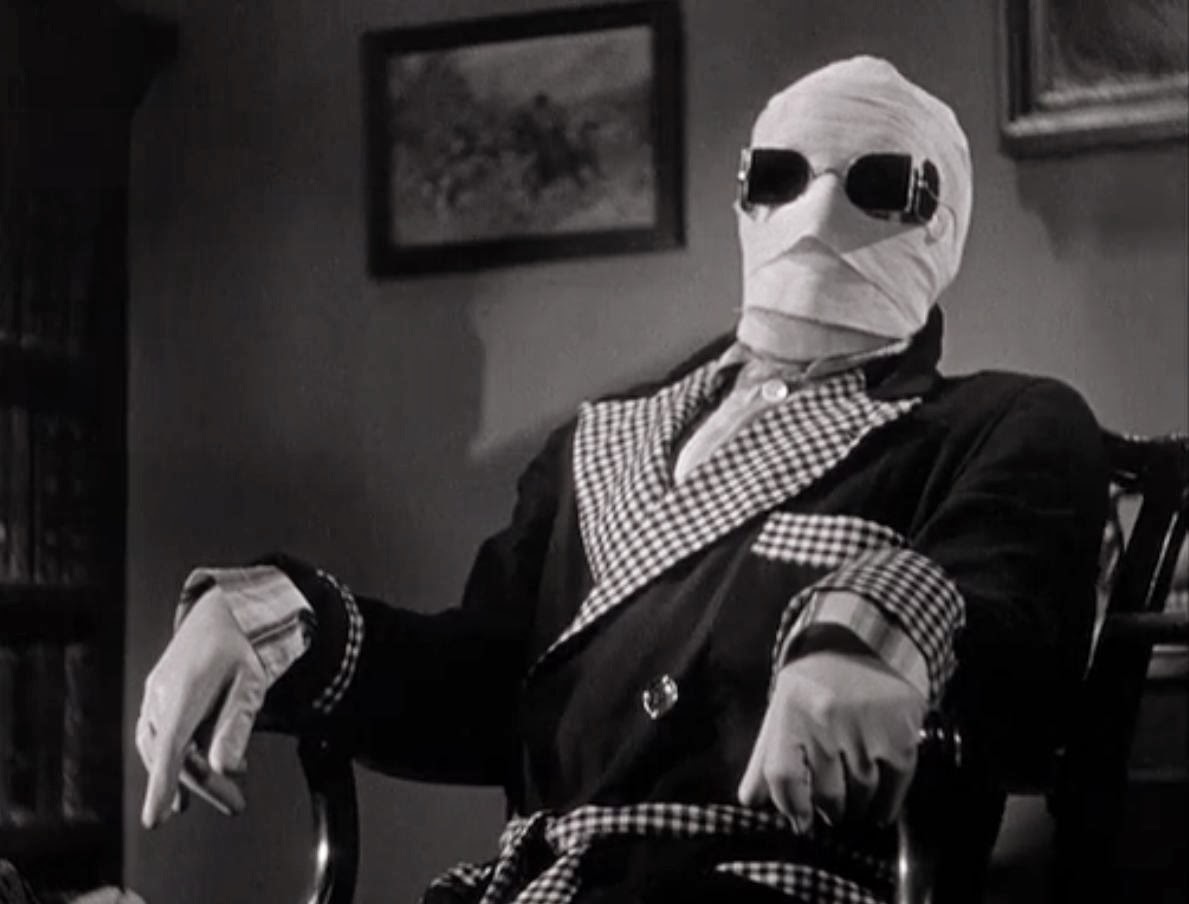
The Invisible Man (1933) may boast the most truly despicable of all Universal villains (left). While it could be argued that Dracula was more evil, one could not say with all confidence that he was innately so. His origin, his turn to the nocturnal life of the God forsaken, is unknown to us, our theories of the source of his malice pure conjecture. It is as if he always was-- one of Heaven's fallen angels. He was, in whatever fashion, created, just as the Monster and his Bride. The Mummy was a banished soul, the Creature from the Black Lagoon was a soldier of and for Mother Nature, the Wolf Man was accursed... The Phantom of the Opera (1943), interestingly also a a faceless Claude Rains creation, is the only other psychopath on par with the invisible scientist Jack Griffin, whose downward spiral is a choice. The entity that is left when he surrenders his mortal flesh-- his appearance of humanity-- is composed entirely of wicked abandon, total self-interest, intense loathing, bitterness, and homicidal tendencies. He is known to frolic naked and cackle maniacally at the joke of human vulnerability and fear. His conscience, his compassion, his sympathy are as vacant as his form. From the original novel by H.G. Wells to James Whale's cinematic interpretation, we are left to deduce that the bare essence of humanity is a Devil. Griffin didn't need to be pushed, bitten, or condemned to become the morally deprived menace he transforms into. He just needed to chip away at the charade of civility to unleash the Hell hound within.

A man ungoverned and totally at liberty, immune to judgment, and possessing something akin to an omniscient power, Griffin can through his pure stealth terrorize for the sake of terrorizing, seemingly penetrate walls, be as the fly on the wall, and-- with no one to account to-- be as bad as he may, devil-may-care. He is thus our inner deviant child-- the little son of a bitch that whispers in the ear and makes us think sinful thoughts, enjoys pulling girls pig-tails, and bullying kids on the playground. This is why we find I actions at times hilarious-- a fact Whale picked up on with his ever astute sense of humor. We would probably perform pretty horrid actions were it not for the learned behavior of cooperation with decency. Imagine being free of the need to "behave." Every rude or politically incorrect thought one has ever had, can suddenly be spoken aloud when there is no shame of having to face the consequences. With no face, and nothing to hide, the lurking ghost that haunts our better judgment can easily take the wheel and use it to ram the car of reason into brick walls, over cliffs, or straight into a pool of sitting-duck pedestrians. Anyone who annoys you can be bitch-slapped. Anyone you've wanted to publicly embarrass, humiliate, or hurt, you are free to harass. There are no boundaries. Who wouldn't go drunk with power? The trouble is that this little demon child has run amok for too long. Just as loss of order turns people into looting, raping, and pillaging animals, so too does the complete lack of restraint birth a murderous, ravenous, incendiary character who has no remaining goodness to counterbalance his ever increasing catalogue of sins.

We all have certain vanities that, were they left unchecked, would lead us down a checkered path.  Griffin's flaw was his greed-- his need to indulge his God complex-- a popular theme in the Monster films-- by making a great scientific discovery. Using himself as his own test subject, because he lacks the patience or the ability to share the glory of his innovation, he further feeds his narcissism. Certainly, he will be remembered as Jonas Salk for providing the masses with his genius discovery. Be careful what you wish for... It is not the Devil with whom Griffin has made a bad deal, but himself. He made himself the God of science and is neither answerable to nor able to blame the God of Man. He concocted the potion. He performed the disappearing act. He condemned himself to shapeless limbo. He too is the one that chooses malevolence over humility when he arrives at a place of existential confusion. As such, he is the Devil we all have on our shoulders grown large. It is fitting that he disappear-- that this level of self love and selfish abandon be invisible to the naked eye. The more he submerges himself in his most insane desires, the more he loses touch with reality and banishes himself to some foreign and utterly contemptible level of consciousness. It is only after this demon is exorcised that the real Griffin reappears-- a malicious voice finally given a face. With Rains' tense and crazed movements when visible in his robes and bandages, and the perfectly snarky, heedless, and toying cadences of his voice, he creates one of the most sinister horror villains that never was. We recognize the crookedness of Griffin, and we even envy him for being able to be so unabashedly, unapologetically crooked for awhile. Still, man needs order to survive. The alternative is chaos. If this movie doesn't scare someone straight, I don't know what will. (The Invisible Man's skeletal face of absence, his soul already cast to the oblivion of his demonic mania, right).

To Be Continued in Part Two...

Monday, September 23, 2013

TAKE ONE, TWO, THREE: Yen's "Sin" - [Part 2]


... continued from Part 1's focus on Broken Blossoms-- an examination of the Chinese lover in classic cinema.


Some very daring poster art for the provocative classic,
The Bitter Tea of General Yen.

Everyone's favorite American sentimentalist, Frank Capra, left his small town ways to enter the big leagues when he pushed the themes of interracial romance to the brink in The Bitter Tea of General Yen (1933). The plot of this film is not too far removed from Broken Blossoms-- the white woman comes under the Chinaman's care-- though this time the woman is a passionate missionary out to rescue orphans, and the man is an uncompromising warlord who essentially orchestrates her abduction so he can make her his concubine. Despite appearances, the attraction between "Megan Davis" (Barbara Stanwyck) and "Gen. Yen" (Nils Asther) is mutual, but the racist ideologies that Megan possesses make it just as equally brutal. Her shame over her attraction to the "dirty Chinaman" is hidden behind her cutting, prejudicial denial of Yen's own scintillating desires. In his case, his insecurities are compensated for by his strange blend of stoic and sensual tyranny. The initial effect Yen s on Megan is shock. She seems utterly confused by the fact that he actually appears civilized-- aka  "white" in behavior-- when she and Yen meet by happenstance in an automotive collision that locks them fatalistically together. Under Capra's direction, the story is a near visual portrait of S&M.

Who else but "Stany" could portray a heroine with equal parts smoldering pleasure and pain? An actress of boiling intensity and sensual confidence, she gives Megan a depth and curiosity that slowly seeks to overcome her own misunderstandings coupled with an increasingly volcanic sexual appetite. An adventuress on her way to a boring life as a missionary's wife, it seems that Megan's only reason for choosing her fiancé was the proximity a life with him might bring her to danger and excitement-- foreign places, existential exposure, intense exploration. Dressed essentially as a wolf in lamb's clothing, Megan's thirst for life could easily lead her to a dangerous addiction, and her struggle becomes on of concealing her passion for propriety's sake. She would be labeled a perverse whore  and social disgrace were she to admit her fetish for her mysterious captor. Megan knows that her emotions, or more honestly her primal urges, are viewed as "wrong." It is incorrect to want a member of the other race. She has been taught this all her life, and she spouts the rules of decent behavior even as her eyes and body language communicate that she doesn't believe them.


Babs draws her silken robe closer to her body in Yen's presence, but
she also always looks like she's 3 seconds from ripping it off.

Nils Asther brings an interesting twist to his take on Yen. In his career, he was often chosen to play the "other" foreigner, because of his exotic, almost androgynous features and Swedish accent, which I suppose sounded Asian to  studio producers (???). He played the part of the tempting Indonesian with fellow Swede Greta Garbo in Wild Orchids (1929) and the Turkish police chief "Kadar-Pasha" in Abdul the Damned (1935) to name but two examples. His slithers into his role as the sadistic Yen well, who uses his poise and confidence to cover his learned feelings of inferiority to the white race. However, through  his over-eagerness to please Megan, Yen occasionally shows his hand, his vulnerabilities, and equally masochistic tendencies. These breadcrumbs leading to the torrent of his desire emerge in moments of desperation. Still, Yen is a mystery-- a man difficult to make out. He is part calculating, emotional strategist and part little boy who has just had his hand slapped. He is secretly intimidated by Megan just as much as he is drawn to her, thus he presents himself as an unapologetic, compassionless, and sinister beast, utterly confident in the fact that he will conquer her without having to force himself upon her. This, in turn, arouses the suppressed sex-kitten in Megan, just as her superiority and refusals arouse him.


Yen's still waters are kept calculatingly cool in order to camouflage the intensity
of his underlying passions. He appears as the token "dragon man," but he has
incredible class and patience. His mind games are traps that are impossible
to escape, because one doesn't realize she's in one until it's too late.

The sexual chess game of clean, white beauty vs. dark foreigner is one of worthless resistance. Both players refuse to be the submissive victim, and both are too tough to admit their true desire for each other. It is becomes a taut "wait out the clock" situation to see who will break first; who will first kneel to kiss the foot of the victor. As compared to Lillian Gish, Stanwyck is no girl; she's a woman, and a tough one. She may not be totally aware that her unconscious decisions have led her here, to the place of her unspoken pleasure, but she's not a fool. While she feels her fortifications falling to Yen's curious hold over her, she too knows the repercussions such an affair would bring her, and as a worldly dame she's not about to surrender her reputation for one night of objectification. With a piece of the bigotry chip on her shoulder, she is also a bit disgusted by Yen, but his strange spiritualism and mind-boggling philosophies-- which both adhere to and contradict his actions-- slowly reveal the flesh and blood man beneath the fetish. He is the dark knight of fairy tales, and it is by touching her mind and exposing it to the open world she craves as a human being that he starts winding his way around her heart.

The win of Megan's desire over her prejudice is brilliantly evidenced in the infamous dream sequence. Yen approaches her as a hideous creature of racist stereotypes-- a rat-like face, long nails, a hunched walk-- creating a terrifying, nightmarish blend of xenophobic horror. Moving like a twitching insect, he comes to her bed and puts his claw-like hands upon her. She shrinks away, but she is just as sexually fueled by the indefinite polluting of her body as she is disturbed. Her acceptance of what has been described to her as utterly filthy will actually be her ticket out of the life she finds so bland and constraining.  She partially wants to destroy herself. But, before this happens, a savior arrives as if on the apocryphal white horse to save her. Indeed, he is even dressed in white-- the pure color. The masked hero defeats the Yen sub-creature and then tosses off his own mask, which reveals Yen the man. Truth has defeated stereotype. In her fantasy, Megan abolishes all bigotry, enfolds herself in Yen's arms, and thus acknowledges the fact that He is Man, She is Woman, and the only line between them is that which she draws herself.


The Yen creature accosts Megan in her bed, a representative of all her disgusting
prejudices about the "yellow" sexual villain.

The duo are never permitted to kiss, but thanks to the films release prior to the 1934 production code, the implications of this scene are pretty damn bold and certainly made contemporary audiences of the time... uncomfortable. Though Asther is a Caucasian in make-up, stating a blatant message that a biracial relationship was A-Ok was not yet to be. Thus, the total fusion of these two very representative characters-- the Yen and the Yang (bad pun)-- had to be halted. The road block to their union is, of course, death. After Megan's eventual supplication before Yen, the reality of the game hits home. She comes to him dressed as one of his heavily make-uped and bejeweled concubines, and Stanwyck's tearfully broken performance as she applies these goods to her body, as opposed to washing herself clean, delivers perhaps the most obvious message of all. Yen, at the end of the day, is still a thing, whose touch will contaminate and make her a thing. Megan gives herself up to this. Yen, surprisingly, does not. He fixes himself the titled 'bitter' cocktail that takes his life and ends his beloved's suffering.

In truth, the story never really feels like one of love. This could be because the chemistry between Stanwyck and Asther does not have much fire, the source of the heat coming only from the independent tortures that both are suffering alone. (Hate and love are very closely linked). More particularly, it is a story about man's sexual nature. It is a tale of primal eroticism and pure lust, not romance. Human affection and human desire are too very different things, which is perhaps why Yen sacrifices himself to keep from damaging the girl he respects but who he can't be certain will ever give him her heart.


Yen drinks a toast to his 'bitter' end.

The end is complicated, however. Yen may decide to destroy himself to release his lover, but he may also do so because he has conquered her willpower by earning her submission, and the mental destruction of her is more important than the physical. This could have been the entire goal: to prove through this victory that his manhood is just as potent and effective, if not more so, than a white man's. Therefor, he has justified himself above his level as an 'other' and can now die a man. Still, one is unsettled, as if this film is an incomplete thought whose true fulfillment is not hampered by the director nor the actors but by the time within which it was made. In the end, whether he chooses to or not, Yen must die because he must not touch a white woman. Death is his punishment. for even considering the idea. The fact that he is the one to drink from the well of death is loaded with the implications of his own lingering feelings of inferiority over his heritage. Megan, meanwhile, returns to life as if waking from a dream and entering a nightmare-- forever haunted by a lost and unfulfilled passage to ecstasy.


~     ~     ~

Anna May Wong dances dangerously close to the edge of acceptable, interracial
behavior in Piccadilly.

The final chapter of this (overly long) analysis is a bit different, for in Piccadilly (1929), the punished, exotic Chinese character is a female. Anna May Wong herself could represent the Asian prototype in American cinema, both in terms of her onscreen presence and the way she endured and overcame the constraints of the industry as implied by her race. A Chinese laundryman's daughter, Wong was very much the modern, "American girl" in every way-- minus her parents' heritage. Rebellious, ambitious, sexual, prone to slang, and thrilled by the invigorating changes enjoyed by young men and women of the roaring twenties, had Anna been born white, she could have been one of the biggest leading ladies in film. Being of Chinese descent, her triumph of reaching stardom is not only remarkably impressive, it was unprecedented. This is a testament to her talent and charisma, which broke barriers in the industry. Unfortunately, successes like The Toll of the Sea and Shanghai Express are evenly matched by the never-ending slaps in the face she was to receives. Caucasians actresses were consistently given the roles that should have gone to her. Her place in cinema was that of the perpetual, exotic harlot-- always the concubine, never the bride.

Hence, Anna May's escape to Europe, where life and art were a little more liberal and accepting of varying cultures, perhaps because so many diverse peoples were and are more closely clumped together on the continent. Piccadilly was an incredible success for Anna in Britain. The unarguable star of the film, the story that could very well have revolved around the Piccadilly Club owner "Valentine Wilmot" (Jameson Thomas) and his dancer lover "Mabel Greenfield" (Gilda Gray), is totally usurped by and overshadowed by Anna's performance as "Shosho." A washerwoman at Piccadilly, Shosho is witnessed dancing on a tabletop in the kitchen and entertaining her friends when Valentine walks in and sees her. It is perhaps one of the most beautiful character reveals of all time. Valentine is immediately smitten by Shosho-- the graceful movements of her body seem to glide through the air like the literal steam surrounding her. She instantly intoxicates both him and the audience. 


Valentine selects Shosho as his next concubine, but she will prove to be much
more than the complacent, delicate flower he expected. It will be he
who is tamed by her. 

Naturally, after firing her, Valentine makes her a conquest. This time, however, the shame of the affair will all be on him. While a man is more generally forgiven for his sexual deviances, the idea that Valentine has totally fallen under the spell of a member of an "inferior race" is humiliating to him. Thus, he keeps it a secret, particularly from his public paramour, Mabel. Had Mabel merely been replaced by a new, white lover, Valentine would have easily cast her off; however, as Shosho is the living embodiment of the ultimate sin, his attraction to her is dehumanizing to him. She is his dark side, his 'other,' other lover, so Mabel will be kept on as the dutiful beard of sorts for his social self while he indulges his fantasies otherwise.

 
The dangerous but desired perception Valentine has of Shosho is at first the product of his own superficial invention, but later Shosho adopts this false characterization and wears it as armor to both conquer him and trump Mabel. The instigation behind Shosho's transference to a villainess is a both financial and vengeful. She is poor and wants the financial support of Valentine, and she is also aware of her inferior standing in society. Her early efforts to rise above both her situation and the social stigma attached to her are later become insufficient. She later craves more than equality-- she wants domination. Thus, when Valentine offers her a chance to perform at the club, Shosho doesn't foolishly grab at the offer nor fall into his sexual trap. She sets one of her own. Before she surrenders to him bodily, she must possess his soul. Longevity will give her a stranglehold over him, and she does not want to be brushed aside as any of the many previous women he has surely gone through like cigarettes.


Shosho takes a fatal swing at the mass of salivating men around her and
makes them her willing suppliants. 

Her winning play is her initial performance, for which she has managed to custom order a gorgeous, expensive outfit for the show, already revealing the power she has gained over her patron. The dance sequence itself is a breathtaking number in which Shosho acknowledges the power of her sexuality and uses it to her advantage. In this moment on stage, with her entrancing, ghostlike movements, she doesn't just own Valentine; she owns all of London. As Shosho continues to spin Valentine into her seductive web, Mabel inevitably catches on and confronts her enemy with a gun. To steal a man from a white woman, the same one who once looked down on her as a mere peasant, is the true jewel in Shosho's crown. Unfortunately, her scandalous ladder-climb ends the only place it can: in death. When she is shot, it is assumed that jealous lover Mabel pulled the trigger, however-- shocker of shockers-- Shosho's friend "Jim" (King Hou Chang) steps up to admit his own guilt and saves Mabel from blame.

Jim's heroism in this act of defending Mabel is also the ultimate insult to his race, as he chooses the protection not only of the white woman but the white race's superiority over the life of Shosho, the woman he loves. However, his murder of her-- a disturbing and gloriously shot sequence-- was one committed less out of jealousy and more as that ever necessary racial punishment. Using the white man to "get by" is something he for which he could forgive Shosho, but she became too greedy. She tried to escape her place in the caste system. Had she become but another one of Valentine's submissive whores, her actions could have been forgiven, but her refusal to obey the laws of alleged modest Asian attitude and social acquiescence was not to be borne. She dared to cross racial lines, and even her brain-washed brethren believed that she had to be stopped. 


Shosho's single eye communicates her sheer shock and terror at witnessing her
friend take aim. One can see how Anna May's performance as a sexual
infection influenced the Asian horror villainesses to come in later films
like Ju-on, Audition, and Ringu.

Despite the dismal ending, this film is spectacular. Beyond the resonating thematic questions it poses, the photography by Werner Brandes and smooth direction by filmmaker/producer Ewald Andre Dupont, are still impressive and transcend the majority of the over-packaged visual stimuli that we're met with on the modern screen. (There is also a surprise Charles Laughton appearance-- never anything to sniff at). Best of all, the film is all Anna, and even as the moderately innocent girl metamorphoses into the Tiger Woman she becomes, you don't blame her. You empathize. In fact, you envy. The success of Piccadilly rests on the fact that the audience is rooting for the villainess because, beneath it all, the villainess is the true victim of the scenario.

~     ~     ~

Lon Chaney as "Yen Sen" in Shadows. The plot of the film concerned the
Christianizing "the heathen," yet Chaney's depiction of the moral and
strong-hearted laundryman did more to reveal the prejudice and
cruelty of the white race and their unjust, uncivilized natures.


All three films depict the societal imposed fate of the Chinese race to be one of inescapable servitude. The culture of the times in which these films were made, particularly the silents, were pleased with and un-intimidated by the people whom they viewed as automatically inferior. The Caucasian majority treasured this minority's modest ways, strict customs, and unobtrusiveness. They did not want these images to change in reality, so they made films perpetuating and perhaps even enforcing them, however subconsciously. Unlike other racial groups, Chinese characters in film were often allowed certain liberties, despite the derogatory way in which they were portrayed. In part, these films project our fascination with them and their beliefs, which we find strange and unusual, yet we simultaneously envy. They are seen as a "simple people" in touch with another, purer level of existence, and they also seem to know something that we do not. Perhaps for this reason alone-- for the questions they raise about our own morality, our values, and our own idols (from movie stars to Jesus Christ)-- the Caucasian ruled industry punished them cinematically. The line in the sand was therefore drawn, and the warning given. While we may live in an multi-racial world, at least in the old days of cinema, there was no room for interracial romance.

Friday, September 20, 2013

TAKE One, Two, Three: Yen's "Sin" - [Part 1]


Despite the obvious discomfort the title of this little ditty inspires today,
Chaney's studied, soul crushing portrayal of Chinaman "Yen Sin" in
 Shadows was one of the most socially groundbreaking in film, and
the film was deemed one of the most important of the year. 

As an artistic medium, the realm of cinema is fueled not only by the desire to entertain but by the desire for change. One can stare at a painter's perfect replica of a bowl of fruit, but it is the surreal, impressionistic, cubist, what-have-you interpretations that draw the most mental attention. At times, we don't like being provoked or prodded from our comfort zones, but our minds also subconsciously relish the opportunities such instigations reveal-- whether the our response is to slam the door shut or kick it wide open.

Film has contributed greatly to mankind's discovery of himself-- emotionally, intellectually, and socially. There are steps forward that often look a lot like steps back. For example, unpacking prejudice has not been a challenge perfectly met by the industry. The ways in which different races, sexual orientations, religions, etc. have been portrayed on screen fall anywhere between the realm of outright bigotry and emphatic reevaluation. Somewhere in the median is the awkward attempt to "classify"-- to define our differences and thus quell our panphobia by making the conflicting, different faces around us manageable. Categorical. The obvious cliches become accepted facts that pepper public perception, even if they can sometimes be true. (I am a blonde white girl from Kentucky, so I can neither confirm or deny whether there is some strain of goat DNA in my bloodstream). With the usual mixed messages, various mediums have often made great steps to abolish stereotypes by cringingly abiding by them at the same time (see former piece on this effect on the African American demographic here).

Some of the most fascinating justifications Hollywood has given for man's occasionally blatant racism is the depiction of the "other" as a sexual threat, a mere fetish, or an outright perversion. Second only to the African American stereotype-- who was and often still is broadcast as a violently potent and thus feared sexual group-- is that of the Chinese. Shrouded in mysticism, the "oriental" class of film characterization is projected as literally from another world. China is not another country; it is another planet. Their customs, their religion, their collective way of life, is both embraced and condemned in the films of the past. On the screen, they are silent, ghost-like creatures who move in small, shuffling steps and appear always in clouds of opium smoke. Their posture is nearly inverted, as if they are making themselves purposely smaller and less imposing, apologizing for their presence in the white man's shadow. 


Sessue Hayakawa, the unexpected Japanese film star, played Chinese characters
interchangably in his career. Here is plays the sinister villain betraying well-
established racial lines in
Cecil B. DeMille's bold film The Cheat.

For the most part, the Chinaman is represented as humble, obedient, and-- to the caucasian eye-- humorous in his ancient, spiritual ideas and backward social indentity. He is a non-progressive, stuck in the past. He is a strange pet, an alien, thus naturally viewed as asexual for comfort's sake. The women of Chinese descent, conversely, are portrayed as beautiful and servile, sexual objects. They don't talk back. They don't even raise their voices. This is comforting. The Chinese in film seem to "know their place," in other words. Their subservience makes them less threatening than the African American, whom is identified automatically as a possible enemy-- a product of our subconscious fear that he will rise up and vengefully pay us back for our prior, inhuman enslavement of them. The Native American is similarly labeled a savage-- who too holds an understandable grudge-- because we color him onscreen with the war paint of our own design. We stole his land after all, so we must cast him as the demonic beast of the West desperately need of civilizing and likewise viewed as a threat to civilization to apologize to ourselves for it. The Chinaman is different. He was a visitor-- not an invader nor a captor-- to our land after we had claimed it. We don't fear him but instead view him with a dormant, skeptical eye. That is, at least until he tries to play lover...

The fetishist perspective of the bold, romantic ladder-climbing minority is overflowing with messages of insecurity and discrimination. As the early days of heavily censored Hollywood would not allow for even the intimation of a sexual relationship between members of two different races, the fate of the Chinese-American's visual storytelling was left in the hands of white actors in "yellow face." The effect, when not in the hands of artistic empaths like Lon Chaney, produced a cosmetic nightmare: an exaggerated, serpentine gaze, a tightened face free of character, and a thin lipped hard line for a mouth. The women were allowed more beauty, portrayed as exotic flowers to feed a man's sensual curiosity, but they too were displayed with the subliminal context of distaste if not disgust. They are creatures, play things at best, but never respected as wholly human. They are but half real-- not wife material, in any case. Both male and female, they are relics of a time that no longer exists and perhaps never did; strange fossils who simply refuse to expire.

In my examination of these themes, I had a plethora of films to choose from: Where East is East, The Mask of Fu Manchu, The Letter, The Toll of the Sea, Mr. Wu, The Good Earth, up to the more contemporary The Lover. I've selected three of my favorites, which will varyingly abide and examine the common through line of interracial romance. In all cases, the Chinese counterpart is deemed correct in the passionate worship of the white woman (or man), but to try to take this obsession to a place of reality is read as a damnable thing. The price paid is always death. The subjects: Broken Blossoms, The Bitter Tea of General Yen, and Piccadilly.

~     ~     ~


Lillian Gish seeks comfort from Richard Barthelmess-- but only at a
respectful distance-- in Broken Blossoms.


One would hardly list D.W. Griffith as a pioneer of unbiased racial translation, but for all his seeming disdain for the African American element, his opinion of the Chinese in Broken Blossoms seems to be much more appreciative. At least in his own imagination, and the way he presents Richard Barthelmess as "The Yellow Man"-- literally, that is his name-- Griffith has an at least superficially poetic view of the race. All of the romantic ideals he preaches throughout his films-- innocence, purity, a desire for good-- are displayed by Barthelmess in a surprisingly moving performance of conflict and heartbreak. That being said, Yellow Man may be allowed elevation in a spiritual sense, but socially there can be no line stepping. He is still referred to as "Chinky"-- an alleged term of endearment.

The plot concerns Yellow Man's unspoken love for "Lucy"-- Griffith's ultimate muse, Lillian Gish. Gish uses her usual incandescent emotional brawn to portray this diamond in the gutter angel, who lives in terror of her father. Dad is "Battling Burrows," (Donald Crisp) and he violently abuses Lucy verbally, physically, and probably sexually, consequently molding her into an impossibly sad wisp of a girl, both stunted in maturity and broken in spirit. After one of her thorough lashings, Lucy stumbles and collapses into what turns out to be Yellow Man's store. He finds her on the verge of death. The doting lover takes her in and nurses her back to health, all while living out his greatest private fantasy-- to be under the same roof with the woman he loves and give her what he can of his heart. Of course, he has to hide the truth depth of his feelings. He is dirty, and she is clean.


The sheer, hysterical terror that Gish exhibits on her face and in her body
when Burrows is near may seem exaggerated and overdone in by today's
standards, but the poignancy of her emotional abandon in the role still
kicks you in the gut.

Griffith does manage to push the envelope here. As usual, while portraying Lucy as a girl-woman-- a feat only an actress of Gish's wisdom and emotional gravity could accomplish with believability-- he too uncovers Yellow Man's sexual side. Beneath society's definition of him as a somewhat androgynous creature, he exhibits the same pulsating, carnal desires of any man. This is a battle that he seems to wage with more success than his white male counterparts. In truth, Yellow Man came to Limehouse, the film's setting, in the hopes of spreading peace and the Confucian ideals of goodness. Yet, in the sophisticated yet oddly untamed space of the Limehouse district, he has has met with little success and instead finds himself accosted at every turn by tempting opium dens, gambling joints, and willing prostitutes. The presence of  Lucy-- the pinnacle of all his sexual torment, now within arm's reach in his home-- demands a restraint that he is barely able to muster. 

In truth, the two lost souls of Yellow Man and Lucy possess an astounding chemistry that makes the audience beg for them to embrace as lovers, and this was assumedly as true during the time of its original release in 1919. However, social mores clearly would not allow such a thing to happen. Ergo, in the story, Yellow Man's yearning sexuality, which grows clearer to Lucy every day, is established as fearful to her. The way she looks at him as he makes his smoldering approach, looking at her like a sinister monster-- a still impressive sequence-- is not a result just of the resultant fear of men her abusive father has stained her with, but that of her own prejudice. Seeing her response when he considers touching or kissing her alerts Yellow Man that he cannot go too far with his affections.


Lucy unconsciously rejects The Yellow Man's intimacy in life, but will
such prejudice and irrational fear follow them to the other side?

The tragedy of this piece is foretold in the title, and the impossibility of the biracial union innately curses at least one of the film's tragic characters to death. One would naturally suppose that the martyred nature of Yellow Man, as Barthelmess has compassionately translated him, in addition to his status as the "other" character-- the eternal, minor minority character who is immediately disposable-- would make the Chinaman the prime candidate for this necessary assassination. Griffith's alternative choice is actually quite liberating. It is Lucy who is killed by her brutish father, then Yellow Man slays him in revenge, and finally takes his own life. The fact that Yellow Man dies for love makes him an unprecedented, heroic character of the 'other' ethnic persuasion. Additionally, Griffith gives the duo a fairy tale ending in an unexpected way. Their voyage to the realm of the after life-- which is marked by the banging of the Buddhist gong-- presents the possibility that the two "broken blossoms" may bloom as lovers there on the other side in the purest sense possible: as the blending of two souls: skinless, faceless, and formless. What is criminal is that this is the length they had to go to attain mutual peace.

This film is truly a beautiful story, and in my opinion it is Grffith's greatest and most unpolluted triumph in terms of story. Obviously, it can clearly be argued that Griffith's respect for the Chinese character exists only because this "sub-group" of humanity is depicted by him as a supplicant before the ethereal, white female. In addition, the director probably vicariously entertained his own sexual fantasies in the story, as was his wont. The male focus on the untouched, virginal female is naturally driven by the desire to make the object unclean in the possession of it. Ergo, the hidden notes of Yellow Man's undeserving, inferior hunger are his Griffith's own.

The positive aspect, of course, is the naked display of goodness and raw humanity present in The Yellow Man. This character ignores his own urges to protect the innocence of the image that Griffith would secretly love to desecrate. The Chinaman betrays his own conscience and religion to avenge Lucy's death, and his personal shame for this makes his suicide even more necessary. Yet, one leaves the story with the subconscious knowledge that it is we-- people in general-- who are the cruel villains and predators of the world, our own savagery destroying what remains of its beauty through our ignorance, cruelty, bias, and fear.


Barthelmess's Yellow Man, while possessing the serpentine gaze, was still
able to overcome the cliches of his character to give him an honest,
sensual, and vulnerable quality that helped balance the racist

images the film may have ignorantly projected. 

Gorgeously shot with Griffith's incomparable eye for detail and visual texture, the environment created is both entrancing to look at and lush even at its disturbing. There too are superb performances  by all concerned, particularly by Gish whose gut-wrenching presentation of fearful hysteria signifies the great torture that her life has been. The moral messages are mixed, but this film, even when awash with controversy, is a sterling example of silent cinema at it best. How do the others fare???

To Be Continued with interpretations of both The Bitter Tea of General Yen and Piccadilly...

Wednesday, September 18, 2013

GARBO... DREAMS?!?!


Greta Garbo: eternal screen Goddess and subject of the
upcoming live streaming event "Garbo Dreams."


There has been lot of love spilling forth recently from the cup of cinema past, particularly with regard to our female pioneers. First there was the triumphant campaign to fund the documentary Be Natural, which will cover the life and work of unsung filmmaker Alice Guy-Blache. Now, the public eye is being redirected at a much more prominent silent screen personage.

Throughout her life, whether purposely projecting into the camera or being publicly caught off guard in a candid moment, Greta Garbo has seduced, swooned, sacrificed, hypnotized, bewildered, bewitched, invaded, evaded, and yes, talked. What Garbo never did-- at least not where anyone could see-- was be "herself." It seems that even her closest friends knew a different version of her, all thinking that they alone had uncovered the true woman. Eventually, whether John Gilbert, Salka Viertel, or Mauritz Stiller, each compatriot would be confronted by yet another one of Greta's chameleon faces from her shifting inner walls, and whatever confident hypotheses had been formed about her would be toppled to dust yet again.

It's possible that Garbo never really knew Garbo, which is why pages and pages of historical research into the chasms of her fiercely-guarded private self are always up for debate, revision, and reinterpretation. Yet, the more she teases with her aloof withdrawal, the more we seek her out. What is found is generally up to the viewer. Garbo was and still somehow is living art, and the broad strokes of her enigma tell each spectator's story more than her own. But who was she really???

Lauren LoGiudice as Greta Garbo.

 This seemingly impossible question has a very simple answer: she was human. This is a fact boldly communicated in the upcoming play "Garbo Dreams," by Lauren LoGiudice:

Greta Garbo doesn’t know it yet, but she is in her final year on earth. Lonely, she spends most of her time secluded in her home, cracking jokes and telling stories to her imaginary friends in the form of two toy troll dolls, a plastic snowman, and a painting. Greta is confronted with her final task: to destroy a small box, which contains mementos of her life and loves. Will she have the courage to burn them -- or will she have to face the part of herself that hides from the world? In this hilariously poignant portrayal, Greta finds that although her life is aflame her heart it still intact.

As depicted in this play, Greta has been off the screen for decades and has become the urban legend of New York, her sightings as rare, as yearned for, and as heckled as those of Big foot. Living a hermetic existence, she is left to entertain, condemn, and console herself-- just as she seemed to have wanted it. How does this incredible woman balance the acclaimed star she once was with the aged and dying recluse she has become? How does she qualify the diverse images of herself? How does she see herself, her past, and her remaining hours? Does she live with regret, or does she merely scoff at the world that was never able to claim her soul? And when she dreams, does she dream in color or in the liquid black and white of her poetic, glory days?

Garbo at 46.

It appears that an actress, and an impassioned one at that, never stops acting, and this "hidden camera" experience creates a window into the life of the Sphinx of Celluloid when at her most unguarded, natural, and vulnerable. The one-woman show hopes to bring down the walls of shadow and illusion, illuminating the shades of Garbo as heretofore unseen, as well as paying homage to the culture of Hollywood which she both lived in, enjoyed, feared, and survived. Greta was never Garbo. She was a mysterious and compelling woman at once easily hurt, surprisingly spontaneous, consumed with self-doubt, and occasionally an impromptu ham. Garbo wore a man's armor to fight off the uncertainties of life, yet she too was a little girl who sometimes irreverently blew raspberries at her own reflection-- the same image society saw as the pinnacle of beauty. She was Garbo sharp as a tack, and Garbo as vulnerable as a newborn. She was a universe unto herself, just as we.

In fact, in being evasive, Garbo may have been one of our most honest sisters. She was human, after all. She wasn't one image, one thing, one easily categorized product to be plopped into one tight, little box.She was a woman. She was alive. She breathed, she lived, she loved, she hurt, and she died. And she knew. She knew that the world didn't want the real Great Gustafson. They wanted only the incandescent movie star of the silver screen-- glowing like an angel and both reflecting and exposing the hidden parts of her audience. In the end, Garbo let the world have the image, and kept herself.

To voyage into the realm of rediscovery-- or to discover for the first time-- the paradox that is Greta Garbo, I humbly beseech you to draw attention to this commendable play about one of our most beloved players. A humorous and touching Portrait of the Artist as an Aged Woman, this slice of life performance promises film references and homages for the staunchest students of the golden era of silent, while offering new treasures to those who are just beginning to indulge their fascination. I encourage you to share this article, the following website, and invite as many film lovers as possible to tune into tonight's LIVE STREAMING of GARBO DREAMS.


!!!Please spread the word and watch a new chapter of curiosity unfold. Let us continue our celebration of our creative heritage and cultural diagnoses of our very humanity-- which always seems easier to comprehend when viewed through a trusted (and in this case gorgeous) face.!!!

To learn more about the play, go to Garbo Dreams: http://www.garbodreams.com/

To tune in tonight to see the live streaming of the play!

Wednesday, Sept. 18th @ 6pm EDT / 3pm PDT on UStream:

http://www.ustream.tv/channel/garbo-dreams

"Your joys and sorrows. You can never tell them. You cheapen the inside of yourself if you do tell them."-- Greta Garbo

Tuesday, September 3, 2013

THE REEL REALS: Hattie McDaniel


Hattie McDaniel


There isn't just one Hattie McDaniel. There are many. There is the true woman and there is her screen identity. There is Hattie herself and Hattie the actress. Hattie the workhorse, the pioneer, the scapegoat, the beloved, the hated, the star, the minority, the champion. Mostly, when we look back over the career of this incredible human being, we define her by her most famous role: "Mammy" in Gone with the Wind. Sad but true, this was essentially the part she was left to play onscreen. Even as a rebellious, ambitious, politically minded soldier of fortune-- the true daughter of her Civil War Veteran father, Henry-- for all her grit and determination, for all her tooth and nail, for all of her accomplishments, she more or less remains a slave, a servant, a victim of the uncompromising racist ideologies of her day. Even more startling are the prejudices inflicted upon her not only by the white element but also the black. A rock in a hard place, she held firmly to who she was and what she believed, her life an eternal struggle to make her mark without apology.

Hattie was the youngest  of thirteen siblings, only 7 of whom survived. Born into an impoverished family-- an unfortunate side effect not only of her color but of her father's brave injuries suffered during the war, which rendered him unable to work for the latter part of his life-- Hattie matured quickly. Seeing her father suffer and work through his pain, witnessing her mother's toil to care for her family,  she knew hunger, the fight a person had to have to survive let alone prosper, and the importance of an honest, hard day's work. She also learned integrity, and she would walk tall, her head held high in the pride of her roots, her family, and her soul.


Hattie at sixteen.

She and many of her siblings, all mixtures of pragmatism and artistry, would find a place for themselves on the stage, particularly her brothers Otis and Sam and her sister Etta. Otis was the true standout initially, but after his premature passing, Hattie became the real trailblazer, thought it would take time for her to prove it. Coming from a family of storytellers, singers, and dancers, Hattie eschewed practicality to pursue a career in vaudeville, juggling odd jobs as housekeepers, cooks, etc, to pay the bills. She built a fine reputation on the stage, writing and performing her own blues songs and comedic plays. In the performances of her youth, she would often cleverly thumb her nose at society, her sensual, bawdy humor mocking the white black-face performers of the era and their wide, eye-rolling ignorance. Her intelligence and wit made her a fan favorite, be it in her home state of Colorado (she was born in KS) and anywhere else she traveled. After her husband, piano player Howard Hickman, sadly passed away from pneumonia, Hattie was on her own again. Soon enough, she was bound for Hollywood to meet up with Etta and Sam. She never looked back. (*Hattie would marry thrice more, but all ended in divorce. Howard was the love of her life).


In Show Boat with the very admiring and admirable Paul Robeson.


The beginning of Hattie's career included the standard bit parts that most film actors endure in the hopes of reaching the top. Yet, Hattie managed to catch enough attention for her double whammy of utter professionalism and characterization to be the metaphorical cream that rises. What set Hattie apart was her defiance. While she was expectantly forced to camouflage her intelligence and adapt to the cliched speech patterns of the "dumb negro," she still managed to inject enough personality and street smarts to make her brief appearances truly memorable. One of her first major coups was her role as the suspicious maid "Cora" opposite Marlene Dietrich in Blonde Venus. Her "I'm no fool" deliveries and unashamed bellowing counteracted the stereotypes placed before her, and better still she somehow maintained an edge of humor so that audiences would be enchanted by her brassy, dynamic characters but not threatened. An example of her cleverness can be seen in her performance opposite Jean Harlow and Clark Gable (the latter of whom was to remain a lifelong fan and friend) in China Seas. In this film, her deliveries opposite Jean identified her as less servant and more gal pal, which gave her onscreen identity more depth than mere "employee."

Her turn as the totally uncooperative and flat-out disinterested maid in George Stevens's Alice Adams even stole a major scene right out from under the incomparable Katharine Hepburn. Hattie's lazy stare and irreverence mixed with Stevens's always impeccable sense of timing make the moment a cinematic treasure. Thus, while she was obedient always in her roles, she gave her characters enough independence to show that her loyalty derived not so much from her devotion to her employers but from the pure need to make a living. This made her somewhat of a hero in the industry, and led to her becoming the most successful black star in Hollywood, surpassing even the flagging career of the iconic "slow-witted negro" prototype of early cinema, Stepin Fetchit, who was the first African American, cinematic celebrity. Hattie's performance in the musical Show Boat didn't hurt her reputation either.


Hattie proves to be a less than stellar cook and server, smacking her gum
as she haphazardly sets down dinner plates for
Fred MacMurray and
Katharine Hepburn in Alice Adams.

And then came Gone with the Wind, which stirred up a great deal of controversy in its own time let alone in the years to come. Looking back on the film now, some identify it solely for its faults in perpetuating and confusing the African American image on film. Much had to be censored and cut out of the film, including the word "nigger," which it is believed Hattie herself insisted be demolished. Margaret Mitchell devotees couldn't wait to be swept up in the magic of her romantic story being brought to life, while the black and more liberal element was frustrated by the film's fairy tale depiction of the "happy slave," which condoned certain public reactions to and misconceptions of race. Finally, after much political wrangling, the film was made and was a success on all counts. Under the incredible, riveting and authentic direction of Victor Fleming (and George Cukor), the film was epic. The definition of a "sweeping narrative," the incredible story of love in and out of wartime was delivered superbly by Vivien Leigh, Clark Gable, Olivia de Havilland, Leslie Howard, Butterfly McQueen, Thomas Mitchell and of course Hattie McDaniel who all arguably gave the best performances of their careers. Hattie's no-bull sh*t approach to the house slave "Mammy" would bring to life a character that had been much less pushy and much less interesting on the page. Perhaps of all the characters in the film, Mammy is the toughest, as well as the one that no one in his right mind would want to mess with! Of course, it was her gut-wrenching, tearfully panicked scene on the staircase leading "Ms. Melly" to the grieving "Rhett Butler" that won Hattie McDaniel her Oscar-- the first ever earned by an African American. 

The film was not altogether rewarding. Hattie wasn't even able to attend the film's Atlanta premiere due to her skin color, and afterward she still had to combat type-casting, which did not improve after her groundbreaking performance. In fact, her career, while comparatively steady, declined in terms of artistry. Hollywood quite simply still didn't know what to do with a "black star." She would still have some bright spots, her proudest cinematic moment being her performance in the provocative and conscientious masterpiece In This Our Life, and her continuing appearance opposite Hollywood's major stars kept her in the spotlight-- The Great Lie, George Washington Slept Here, Thank Your Lucky Stars, Saratoga, and, of course, the very controversial Song of the South, for which her co-star James Baskett won a special Academy Award for his performance as the lovable "Uncle Remus."


Hattie and Clark in GWTW. Gable adored Hattie and always attended her private
parties, regardless of public opinion, which led to other whites attending.
What was good for the King was good for everyone else. 

Yet, the major issue was one that had been simmering for awhile. Hattie was attacked by many people in the African American community for her performances in these stereotyped roles. Her existence started to feel like a trap with no escape. On the one hand, she was being held down by an industry that  fortunately provided her source of income yet refused to allow her any form of true artistic elevation. On the other hand, she was being crucified by her contemporaries for being a traitor to her race, and as they saw it essentially accepting hush money: shut up and act. Hollywood was not ready for any envelope pushing in the race department-- they had ticket sales to think about. Christian groups and animosity particularly that from Southern theaters and theater-goers made it impossible for filmmakers to be too groundbreaking in terms of unpacking the race issue onscreen. Any who were so bold, generally had their films edited and cut to shreds before they could reach any possibly disgruntled viewers. On one side were veterans like Hattie, Louise Beavers, and Clarence Muse, who believed that their contributions to cinema, while imperfect, were paving the way toward equality in cinema. On the other side, there were the more activist performers like Fredi Washington and the whole NAACP who were dedicated to eradicating racism and believed that all black performers should go on strike until they were given justifiable roles. The tightrope became too difficult for Hollywood to walk, so... they simply stopped. After introducing Lena Horne as the answer to all their problems-- a beautiful, talented, and light-skinned African American leading lady-- they stopped producing politically minded films that even addressed segregation or racial tension and, for a time, cut the black community out of cinema almost entirely.

Roles became scarce, and Hattie found herself without a studio and yet again looking for work--freelancing  as she had in her youth. Fortunately, with her impressive resume and popular name, she was able to work, mostly on radio, where her show "Beulah" gained enough notoriety to be produced into a Television show. As ever in her life, Hattie just wanted to work. It was who she was, and she knew no other way. Her steam engine of positivity and unstoppable work ethic would make it to the age of 60 before diabetes and breast cancer finally claimed her life. Sadly, sixty years of struggle ended with the final insult-- she was refused burial at the Hollywood Forever Cemetery-- where there was segregation even in death (see past article here).


Hattie rarely got to unwind and clown it up like she once
did on stage, but you can see some of her comedienne
spirit peeking out here.

Though many have "forgiven" Hattie for her performances, which are often read as nothing more than examples of man's bigotry, her talent and personal character seem to have survived all critical tongue lashings. Many modern industry icons, like Spike Lee, speak out in her defense, paying their respects to a woman who endured so much in order to make the road for those to follow a little easier to tread. While America can't help but still enclose the beloved protector Mammy to their hearts, an act that I would like to believe is done out of true adoration for the woman who created her, few are aware of all that very special woman was. Hattie was eloquently spoken, sophisticated, and always classily dressed. She was kind and loving, donating much of her money and spare time to charities and fundraisers-- particularly to children and education-- and taking care of her family members. A soft touch, she generally donated to anyone for anything. Her intelligence and her great will can be witnessed on the screen in her still remarkable performances, which earned her many admirers among her fellow actors and directors. Today, while her roles still may be attacked, Hattie should not. She never saw the role. She saw only the opportunity to build upon it-- to make her own statement, her own way, on her own terms. The testament to her ability is perhaps that she remains so inseparable from her creations. Just as in her vaudeville days, Hattie pulls the wool over our eyes, teaching us right from wrong, pointing out social inadequacies, and touching our hearts without us even realizing it. Silent instruction: that was her rebellion, but perhaps she said it best:


Trained upon pain and punishment/
I've groped my way through the night,/
but the flag still flies from my tent,/
and I've only begun to fight.