FYI

Don't forget to refer to my Contents page for a more convenient reference to past articles.

For More L.A. La Land, visit my writing/art/film appreciation site on Facebook at Quoth the Maven and follow me on Twitter @ Blahlaland. :)

Showing posts with label Spencer Tracy. Show all posts

Friday, May 9, 2014

A DELICATE BALANCE: The Enigmatic, Androgynous Power of Katharine Hepburn


Kate the Great as photographed by Ernest Bachrach.

*In conjunction with The Great Katharine Hepburn Blogathon of May 10-May 12 2014 as hosted by Margaret Perry.

It goes without saying, but I’ll say it anyway, that Katharine Hepburn was an extraordinary human being. There are many ways in which one could analyze this “extraordinariness”-- her talent, her humanitarianism, her courage-- but at the end of the day, the commonality exposed in all areas of her life and livelihood was that she was, unarguably, a woman without compromise. Indeed, she was a woman who refused to play 'woman' or be labeled, constrained, or predetermined by any outstanding social statutes regarding “expected feminine behavior” or such attempted assignations upon her person of the female gender role. It wasn't that "Kate" colored outside the lines; it's that she flat out ignored them. They didn’t exist, whatever these line separated between rich and poor, government and people, and most intriguingly, men and women. As for the latter, her unapologetic trespass over gender lines illuminated her as an unexpected force of nature on the screen and an accidental-on-purpose groundbreaker. 

Taking to the Skies like the guys in 
Christopher Strong.
With Kate, the sky was the limit in terms of just what she was capable, (as was expressed in one of her most androgynous roles in Christopher Strong). The way she played this game of mixed sexual power, her duality of the masculine and feminine (here discussed in the most conventional terms), evidenced itself in her decisions as an actress, and in a strange fashion, allowed her to indulge in an almost asexual fortitude that was absolutely atypical compared to the majority female performers of her day. She produced through her natural efforts an elevated, intellectual, and still romantic cinematic hero. Notice I didn’t say “heroine.” In her fashion/presentation, her acting style, and her explorations of love on the screen, she was one of a kind by being two of a kind: embracing both the male and the female stereotypes and melding them into one. She fused them so perfectly that the audience wasn’t even aware that she was leading them by the nose right into the future. She was herself a living testament to sexual equality.

The effect of her unspecified gender and for lack of a better word "sexlessness," (not sexiness-less) was most effective on film, of course, where her persona was indulged through the eager mass consumption of her work. Our conceptualization of sexual identity in any regard is forever in flux, which is to say that one’s sex does not necessarily define his or her gender and never has. However, we do try, as is our nature, to establish certain modes and codes of conduct in our daily interactions to diffuse the tension such unlabeled sexual confusion can cause. Ergo, the “effeminate” male and the “masculine” female are generally viewed as contradictions in terms, as their behaviors, and not necessarily sexual preferences, work in opposition to certain societal dictates and preconceived notions of “male” and “female. The meaning and power behind various cultural and sociological symbols, and the subliminal or even overt stories they implant in our subconscious, the ways in which they have and will continue to manifest within each era, are never totally synchronized, though the typical assignation of the female into the subordinate and domestic role seems to have maintained the most lasting and perpetual of impressions-- with few exceptions.

Kate in the stage production of "The Warrior's
Husband," which exemplifies not only her
rebellion against submission but an example
of her early twisting of gender roles.
From the genesis of "Genesis," the overwhelming consensus that women are the “weaker” sex-- in physical, mental, and emotional terms-- but also the most sexually dangerous-- temptresses bearing the fruit of life and turning all (heterosexual) men into legions of Tantaluses --- has throughout history, literature, art, and film, made "Her" a thing honored, adored, feared, and most desperately contained, if only to protect her from becoming a danger to herself. She is objectified, she is conditioned, and she is given very little freedom of movement on her journey of self discovery. Her “self” has already been structured into an easily duplicable system to which she is expected to abide. Though, it must be said, men suffer the same limitations and pressures in terms of proving their masculinity and worthiness both to their brethren and the women to whom they are expected to dominate with great "authority" and "confidence." It is a never-ending balancing act between desires, lust vs. loins, with little space for expansion. Even the sacred structure of the nuclear family couldn’t prevent its eventual implosion.

With this background, returning to the ‘feminine’ label, does it not make sense, after being subjected to such deliberate and unconscious sexual programming that one of the most liberating things a woman can experience is the rejection of her designated femininity through her indulgence in typically masculine behaviors? To do so is immediately empowering. It is to overcome preconceived limitations and walk comfortably in trousers (literally and figuratively) after being tightly bound and  handicapped by bodices and petticoats. Conversely, while the male emotional state must remain in conflict due to his inability to express himself through anything other than aggression, he can still not stoop to the level of feminine behavior, whose demure presentation would be viewed as debasing. The crassest example of this is the allocation of, pardon me, “pussy"-- the flowery term describing the female genitals-- as the lowest of lows when it comes to insults.

Dietrich being devious... with a wink.
But I digress. Coming to the point, in terms of cinematic presentation, the alternating and contrasting depictions of the masculine-feminine or the feminine-masculine in film leave quite an impression on the viewer and are generally displayed as tongue and cheek comic relief, indicating that in reality such sexual tradeoffs are incorrect. Still, like a pink elephant in the room, the manifestation is unexpected, exciting, and at times quite divine. For example, the dominating eroticism of a cross-dressing Marlene Dietrich vs. the immediately homophobic presentation of the femme man as comic relief (Gary Cooper’s butler in Mr. Deeds Goes to Town or James Cagney’s tailor in The Public Enemy), both toy with yet maintain the assertion that the exhibition of female qualities in a man is debasing, as women by nurture are the denigrated sex, but the exploration of the masculine is the highest of compliments.

In keeping, at the end of Morocco, Marlene still has to don a skirt and traipse after her man (again Cooper) to prove her worthiness of womanhood, and the more macho Cagney and Cooper, in their respective films, have to in various ways exude more male confidence to negate and thereby make fun of the homosexual, “girly-men” in their films. The message left behind is that such sexually incoherent gender trespassers are inadmissible in reality. Play with these delineations as one may, as far as symbolism is concerned, a man must still “be a man” and a woman a woman in order for the world to turn.

Perfect fusion of Kate's both masculine and
feminine beauty.
But Kate? Kate's 'musts' were of her own making. She went right ahead with her perplexing manifestations of both "womanliness" and “manliness.” However, whereas Dietrich donned a top hat in self-indulgent and comic provocation or Louise Brooks cross dressed in happenstance to only further elaborate upon her potently sexual girlishness, Kate wore pants because she literally “wore the pants,” which is to say that she was ultimately the lord and master of her own life. Her attitudes were not those of a woman out to prove a point. There was no agenda behind her choice of trousers over skirts, and she vacillated between both options on the screen with total ease. She looked eqally at home in any wardrobe, and not just because of her complimentary, trim physique, but because her posture was that of a confident being and not a costumed creature in dress-up. The only role she ever played was herself.

She wore makeup, certainly, but this only enhanced her natural beauty. It never exaggerated her features to transform her into a living doll. Imagine the clownish mouths of Bette Davis or Joan Crawford or the exploitation of such ultimate cosmeticized sex icons like Jean Harlow and Marilyn Monroe. Their faces were elaborate fictions, labeling them as creatures of lust while simultaneously hiding the soft, fragile human being beneath. In effect, it was dehumanizing. As such, Monroe as a pop-icon has legions of fans who have never seen her films and don't know or respect her work. In contrast, Kate’s face was never fraud, and more particularly as she aged, she embraced her flaws, warts, wrinkles, and all and wore them nakedly, which is why she continued working with regularity while other actresses of her time did not. She was able to go from the ingenue of Morning Glory to the aged, defeated Queen Hecuba in Trojan Women, because she had never painted herself in broad strokes (pun intended). She exhibited no physical vanity, unless this was specific to the character. Her identity as a woman was not plastered on her face and there upon advertised like a billboard for her purchasable  sexuality. Again, few recognize the continuing crucifixion of Monroe as a product, which forces her to interminably, while Kate remains unmarketable.

Still vibrant.
The same is true of her more casual presentation. Kate was able to more directly inhabit the threads of the typically masculine gender, because on her they too were clothes without labels. They said nothing about her identity and were not a calculated social movement bourn upon her breast like a badge of political anarchy. So, in Pat and Mike she jaunts about in athletic wear while jogging and playing tennis (again, more male associated actions) and in Sylvia Scarlett she goes full drag to “disguise” herself, but in so doing never seems to be in disguise nor incongruent, because she never defined herself by typically feminine nor typically masculine gestures. She remains the perfect hermaphrodite, attractive and intrinsically interesting in her bare faced, ornament-free, “Plain [John]” suit of clothes. One could just as easily imagine her punching her timecard at the mill as pressing trousers at home. (Hers, not her husbands).

In fact, much fun has been had utilizing Kate’s seeming ignorance of certain female sexual queues. The idea of her performing token domestic roles like folding laundry, vacuuming, or cooking seem immediately comic-- especially when it comes to cooking. These tasks may be "woman’s work," but they are not something a "working woman" has time to do. Kate absolutely fell into the latter category. She didn’t cook. She didn’t clean. Even when she is folding laundry and unpacking in Stage Door, she seems confused by the motion and making a trivial joke of it-- What a silly function it is, performing these ‘chores,’ she seems to say. 

Kate was equally indefinable as an actress, being neither the Gal Friday nor the femme fatale, and she rarely, rarely played mothers. The maternal instinct was totally lost on her. It wasn’t in accordance with who she was, and her portrayals of a mother on the screen could definitely feel unnatural (State of the Union), if only because such a display was irrefutable proof that she was absolutely a female who had at least once been penetrated/dominated (figuratively and literally) by a male force. (Though my guess is that she was on top). In any case, "Mom" was far too distinctive a title to be placed upon her. To be a mother would immediately erase her chameleon-like abilities as a gender blender and sell her incredibly malleable abilities short. Mostly, it would remove her androgynous Sainthood. Audiences didnt like Kate in a form fitting box. They wanted to see her ram her head against the wall 'til it gave. In truth, her audiences would be less surprised to discover that she had actually knocked up say Colin Clive or Fred MacMurray than they would to find her sitting in a rocking chair with a fat belly, knitting booties for "Junior." 

Alice Adams
Even in perhaps the “girliest” of her roles, that of Alice Adams, Kate may have presented a woman of grace and possessing other erstwhile symbolic examples of her femininity-- an interest in fashion and flowers, the intent of landing a husband-- but she also undoes any possible feminist insults such token symbols could inflict upon her person by choosing to make Alice's determination and drive the fundamental issue of her story. She never comes off as hopeless, delicate, or helpless. She isn’t a girl sitting by the side of the road, showing a little leg, in the hope that her hero on a white horse will trot up and whisk her away. Most importantly,  she’s not a “dizzy dame” searching for social validation through marriage. Instead, she’s a warrior, albeit in taffeta, with a concrete goal-- to establish for herself a life of romance and beauty, one which society tries to deny her due to her low social status, poverty, and family. Therefore, her romantic sensibility is more rebellion than romance. 

Love was a basic human right to Kate’s heroines, but not one she necessarily was compelled to indulge in-- unless the fruits offered were substantially appetizing. As such, men were easily determined by her as useful or expendable. She seemed to just as easily love ‘em as leave ‘em. The primary issue was that one didn’t waste one’s time. She would get around to it, "love," when she got around to it, which separated her further from some of the more obsessive women of the era who used to devote their time to either landing the love pup, getting over the guy that got away, or getting revenge on the skunk. The depictions of this woman were best showcased by "dames" like Joan Blondell or the perpetually lovesick and ever man-centric Joan Crawford.

Holding her own with or without Bogie in The African
Queen
Conversely, in most cases regarding her interaction with the opposite sex, Kate consistently presented herself with a bewildering but befitting androgyny, at least until she found the proper partner. In any case, she checked her typically "feminine charms," (cleavage, eye-batting), at the door without eliminating her sex drive. This wasn’t an effort consciously done, at least not in the way Kate presented it. As opposed to tough broads like Stanwyck, whose characterizations were often those of a jaded woman who had taken herself off the market in an “I’ll be damned if another man gets the best of me,” kind of way, Kate didn’t withhold her sensuality purposefully. She was merely too preoccupied with other, more interesting things to operate under such a mentality, which rendered her at the point of her own asexual oblivion. Anyway, men weren’t a threat to her or her happiness, as she never made a social distinction between herself, as a woman, and men in general in the first place. As such, she never gave a man, nor anyone else, power over herself. In Stage Door, while most of the other actresses are focused on “date night” and catching a beau, Kate is more intent on building her career. In The African Queen, she is a spinster unashamed of her spinsterhood, and only through the presence of Bogart considers that, having already devoted her life to selfless missionary work, she may be ready to indulge herself a little as a personal reward, since the situation has thrown a man in her lap anyway. Previously, any man would have been a mere distraction from her "calling." The ingredient of danger, the real attraction for her, makes him more interesting.

Sex, therefor was a maybe and not a necessity in her decision making. She had bigger fish  to fry. When her curiosity was peaked, and she did indeed find the great, white whale worthy of her attentions, she would use whatever means she had to possess him-- her ‘means’ being honesty, loyalty, and the innocence of her affections.  She did not “seduce” in the typical sense by using her physical presence to lure a partner. She offered. She let ‘it,’ her attraction, be known. This is me, fella. Grab it if you want it. We see this in the way she clings to Jimmy Stewart after their late night swim in A Philadelphia Story, “Hello, Mike,” rolling into his neck or the way her eyes are naked and open, staring at Rossano Brazzi in Summertime, telling him everything and leaving nothing unturned. In these moments, she is a child-- a changeling. She is a sexless spirit and a reflective soul asking recognition from another. 

Herein is the vast distinction between her approach to “wooing” and that of the typical female screen personality, the clearest evidence of which can be observed in the fact that that it was she who typically played the wooer-- not the guy. While studios liked to promote submissive good girls and "tits-first, ask questions never" sex goddesses, Kate was a slip of a woman that, had she been allowed to wear her standard choice of khakis and an old shirt, would have completely faded into the background amongst Tinsel Town’s more voluptuous treasures. As such, in her characterizations, her lack of these typically obvious female signifiers-- large chest, wet mouth, wide hips-- forced her to transcend her gender again to become the amorous instigator. This, in a way, was an apology for her her unapologetic indulgence in her own androgyny.

Sylvia Scarlett
The most obvious example of this is Sylvia Scarlett, the film in which Kate falls in love with and is tested with earning Cary Grant’s love in return, while in crossdress. Without the distraction of cosmetics and veneer, she is left with nothing but the revelation of the depths of her love and genuine respect to earn his. In Little Women, she is the headstrong Jo March, who eschews the standard role for women by refusing to marry Laurie, the boy who would have made her an eternal girl, and instead endears herself to the older, more educated Prof. Bhaer who challenges her mind and fosters her growth as a genderless human being. So too is her fate in Mary of Scotland, wherein she suffers the sexless life of a Queen-- thus making her the sole ruling King-- to whom marriage is politics, leaving no room for the usual female flirtations of youth. The man she truly desires, Fredric March, she must bind to her through reason, understanding, and true compassion, because she has a job to do and cannot exhibit her affections in the conventional sense. 

Perhaps the simplest way to say this is that Kate did not submit herself at any point to objectification, especially in terms of obtaining a man’s love or, at the very least, his attention. More bluntly, she led with the thing between her head, not her thighs. She did not "tease" in the physical sense. If she, with her strange duality, was going to win a partner, she had to come at him from an unexpected place. She worked from the inside out, pulling them apart and rearranging them like a puzzle, and in doing so opening their minds to the revelation of herself-- a different product of “woman” than they had ever seen before, as she was ultimately half man. 

With Fredric March in Mary of Scots
The effect was perhaps even more compelling than the standard experience of a male character falling in love. With Kate, he didn’t know he was falling until he had landed, face to face, with her. The ride was over just as the new one beginning, and his heart was already a lost cause, for where again would March, Franchot Tone, Bogart, or Grant find so fascinating and brave a sphinx to contend with again? Who could offer any of them so perfect a relationship? After all, what is a “couple,” whether heterosexual or homosexual, but a perfect blending of the genders and a sharing of each other-- becoming one another? Kate left immediate room for her mate’s further expansion and growth with her, because she had already arrived at the place of gender equality on her own and offered him the space to share it. Love with Kate, therefore, was on another level. It wasn’t “I am woman; you are man.” It was, “Here we are, two human beings. Now what?” The possibilities were endless.

Despite this description of Kate’s asexual presentation, one could hardly say that she wasn’t sexual. One of the most fascinating aspects of Kate’s screen presence was indeed her sexuality, her marked sensuality, and her enthusiastic desire, the evidence of which only works to further exaggerate her male-female conundrum. For the masculine, she is consistently the predator and a potently sexual one at that. She is always direct in what she wants, whether she has selected Grant’s lovable, overgrown boy buffoon as her next meal or the equally direct but close-to-the-vest Spencer Tracy, with whom oceans of philosophical dialogue passed in mutually appreciative stares, which indicated all the ravenous lovemaking that the camera, due to censorship, could not.

What differentiaties Kate from her contemporaries is actually her unemotive approach to the mating ritual. She is cut and dry and unencumbered by analytics. Her head was never spinning with wonderment about what lied within a man’s mind or his heart. She thought like a man herself. She had the ability to separate sex and love, and as such, in the realm of romance, led with an intellectual foot. This, a typically masculine demonstration of the head and groin approach (vs. the heart and gut of the female) is best exemplified in her partnerships with Grant, with whom she made four films-- Holiday, Bringing Up Baby, Sylvia Scarlett, and A Philadelphia Story. In all of these films, whether he knew it or not, Cary was her sexual toy-- whether we were witnessing the effect pre- or post-consummation. The latter film would eventually exhibit the toppling of Kate’s sexual methodology when her Tracy Lord has to surrender her macho behaviors to wind up with Grant's C.K. Dexter Haven.

With Cary in her net in Bringing Up Baby
Bringing Up Baby, a screwball comedy about a wild feline-- the leopard “Baby”-- could be interpreted as a parallel between Grant’s learned Dr. David and Kate’s blasé Susan, in that she is the real wild thing that has come into his life and is, as a result, spinning it into complete disarray. However, the ‘bringing up’ can refer only to David, who is little more than a baby-fied nerd whom the feral and comically unpredictable Susan must bring up to her level. While the more educated of the two characters, David is clueless, helpless, and even infantile in operation. He is equally sexually immature. Yet, at no time does the audience experience any confusion regarding the fact that the more poignantly carnal Susan wants to rip his clothes from his body and take him to task, no matter how daffy the presentation of her erotically charged affections. She leads David by the nose, being perpetually one step ahead, walking backward, ultimately waiting for him to catch up, reclaim the caveman instincts he left behind for the starched life of an intellectual, and shag her brains out properly. 

The bride wore shame.
Susan as the sexual aggressor, which was typically the male role during this cinematic time period, keeps David utterly befuddled and trapped in her manipulative game-- her creative sport of foreplay-- during which she preys upon and uses his sense of decency and responsibility the same way that male figures are typically portrayed as preying on the female sex’s maternal instincts and romantic eagerness. The result is David’s utter shaming and emasculation. While Susan cleverly creates a maze that will ultimately coax David into the marital bed with her whether he likes it or not-- “here, kitty, kitty, kitty"-- he is left to wander aimlessly in a frilly, white robe akin to a woman's wedding night negligee. It is Susan's purposeful costuming of him. She dresses him for the part and challenges him to change genders. When he leaps up and shouts the immortal retort to May Robson, “Because, I just went GAY all of a sudden,” it is a loaded statement. Due to the confused gender roles of the film, David is, in effect, a quasi-homosexual: he is a male attracted to a female who is in turn wearing the masculine gender. It’s not a sexual awakening; it’s a nightmare! And, ultimately, a turn on.

Naturally, as Kate represented herself in all her roles, she was consistently looking for an equal, or at least her perfect opposite, which was difficult considering her duality. Lovers, husbands, and boyfriends were faceless and interchangeable. A true sparring partner, now that was the real goal, and when she found a worthy opponent, she dug her claws in-- even if he needed a little coaching along the way. In Baby, in order to amp up David’s maturation process, we see Susan's comic shenanigans in the jail scenes. She and David have been locked up as local loons in the town jail, and it is Susan, not David, who uses her wiles and physical prowess to save the day. This she does by posing as an imaginary gangster’s moll, which causes a destruction so she can make her exit.

"Swingin' Door Sue makes her play in the pen'.
It must be noted that during this process, Susan inhabits the mannerisms and vocal intonations of a man-- a gangster, not his mill. She slouches, makes the choice to sit about-face on a chair, and leads with the shoulders-- not the hips. She’s a lampoon of Al Capone not his mistress. Cracking jokes with the big boys, she makes her getaway, finds a faux Baby, and returns to the jail, proving that she and David are not insane but genuinely were scouring the town for a lost leopard. Unfortunately, fake Baby is a mean Bitch, and in effect a sacrificial offering to David. When the cat goes wild and poses a real danger to Susan's life, he must finally step up and play the hero, protect his woman, and save her-- though it is clear that she never really needed his help. It is almost as if the effort is done simply to boost David’s confidence and temper Susan's own intimidating effect on him. This one act of heroics makes it safe for David to be with her, because he has already proved that he is a Man, even if not as big a man as she.

The combination of these two talents is beyond pleasurable, however one notices that their medley of sexualities only works in comedy. In reality, their chemistry doesn’t make sense romantically. They are more like a brother and sister at play. Who can recall them even kissing? If they did, it didn’t leave much of an impression. Kate’s masculinity was really too much of an accidental threat to Grant’s own, as he increasingly throughout his career devoted himself to the image of his sharp-dressed man seductiveness. He was Bond before Bond. (And nearly was James Bond, but that’s another story). This prototype that would be solidified in his Hitchcockian performances would and could not be dominated by any woman. As his career progressed and he distanced himself from the handsome clown of his youth, his performances took on a bit more of a sinister air (Notorious, North By Northwest) as his emotional detachment, the same seen in Kate's romanticism or anti-romanticism, began to invade his demeanor. 

Dressed down and chumming between takes.
As such, they were really mirror images of each other, not fuseable counterpoints. The result of this-- Grant having transformed totally into this put-together, macho person-- was their last collaboration, A Philadelphia Story, a film that works perfectly but somehow feels wrong. While the couple of Tracy and Dexter duel for domination in their failed relationship and eventually reunite, the hoped for Hollywood ending, the resolution rings false. Neither one is ever really going to submit to the other. They are too in sync to be compatible. The greatest chemistry produced in this film was actually that between Kate and Stewart, whose is sycophantic passion is illuminated by Kate’s luminosity. He comes to adore her, but he knows his place-- beneath her, beside her, basking in her light. Unfortunately, her Tracy “doesn’t want to be worshipped; [she] want(s) to be loved.” She sought a partner in toto, one who would not idolize her more than she idolized him back. Interestingly, she would find him in the man she had originally hoped to cast in A Philadelphia Story...

Tracy and Hepburn
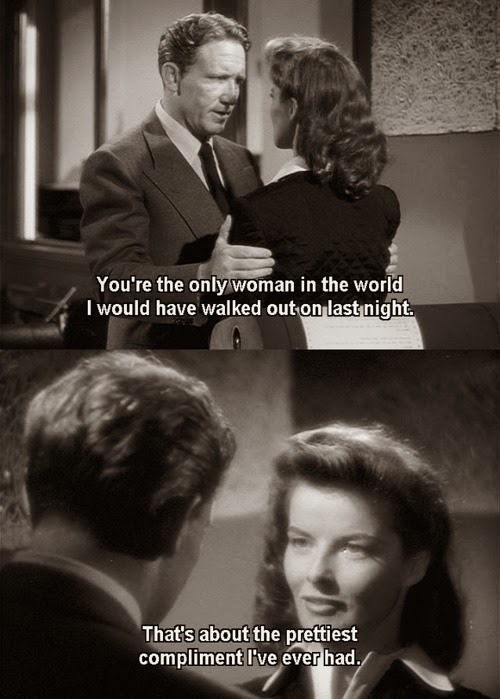
Nowhere better was the perfect exchange of Kate’s other gender and elevated romantic expectation met and fulfilled than with Spencer Tracy. Their first coming together (pun may or may not be intended) was beyond perfection. The story behind their offscreen romance has become mythical of course. It was a legendary companionship and extra-marital affair that lasted from their teaming on Woman of the Year until their respective deaths. (Kate naturally outlived Spence, as was her way). Their rapport onscreen is beyond skepticism or gossip. We have the evidence of this consensual beauty. Perfect opposites who complimented and exaggerated the better, worse, and lesser indulged qualities of each other, their onscreen companionship-- at its best-- was poetry.

Examining the films of Woman of the Year, Adam’s Rib, and Guess Who’s Coming to Dinner as a trilogy of their best works-- the young couple, the married couple, the aged couple-- you witness the endurance of their chemistry: the way they move around and adapt to each other, compliment each other, battle each other, and mostly just love each other. In their pairing on the screen, there is never any question of that love, and there is neither any question that in her roles Kate was never more sincerely romantic as an actress than in her films with Spence. It is the only time you truly see her vulnerable.

A date so good, they didn't want to let go...
This is interesting, because in a way, Tracy and his intense, every man masculinity,was perhaps the first beast that Kate’s film females were truly impressed by or in awe of. In their films, she moves away from her feigned girlishness and coquettishness and spars with her partner in a continuing trade of domination/submission. Their early scenes in Woman of the Year-- their first real date at the bar when they get drunk together, that first cab ride home-- feels like an intrusion into very private and honest moments. With her eyes and manner, Kate’s entire being seems to curl up like a cat in Spence’s lap, where he lovingly and tenderly offers safety for the expression of her total inamoration of him. 

Most importantly, it is a fair trade. Tracy is just as enticed by Kate’s strong-headedness and ambition as a worldly working woman, someone form whom he can learn something and experience more of life, as he is thrilled at seeing the revelation of her secret charms and hidden sincerities. His duality as Kate’s fellow asexual counterpart is his ability to take on, in the film, equally more feminine manifestations. While her gaze is fixed, he often casts his own downward, bashfully-- searching clumsily for words on the table, for example. When he first asks her out, she challengingly meets him head on, forcing him to walk backward at her show of intimidation (and up the stairs at that. Oh, George Stevens... I heart you). It’s a cat and mouse game with her showing precisely what she’s made of to ascertain if Tracy is willing to put on his gloves and face her, again, like a man. She is also ultimately more successful than he in the film-- she has a higher education, higher breeding, she comes from money and makes plenty of her own, speaks several languages, etc. He, comically, goes to her business gatherings and stands aside like her socially incompatible wife and arm trophy. When she adopts a son, it is he who takes care of him. It is also he who has the heart in the relationship. He’s the woman trying to break through to the unattainable fortress of emotion in Kate’s masculine facade. 

Rebuffed.
Perhaps even more telling is the fact that Kate is ready to pounce on her prey, as ever, on the first date, but it is Tracy who makes his innocent exit. He doesn’t want to lose a future with this woman by indulging in the heated superficialities of immediate sex. Kate wants his “cookie;” he won’t give it to her. He plays his cards in order to win a wife and not a temporary lover, just as women are perpetually coached to guard their carnal treasures: “Men of the world only want one thing,” “When they get what they want, they never want it again,” etc. Spence's card up his sleeve is-- to borrow the philosophy of modern comedian Steve Harvey-- that he already “thinks like a man,” because he is one. So, he doesn’t fall into Kate’s more typically male sexual traps.

In the end, Kate has to surrender her position as the sole pillar of strength and her independent, career-focused lifestyle to accomodate her role shared position in their marriage. She is, by title, his wife. She must, therefore, embrace her femininity. Naturally, this makes the modern feminist cringe a bit-- a woman’s salvation was always in an apron in the studio era. The ending would be more insulting, however, were it not for the equal balance of Kate and Spence's sexual-chameleon qualities. In the beginning, Tracy was willing to play the wife as much as the husband; Kate was never willing to do the same. It is therefore only fair that she must surrender some of her authority to embrace and offer him equal tenderness. She must give as well as get. While one can’t help but feel that she will never, ever be comfortable in the kitchen-- not after the breakfast scene that destroys any illusion of her culinary abilities-- one feels that she will at least be consistently willing to bend a little, and in turn, to compromise and fuse her androgyny with Tracy’s own.

Spence and Kate, post-slap.
In fact, Kate seems happy to do it. While she certainly has the carriage of a woman who bows to no man, you also get a sense from this pair’s playfulness and flirting that she wouldn’t mind letting her guard down and getting a spanking or two from the only man in history who could knock her off her guard. Fittingly, Tracy does slap her right on the tush in Adam’s Rib, which instigates a brilliant quarrel on the rules of consensual S&M, gender roles, etc, etc, etc. Had the slap been a sexual slap, it would have been one thing. However, in this scene, the two dueling lawyers are genuinely debating each other, and the resentment and use of masculine power attached to Tracy’s slap goes from being an acceptable form of foreplay to an assertive sublimation of Kate into the role of the weaker sex. She rebels against it. Thus, the matter of contention in the whole film: the compromise between the sexes and the establishment of peace in between.

At ease.
This is an extension of Woman of the Year. The married couple battles in the bedroom and the courtroom for the determination of just exactly who the "man of the house" is. The end is a justified compromise: Kate wears the pants in court; Tracy at home. Their roles become switched a bit in Guess Who’s Coming to Dinner, with Spence playing the fixed stick in the mud, and Kate the more emotional and amenable matriarch-- the curmudgeon vs. mother earth. Their mental ping-ponging remains in tact. Of course, this exchange exists in all of their films, perhaps best witnessed in Pat and Mike, wherein Kate is the athlete who is accepted for the collision of her masculine-feminine nature by Tracy, who specifically fosters her androgyny as her trainer. As ever, he wants the best of both worlds in one woman. In Desk Set, they are again competing professionals-- Kate leading with her limitless intelligence and encyclopediac mind and Tracy with his technical expertise, neither being able to outdo the other. The formula works less when their delicate balance-- a wider establishment of Kate's own-- is found not in the middle but on opposite ends, with Kate taking on the token suffering wife roles in Sea of Grass or Keeper of the Flame. These example, as it turns out, were playing totally against type for her if not totally for him. When their playfullness is lost and thus their almost psychic understanding, so too goes the emotional connection the audience has with them, but mostly with Kate. We want to see her wearing both the pants and the skirt in her usual 50/50 ratio. 

What we can gather from this (very longwinded) description of Kate’s fluid indulgence in her own identity and her total lack of allegiance to stereotype is that this was in large part the quality that made her work so resonant. One never witnessed Kate as a cliche. She eschewed the word. When one can be impersonated, one has reached true distinction. When someone puts on a Katharine of Arrogance accent, everyone (with some level of film knowledge) knows who is being lampooned. This is both the reason for her success and the reason why it is so impressive. The fact that she wasn’t a “type” should have made her un-castable. Hollywood doesn’t like to think or create. It likes Model-T stars and stories. Yet, Kate’s desexualized personage and un-homogenized acting style,made her range run the gamut from A to Z to the far stretches of the universe. (Yup, you were wrong about that one Dorothy Parker).

Kate transcended material, general audience expectation, and direction, meaning that she spread herself in every possible way across the mortal landscape when it came to her interpretations regarding the human heart, human ugliness, and humanity period. She was both old and young, comedic and tragic, flawed yet beautiful, and-- yes-- man and woman. She was, in her art, the upright and the upside down triangle, the token symbols of the masculine and feminine, creating an interesting specimen of the eternal figure eight-- infinite possibilities. No beginning, no end, just an experience.


The epitome of the androgynous allure. She is
indefinable and everything.
Katharine Hepburn's films last because she made them real by offering all facets of herself without shame. She was whatever she wanted to be, and all of that offered with the one-hundred percent generosity of her spirit. 

She was a great guy. And one Hell of a lady.

Friday, January 10, 2014

HISTORY LESSON: Man Enough? Part 3 - Method to Modern Times

Continued from Part One - The Silents and Part Two - The Studio Era: 


The Wild One was not a fantastic film all considered, but it remains interesting
for its incite into the angst of the youth culture in the 1950s. Brando's line in this
scene summed it all up. As he beats on the juke box, with a contemptuous
eye fixed on his surroundings, he's asked, "Hey, Johnny... What are you
rebelling against?" He replies: "Whaddya got?" Gold.
Guttural actors of passion, guts, and loins have been acting their hearts out in cinema since from its very advent. However, something different started happening as the 1940s transitioned to the 1950s. With World War II over, another battle was inevitable. Mercifully and mercilessly, this one would be “Cold.” Broken by the horrifying glimpse into man’s darkest chasms—the Holocaust, the Devil and/is Adolf Hitler, the American boys coming home in coffins—the United States lost its trust, and the word “united” stopped being aptly descriptive of the nation. The country would be divided, not between North and South, Republican from Democrat, or Caucasian from all others, but instead everyone from everything. This new paranoia naturally led to the red scare—the obsession regarding an impending war that was only theoretical. We sought to identify villains, weed them out, and destroy them before they could strike. Less focus was given to the “Commie Bastards” building missiles on the other side of the globe than to the silent threat hiding among us: the radicals, the divergents, and those threatening the sanctity of our fictional impenetrability. A skeptical eye was turned on every neighbor, and the witch hunts began.
The movies followed, both before and behind the scenes. As the Hollywood Ten were called before the bench of public opinion and hypocrisy, celebrities of the past were forced to confront the HUAC tribunal—The Father (Joseph McCarthy), The Son (Paranoia), and the Scapegoat. Those too proud to beg (Dalton Trumbo, Lester Cole) or those too petrified to argue (Elia Kazan, Robert Taylor), became the sacrificial lambs in the nation’s shamefully unfolding history. Most kept their heads down and stayed "polite" and non-political (Gary Cooper), some were scolded for their resistance and then silenced (Humphrey Bogart), but others flew into a rage of protest (John Huston, Gene Kelly), the same vigor within them that had drawn them to art hastening them to protect humanity. This created conflict on the screen; film noir grew even darker and the heightened paranoia punched up storylines. In the meantime, while Hollywood would continue to produce films starring the greats of the past, these men were aging. Audiences held onto them as necessities, guys indivisible from the very name America, but our hold on them was loosening. 


John Garfield, the wronged man in They
Made Me a Criminal.
New actors with fresh perspectives started to emerge. These guys came with a contrasting conscience to their macho forbears. John Garfield is often credited with paving the way for the method actors to come, his art being his lack of art. He was not a superhero, a cowboy, a villain, or a martyr. He was just a man, and he presented himself as such. He mumbled with streetwise, apathetic articulation, and his movements were natural and un-mannered. His prototype of masculine authenticity became a game-changer: each man is his own sinner and saint. Your worst enemy is not he at whom you point your judgmental finger, but the voice you hear in your head-- the one you are often too weak to combat. So, Garfield fell prey to both greed and his desire for Lana Turner in The Postman Always Rings Twice, played the underdog as the desperate boxer turned puppet in Body and Soul, and represented the wronged minority as the Jewish Dave Goldman in Gentleman’s Agreement.
Kirk Douglas as the unconscionable reporter in Billy Wilder's 
Ace in the Hole, one of his many shades of gray
morality pieces.
Film had always asked moral questions, but it had never penetrated the gauze of hypocrisy that simplified black and white philosophy to ask truly social questions. The distinction was no longer that of "Is this right or is this wrong," but "What does this say about us? What if there is no hero? What if there is no solution?" Hollywood doesn’t like open endings, sad endings, nor any package that is not cleanly wrapped. So, while the monarchs of the past—Gable, Wayne, Cooper—carried the torch of vintage Americana, actors like Garfield, Burt Lancaster, and Kirk Douglas acted as progressive, envelope-pushing phenoms of male complexity and rebellion, slowly paving the way for those others reacting to a changing world. Confinement is not acceptable to the male animal, and while some stayed behind, others would mature with their world, working to untie the knots that they had seen formed even in their own lifetime. Yet, the tug-of-war between the past (a lost era that can never be revisited) and the future (a horrifying but necessary prospect) would begin and end in one word: “Stella!”
Brando's Stanley Kowalski in A Streetcar Named
Desire
. His macrocosm of machismo would
knock the socks off Hollywood.
Marlon Brando killed Tinsel Town. After he ripped off her crown, it was no longer possible for the public to ignore her lies. Every new generation of man has a need to discover the world for himself, and such evolution necessitates demolishing the old images we had once so relied upon. The New Kids, those of the Stanislavsky or the Strasberg or whatever school, lashed out at their parents as all children do. They translated the world as they saw it, maturing into ungovernable, multifaceted anti-heroes performing only accidental heroics. Brando’s appearance as the cave man of humanity’s past in A Streetcar Named Desire unleashed a horridly brutal portrait of those theories of manhood that we had once held sacrosanct. He was a man unmannerly, primitively sexual, alcoholic, abusive, and even sadistic, all of these qualities simultaneously enclosing a scared boy desperately clinging to/rejecting his mother’s breast-- exemplified in the mother of his own child, Stella (Kim Stanley). He desires and is addicted to her earthy appeal, even supplicating himself before it, while shunning the pretense of the past, mercilessly raping false Hollywood’s personification in Blanche Dubois (Vivien Leigh). He makes her antiquity a joke. It was a savage way to bring us into a new era, but it worked.
Working alongside him were Montgomery Clift, Eli Wallach, Paul Newman, Steve McQueen, Ben Gazzara, James Dean, and Dennis Hopper. These artists in the early method days were like a jolt of adrenaline in the arm of America. While Hollywood tried to package them, they rebuffed the shackles of the star system by doing something different with their performances. They weren't playing to their audiences; they were playing their audiences. Neither enunciation nor dialogue were as important as internal and thus physical authenticity. Brando mumbled and tossed lines away. Clift spoke with his eyes and his body. Dean went to another planet, playing hide and seek with the camera, giving it the proverbial finger while making his audiences search for him and the truth. Newman defied his good looks by wearing a chip on his shoulder and letting his guts hang inside out-- the only man in known history to eat "fifty eggs" to prove a point. Actors suddenly weren't actors, they were people. In a return to the "every man" appeal of the silent days, stars were replaced with standard, every day guys, albeit with a little artistic elevation. 

Monty Clift, post-crash.
With an enthusiasm for the art that eclipsed the drive for celebrity, these actors seemed to resent themselves. Most openly admitted to an embarrassment over their chosen profession. A real man would be the men they pretended to be instead of being imitations. Their ego was hurt by society's definition of them as "pansies." Perhaps their reaction to this was a result of the fact that they were being more emotionally open than actors of the past. Yet, in their unapologetic tears and vulnerability, there was an aggression, a naked abandon, a sense of dissatisfaction and fear, which often revealed itself in moments of poetry. They were flawed men, and as such, they were relatable men. But, they were still men for other men to look up to. They took movie star status and brought it back down to earth. The polish was gone; the anger was still there. Clift perhaps embodied this best, as his great beauty and "movie star looks" were corrupted by his fatal crash. His life as his art, most specifically in A Place in the Sun, thus visually revealed what many instinctively felt-- that the American Dream was broken, and they were left the sons of its still perjuring manipulations. 


McQueen on the move in Bullitt.
Men were not portrayed as valiant fighters of the Flynn or Wayne variety. They were only accidental heroes. Brando's conflicted and bitter character in On the Waterfront had no desire for social glory. His own feelings of social rejection-- the boxer who didn't make it-- have made him disinterested in its salvation, until he finally stands up to the "the Man," Lee J. Cobb, to reclaim his integrity-- the only real thing a man has to hold onto. In keeping, Dean's Jett Rink in Giant starts out a buffoon chasing "the dream" and ends a ruined, despicable tycoon. An audience that understood his desperate rise and fall never withdrew its sympathy. McQueen did everything fast and hard, barely stopping for breath, sleeping his way through every beautiful woman's bed in every movie, rejecting his responsibility to them all in the desperate attempt to make The Great Escape from America's uncertain cobweb. No matter the struggle or his characters' flaws, the existential discontentment that followed him from film to film always made him a victim of circumstance. As in Papillon, he never stops trying to break from imprisonment. 

People needed this carnality. Men particularly were desperate to make such carnal howls. As young men were called to serve in the Vietnam War, their drafts arriving like preordered toe tags, there was plenty to scream about. As women grew more independent and feminism started taking a more assertive stand, the male position in the generally accepted patriarchy started to crumble. As society endured race riots, police brutality, the push toward desegregation, the arrival of the hippie, the metamorphosis of sock-hop rock 'n' roll to the Kinks early premonitions of Heavy Metal, the world seemed to be moving faster than it had since the 1920s without the nonchalance. Men onscreen began to inhabit all facets of the male human conundrum. His desire for love, and his desire to dominate; his quest for order and peace of mind, and his desire to escape the roots of his father. His brute force was supercharged but tempered with an increasing attraction to knowledge. A child of communal hysteria, he questioned the world around him. He defied it, and fell prey to it. The jig was up, and a new game was set: there is no peace on earth. Life is War is Hell, From Here to Eternity.
While Poitier's character in The Defiant Ones
still had to inevitably take a fall for "the
white man,"
Curtis, he also presented a
man morally superior and more
sympathetic than his partner
in crime.
Along with the surprising sensitivity these guys allowed to manifest in their performances-- Clift's jaw dropping and soulful performance in Lonelyhearts, Wallach's vengeful complexity in Baby Doll-- bigger issues were taking place than man's internal conflict. The camera turned outward as the actors turned inward. The world became the stage and its changing geography was mirrored on the screen. There suddenly emerged the minority voice in the person of Sidney Poitier. With the black man’s definition of masculinity on film as yet undefined-- previously only viewed as the segregated, submissive dog to the true, Caucasian male authority figure-- his windy path to absolution on film was yet to come. Sidney’s intelligence, poise, and natural command made him a worthy and acceptable vessel for all audience members to follow, and this initiated their Voyage Out of the deep dark forest of bigotry.  His instant charisma made him likable; the fact that he had the air of a gentleman and spoke in sophisticated "white man's speak" made him nonthreatening. His work-- The Defiant Ones, Porgy and Bess, Raisin in the Sun, Lilies of the Field, Patch of Blue, In the Heat of the Night-- presented him not as a cliche but as a man. While his skin color played a significant part in each role, it was not viewed as an unfortunate handicap that was to be pitied nor one that deserved condescension. He was an American trying to "make it" like any other citizen-- his biology so inconsequential that it made those who tried to use it against him the sorriest of villains. 

Spencer Tracy defends Darwin in
Inherit the Wind.
As this progress was made, the old school veterans tried to keep up.
Spencer Tracy, always an actor with conscience-- a quality that haunted him in his private life-- approached groundbreaking material with his token respectful humility and uncanny intuition into the altercation of man's eternal maturation. In his films, he not only kept up with but outdid the rebel boys riding his coattails in Judgment at Nuremberg, Inherit the Wind, and Guess Who's Coming to Dinner, the first of which he acted opposite Clift, the last Poitier. Meanwhile, John Wayne entered darker territory, and as his conservative politics found resistance with the changing world, his characterizations became even more multifaceted than before. He went from tough on the outside, to tough through and through. His work in True Grit and The Shootist did two things. One was to reveal his depths as an actor, which echoed the secret personal frustrations and bitterness as insecurity followed him into old age. The second was to reveal the lingering public need for icons-- the ones who had never let the world down during their Hollywood reign. Society sought that certainty, particularly the older generations, as the world around them became a thing they didn't recognize. Never was there such a clean split between age and beauty on the screen.  

Peck and Mitchum represent exaggerations of
two versions of the battling American male:
the Apple Pie man of morality vs. the
inner, untamed beast. 
As such,
Clark Gable continued drawing fans to theaters to see his work in Mogambo and his wizened, vulnerable, and raw performance in The Misfits. Gary Cooper brought his usual understated pathos to High Noon, then shied away from provocative material to uphold his Mr. Deeds image. Mitchum always worked-- when he wasn't fishing, that is-- all the way into the '90s, performing in everything from The Night of the Hunter (1955) to Dead Man (1995). Gregory Peck held the badge of the eternal man of conscience, representing the soul of what America at least stood for-- or hoped to-- as Atticus Finch of To Kill a Mockingbird, and wrote his own cinematic doctrine by performing in topical or controversial pieces like On the Beach and The Boys from Brazil. He then proved his merit by pulling off a transition to horror in The Omen-- only a solid man of common sense as trusted as he could pull off the conflict of a reasonable man who comes to fear God through the acceptance of the Devil.
As these heroes died, retired, or were forgotten, the turmoil didn't cease. Men were left without giants and forced to reckon with themselves as cinema delved even deeper into the disturbances of the human psyche, his condition, and the complications of the world around him. The Kent State shootings, Patty Hearst and the SLA, Watergate, the Munich Massacre, Korea, Ted Bundy, the death of Morrison, the death of Hendrix, the death of Joplin, the death of Elvis... All these monumental crises chewed up the "glory, Hallelujah" of life and left man to reinterpret it's National Anthem as one big con. 


The Godfather opens with Vito Corleone almost immediately asking
for his son Michael. "Where's Michael?" He doesn't even share words 
with his son at his his daughter's wedding. Mistrustful of his eldest son 
Sonny,  he seeks the true family anchor to carry on his heavy burdens. 
These actors do not  have a genuine scene together until Pacino comes 
to Brando in the hospital and names him as his father,  stating, 
"I'm with you now."  Inheritance accepted. POETRY.
With the now absolutely dominant presence of television and the quickening informational capacity of the media, America was shrouded in mistrust and was Hell-bent on dismantling any still perpetuated delusions of grandeur. We are men; we are monsters. The method trend continued in two strains-- still real guys-- as activists or anarchists. Thus we witnessed the emergence of Dustin Hoffman's feminism in Tootsie and Kramer vs. Kramer and Robert De Niro's anti-christ in Taxi Driver and Raging Bull. Heroes were villains as they hadn't been since the '30s, and all were political. Who better to usher in these angst-ridden young men, seeking in vain to establish their misshapen identity than the Don himself-- he who had paved their way? Brando passed the torch to Al Pacino in The Godfather, and what followed on film was a new breed of man, violently tearing himself and his society down so he can build himself, and it, up again.

This anger began to dissipate in the hands of
Ronald Reagan's 1980s optimism. America, in between battles for a time,  was determined to enjoy the economic boom and continue the progress of the '60s and '70s by turning itself into a big enough threat to keep all further mutinies, attacks, and depressions at bay. From the spring-board of the Jewish and Italian actors who populated the masculine screen in the last decade, Captain America was due to return-- our arrogance transforming itself into the muscular, one man heroes that only needed a gun to save the world (a trend started by Charles Bronson in Death Wish, and Clint Eastwood in Dirty Harry, the bridge films to a new era). 


Arnold goes Commando; America is secure.
Regular guys with chips on their shoulders disappeared behind muscular Gods from Mt. Olympus. Stallone: the broken, underdog poet on a mission. Willis: the clown having "a very bad day." Gibson: the loose cannon, crazy enough to do anything. Cruise: the miniature but cocky pretty-boy whose belief in his own invincibility worked better than any firearm. And Schwarzenegger... Where did this human treasure come from? His Austrian accent only enhanced his status as a mythological creature: Conan the American. His unprecedented reign in everything from action to science fiction to comedy made him an unparalleled force in the industry. People loved him. Utterly. His gravity as a performer was never exactly earth-shattering, but his unabashed commitment to whatever battle he was fighting was. Say what you will about the guy-- he always went for it. America was safe under Arnold's watch. He had our back, and we knew we could trust him every time he uttered those eternal words, "I'll be back," and he always did come back again... Up until the new millennium we he found politics and we found iPhones.

Our heroes aged, only reappearing to mock their image or play on their past mammoth status-- mostly thanks to Stallone's still active imagination and business savvy, as evidenced in The Expendables. At the same time, the world was intruded by the world wide web. As the increasing technological forces at our fingertips became our new heroes, our fascination with human representatives diminished. Our art, our introspection, slowly lost its way while we personally downsized to smaller screens in separate universes, wherein we became our own idols. (For more on that subject, visit my past article YouTube Killed the Movie Star). 


Now we find ourselves in search of "men." As a reflection of society at large, where gender equality between men and women has become (arguably) more balanced, more negative/competitive attention is given to the "other-genders": the homosexuals, the transvestites, the transsexuals, and even living dolls. The emergence of these different strains of manhood and the slow acceptance of them has split the previously more "predictable sex" completely asunder. A Man is a Man isn't a Man anymore. Men are expected to be more emotionally mature, to be more participatory and open in relationships, and to make room for women, who have invaded and irreparably altered the work place, changing all pre-programmed existential strategy. Wife, baby, house: they no longer apply. Your girlfriend is working, she's not ready to have kids, and who the Hell can afford a house in this economy?!?!

This economic slight is perhaps the worst. The depression has made our men depressed. The inability of a man to be a provider is the greatest wound to his ego. A provider is the one thing that he historically must be and which has been consistently represented throughout his path on film. A man must earn-- legally or illegally. Now, men are either out of work or working at jobs that torture them at breakneck speeds for far too little compensation. This, in conjunction with media saturation and our current obsession with surface over substance, pressures him to be a body-conscious metro-sexual with a sweet car, (that he can't afford). 


Man is showcased as presentation-- hiding behind cool specs and wearing skinny jeans, because he doesn't know what else to do. At least, that is the way he is portrayed in advertisements or by the baby-faced, interchangeable pseudo-stars of today. "Men" are Zac Efron, Channing Tatum, singer turned "actor" Justin Timberlake, or that other guy from the inexplicable tragedy of Magic Mike... hold on, I have to look up his name... Alex Pettyfer? Whatever. He's so boring that I would rather watch two retarded hippos have sex than see anything he's in. Pretty, pretty presentations... Some of them try so hard to act, to come across with actual guts, but most of them are just nice guys who are nice looking and that's it. When they imitate the strong men they grew up with, it comes across as insincere and a little pathetic. We're far too cynical to take any of them seriously. As such, they have replaced 1940s wartime pin-ups to become our modern bimbos, a total sexism boomerang effect.

Instinctively, contemporary men reject their actors as physical embodiments of their threatened emasculation, and are consequently left without what they deem to be true representatives, which is why they reject the options placed before them. There are some standouts. 
Ryan Gosling gets away with what he does due to his taste for intriguing material and his tendency to keep quiet and underplay. (Is it minimalism, or is it just not acting? At least he keeps things interesting). Ryan Reynolds and Bradley Cooper have genuine chops, but they aren't taken seriously enough to be idols. DiCaprio keeps killing it due to his genuine talent and eagerness to take risks. Still, while men respect him, no one man-crushes on him like they once did Cruise. Mark Wahlberg will always be Marky Mark, with or without his funky bunch. Even Brad Pitt's Fight Club sheen has tarnished behind the public campaign he always seems to be waging to be "Look, I'm the Nicest Guy EVER!"


No.
The amped up versions of masculinity presented in the sorry excuses for action films over the last decade-- which are so nondescript and cliched that I can't really think of one right now-- aren't authentic. We rely on Willis to reappear with Die Hard sequels, or Stallone to pull another Rambo or Rocky out of his back pocket. Yet, today's men aren't bodybuilders, because they are expected to be lean-- and not fighting machines, but sex objects. They also can't relate to Dwayne "the Rock" Johnson or Vin Diesel because they are beefy doofuses. In truth, audiences can only tolerate an action hero when he's a superhero, because these are mutants and real men don't feel that they are capable of superhero-dom right now-- not after what happened to us on 9/11. Real guys walking through fire or being shot to Hell and surviving don't make sense after witnessing bodies dropping from the Twin Towers and subsequently watching the economy bleed. Such fictions insult our intelligence. As such, when good looking guys with empty heads put on the cape (Superman Returns, 2006) we don't care. When an actor with actual ability does and the material is darker, we are more apt to get on board (Man of Steel, 2013). 

In contrast to Bruce Wayne, the Joker dives into
the chaos, as this is what has made him what
he is. His indulgence in it is his antipathy for it,
a fact many could certainly relate to.
In truth, the superhero marathon we're still lazily championing has another effect. Thanks mostly to
Christopher Nolan's work in the latest Batman franchise, the fantasy world of these masked crusaders has become more interesting. Christian Bale's Bruce Wayne is kind of an asshole in reality. He's self-obsessed. He loses the girl. His life is a self-inflicted curse... He has money, but what good does it do him? He consistently has to get out there and fight to defend his honor and save Gotham City, just as men put on their suits or khakis everyday and get out there and try to make a living and save the country from itself. Life sucks. Perhaps that is why people responded to Heath Ledger's joker with such passion... Being a hero isn't glamorous. It stinks. Robert Downey Jr's Iron Man could die at any moment, because of his defunct heart. The Hulk is the biggest loser ever and a bona fide freak. Thor lives on a boring planet that I wouldn't visit on my worst day. 

What is interesting about these films, aside from Captain America-- which didn't catch on because of the pretty boy problem-- is that the commendable acting when mixed with the machismo is what made all of its stars acceptable. Bale was an actor's actor before. People knew him as the guy from American Psycho. He puts on a cape, and suddenly he's the man. Downey became the comeback kid when he got clean and became Iron Man, going from public enemy number one to everyone's favorite movie star. If it weren't for Thor, there would be no Chris Hemsworth. He would have been one of the vanilla, interchangeable, revolving-door-duds on the cover of whatever constitutes today's internet "Tiger Beat." Similarly, everyone thought Matt Damon was a "pussy" until he became Jason Bourne. Men need the personifications of their complexities with a little flexing of muscle. They may not be he-men, but they're still men after all. Whatever "men" means these days...

Zach Galifianakis: modern hero lampooning
the superficiality of an industry that normally
wouldn't have him. Thank God for tough
times...
In truth, the biggest and most celebrated stars of today are the comedians-- coming full circle back to the silent comic days. Their modus operandi is different-- more vulgar and uncouth-- but losers who make us laugh are definitely on top in the industry game. Their masculine ineptitude gives men a cathartic sigh of relief from the pressures of contemporary narcissism and equally gives them permission to be a little screwed up right now. It's nice for them to see dudes just being "dudes." 
The appeal of the "Frat Pack" of Ben Stiller, Vince Vaughn, and the Wilson brothers may have died down, but one of the most iconic, oft-quoted, and beloved characters of the current generation is Will Ferrell's Anchorman, Ron Burgandy. Zac Galifianakis is cleaning up with his pot-bellied, pot-smoking, supporting characters-- who coincidentally look like they rarely bathe and sound like they didn't pass the second grade. The new bro-from-another-ho-team of Seth Rogan, Jonah Hill, Danny McBride, and James Franco scored box office gold last year with This is the End. 

This does feel like the end, doesn't it? Everyone feels totally screwed, and seeing actors playing losers, degenerates, selfish bastards, and social retards reflects the feelings of total disorder that mankind experiences on a daily basis. Every day is like The Hangover. "What happened last night? What happened yesterday morning? The day before? What's happening now?! Where did my life go?!?!" The picket fence, the pie in the sky, the childhood home you grew up in, are all relics of a nonexistent society. The most we can do... is laugh. 

With the return of our modernized Tramps to the forefront, the masculine onscreen presence is as cryptic as it has ever been. The absence of movie stars with the instant accessibility of Netflix streaming has also done some damage, as there is no hugely adored prototype of Americana to latch onto and label as the new "He." We have gifted actors like
Daniel Day-Lewis and Joaquin Phoenix who do compelling work every once in awhile; we have Hugh Jackman trying to be Wolverine and Russell Crowe trying to hang tough, but neither pull it off, because we heard them both sing. And "sing."


Jon Hamm has won an equally adoring male and female audience through his
performance as the mysterious and conflicted Don Draper on the "Mad
 Men" 
television series-- TV being much more influential than cinema these days. 
Of course, his character exists in another time, which brings the fascination 
into question. What does the "business man" really look like today? 
Are our working men no better than those portrayed in 
The Wolf of Wall Street?

As man searches for his masculinity in modernity, trying to find that balance between personal, emotional security, intellectual stimulation, and faith in his government, we may be at a point where we have outgrown such distinctive representations of Manliness. We live in a world of big box-office flops and unique, unpopular independent films, which present many interesting stories about the struggle to just hang on. With so many voices trying to be heard, there may be no need for fictional, pinnacle male models to do the heavy lifting for their living brothers. As our world opens up, it too disconnects us. We are all introverts living on Instagram. Our films, therefore, present a myriad of faces and slices of life: individuals not communities. It's a strange sort of limbo. Where it will lead artistically, I don't know. But wherever humanity goes, the cinematic male archetype is certain to follow.