FYI

Don't forget to refer to my Contents page for a more convenient reference to past articles.

For More L.A. La Land, visit my writing/art/film appreciation site on Facebook at Quoth the Maven and follow me on Twitter @ Blahlaland. :)

Thursday, October 20, 2011

HISTORY LESSON: Hollywood Suicide


A title card from The Flapper, which ironically appears after Olive Thomas's character decides 
not to kill herself. This single slide could serve as the explanation many have
 as to why Olive's death was not a suicide but an accident-- 
she loved life too much to let go... Or did she?


As Halloween creeps closer, I thought it relevant to dip into the more macabre side of Hollywood. Since All Hallows Eve is embraced as a public indulgence in the sometimes very thin line between life and death, it seems a perfect holiday for La La Land. Hollywood itself, sometimes appearing as a glorious Heaven and others as a torturous Hell, has birthed multiple superstars but has too killed its own children. The most depressing and pitiable of these fallen angels are those who choose to take their own lives. In all cases, the deaths are shocking, unexpected, and heartbreaking, but there are a few that are so unbelievable that, even when given direct reason or motive, one cannot wrap his or her mind around the tragedy; at least I can't. Olive Thomas remains the first official poster girl for the inexplicable, self-inflicted death, which to this day remains debatable. One can continue to turn over the evidence, but the varying testimonies of husband Jack Pickford, the memories of friends, and the final conclusions of medical professionals all produce contradictory evidence. Whether suicide or accident, the outcome is still devastating and Olive still a victim. Journeying down this same vein of the unfathomable and unreasonable disappearance of some of our brightest stars, I've compiled the following collection of some of the most bizarre and yet little discussed suicides in Hollywood History. Years after their shattered ends, one can still cry "Why, oh, why?" to the Hollywood Hills and receive no answer but a pained echo for the lost souls, volleying without end.


LUPE VELEZ:


Lupe was branded the "Mexican Spitfire" due to her feisty, sensual, uncontainable spirit and her obvious heritage. Born in San Luis Potosi, she-- like Dolores Del Rio and Anna May Wong-- paved the way in the industry for "ethnic" girls, bringing her beauty, fire, and passion to the screen with full force. After a stint in vaudeville, Lupe landed in Hollywood where she made unprecedented, scene-stealing appearances in films opposite Douglas Fairbanks (The Gaucho) and Lon Chaney (Where East is East). The girl didn't just have "something," she had something indescribable. Who else in the history of cinema has outshone the Man of a Thousand Faces? Intensely sexual with a temper to match, she had a notorious romance with Gary Cooper-- whose placid demeanor was probably the only one who could withstand her raging bouts of anger-- and a failed marriage to an equal wild man, Johnny Weissmuller. Her career thrived through the silent era, where she gained a reputation as a comedienne with punch and panache, but the coming of talkies allegedly inhibited her career due to her obvious accent-- taking her out of the running of more acceptable, all-American leading ladies-- and later accusations of communist support dampened her public appeal. In her thirties, she did Broadway, returned to her native Mexico-- where she was very popular-- and landed back in Hollywood where she fell into the arms of actor Harald Maresch. Then, on Dec. 13, 1944, Lupe was gone, having taken her own life with the aid of Seconal. She was but 36-years-old. The reason for her shocking end was given by herself in a suicide note: "To Harald, may God forgive you and forgive me too but I prefer to take my life away and our baby's before I bring him with shame, or killing him, Lupe." The reason, therefore, for her desperate final act, was personal shame over the fact that Harald had gotten her pregnant and refused to marry her, but even in this there is controversy. 


Lupe may have gone to convent school as a child, but she was far from conventional. A vibrant, caution-be-damned kind of girl, it is doubtful that she killed herself to protect her own reputation and save her child from a life of ridicule.  The Lupe the world knew and loved would have most certainly socked anyone in the nose who so much as looked at her child the wrong way. There must be more to the story, and in the end it seems more likely that it was Lupe's own impulsive, defiant behavior that killed her. Perhaps after a lifetime of broken hearts, a lover's refusal of marriage became the last straw. One could argue that she killed herself more to hurt Harald for his betrayal or to simply give one last eff-you to the world that she had considered so cruel. Adela Rogers St. Johns would state that Harald had every intention of marrying Lupe, but simply refused to lie about the date of the nuptials in order to make their child the product of marriage and not conversely marriage the product of the child. If this is true, it makes the suicide even more head-scratching. More puzzling is the speculation that Harald was totally innocent in the debacle and that the child was that of Gary Cooper, with whom Lupe had maintained an on-again off-again affair. The most commonly accepted theory is that Lupe was not a well woman. Her vacillations in temperament indicate that she would have been diagnosed with bi-polar disorder had such a disease been recognized in her day. Friends too reported that, despite her bravado, in which she attacked life with chin out and up, Lupe had great pain and melancholy. On rare occasions, she would open up about her life's disappointments and what she felt was the absence of real love. Her death scene is too debatable because of the way it has been painted. Some state that she was found lying in a bed of white satin, completely composed and beautiful, the way she herself had dramatically staged it. Others attest that she had a violent reaction to the Seconal and died with her head in the toilet, drowning to death. Both are debatable: suicide is never a glossy affair, but one doubts that anyone could "drown" in a toilet, given that the weight of the human body would, if unconscious, naturally slump to the floor. The only hard core truth we can rely on is that Lupe left us all too soon, and whatever reason she had for taking her own life was not reason enough.


GEORGE SANDERS:


Talk about unexpected... The Sultan of Snark and fastest s-wordsman of witty barbs taking his own life? No. Not possible. George Sanders, on screen and off, seemed to be the smartest of them all and ten steps ahead of everyone else. Sitting comfortably on a pedestal of intellect, he looked down his nose at a world of neandrethals and gloated at his own superiority. We counted on his smirking charm to add layers of humor and biting edge to films like The Picture of Dorian Gray and All About Eve, and with every opportunity to impress us with his entrancing voice-- one put to use as Shere Khan in The Jungle Book-- he succeeded. But this Englishman too must have been hiding a secret behind his superior jabs and polished deviance, for his life ended in April of 1972 by his own hand. Even more startling is the fact that he was well into his sixties when he committed this personal atrocity. One thinks of suicide as being the haven for discontented and bruised youths who have given up hope; apparently we never mature past our own insecurities and need for escape. After four marriages, one of which was to Zsa Zsa Gabor, George dwindled into ill health. The aid of alcohol certainly didn't help things, and in his later years he had become mentally unstable, experiencing moments of complete delirium, which resulted in angry outbursts. Losing his mental faculties-- the man whose shrewd mind was his key asset-- was something he could not bear. When he was unable to play his piano, he solved the problem by chopping it to bits. He wandered aimlessly, landing in Barcelona, where he finally said farewell as only he would, with annoyance and condescension: "Dear World, I am leaving because I am bored. I feel I have lived long enough. I am leaving you with your worries in this sweet cesspool. Good luck." His drug of choice was Nembutal. What remains so indiscernible is that a sharp man such as himself could suddenly become the butt of life's joke.


CHARLES BOYER:


The ultimate French lover, Charles Boyer could inspire amore in even the lowest of skunks-- which he did when Looney Tunes modeled Pepe le Pew after him. With unforgettable performances ranging from superb malevolence in Gaslight to pious romanticism in All This, and Heaven Too, his acting talents were enhanced by a single raised eyebrow that drew women to him like moths to a flame. In his private life, Charles maintained his suavity but had much less ego. Fairly shy but amiable, he was entrancing for reasons aside from his looks-- which was necessary since he was prematurely balding, short, and had a bit of a gut. Originally a student of philosophy and a fluent speaker of five languages, the equally religious man wed his only wife in 1934 and remained faithful to her for the next 44 years (although, James Cagney--also a loyal husband-- would recall overhearing ol' Charles putting the moves on a young actress on one of their WWII morale boosting tours). The classy Irene Dunne named him as one of her two favorite leading men, (Cary Grant being the other), and he was able to befriend even the intensely private Maurice Chevalier. However, despite a prosperous career and happy marriage, darkness too was lurking over Charles's shoulder. After losing his son, Michael-- who shot himself either by accident or suicide on his twenty-first birthday-- Charles lost his beloved wife Pat nearly fourteen years later in 1978. Two days after this tragedy, Charles took his own life, again with the aid of Seconal. It is believed that he did so because the great romantic could not bear life without his paramour, but there had to be more cracks in a man than a broken heart to spur on such a desperate act. Whatever pains he felt in his personal life, he kept hidden, therefore giving a performance that far outshone anything he did on the silver screen. Without Pat as the glue to hold him together against his demons, death must have seemed the only out, but the results still make one shake the head in consternation.


MARGARET SULLAVAN:


Everyone's favorite girl-next-door ruled the silver screen in roles that showcased both her warmth and resilience. Close friends would be impressed with these qualities in her private life, including Jimmy Stewart who was head-over-heels for her in his early career. Maggie was a fighter, and proved it by overcoming a muscular weakness that prevented her from walking when she was a child. Rebellious in spirit, she overcame this malady and grew into a tomboy who shrugged off familial disapproval to pursue a career in dance and theater. When they cut her off financially, she paid her own way, making it all the way to Hollywood and cementing herself as a leading lady with grace and gumption. One of her most remarked upon qualities was her voice, which did not ring out clear as a bell, like so many young ingenues, but was instead deep and lush. Few knew that this was because she had a hearing problem diagnosed as otosclerosis: only by speaking at a deeper register could she even hear herself. As she aged, her condition worsened, which deeply affected her psychologically, as did her divorce from third husband Leland Hayward. After her three children forsook her to live with their father, Margaret was crushed. Separated from her family, she felt alienated and it gave her great pain to see the lives of her loved ones fall apart-- all of her children possessed her same rebellious spirit if not her focused drive. She became increasingly depressed, finding it difficult to sleep, and spent a great deal of time on her own. Though she continued to work, her only real companion seemed to be the foggy static that used to serve as noise in her increasingly isolated and lonely life. After spending time briefly in a mental institution, she was found home in bed suffering a Barbituate overdose on New Years Day 1960. It was too late to save her life. It continues to be argued whether the death was accidental or purposeful, but examining the evidence it seems that Maggie's flinty strength finally succumbed to her emotional abandonment. To make things even more tragic, two of her other children-- Bridget and Bill-- would later commit suicide, continuing the sad legacy. Only daughter Brooke remained to pen the novel of her family's breakdown: HaywireWatching Maggie's movies today, she remains one of the least likely candidates for such a death, yet there the hard truth lies-- etched in stone. 


LOU TELLEGEN:


Lou is a rarely remembered film personality. If he is recalled at all, it is only by history buffs who know him as the one-time husband of screen siren and opera star Geraldine Farrar. A handsome man, he clearly had something in the way of charm, since he was able to woo some of the biggest and most untouchable women in show business, including the illustrious Sarah Bernhardt in addition to Farrar. Charm also helped him in his acting career, where it has been reported that what he lacked in talent he made up for in personality and the ability to forge the correct "relationships." He got his start on the stage after seducing Bernhardt, who cast the young man as her leading man. He had no experience and at the time had just been released from prison. His drive for success was perhaps propelled by his status as an "illegetimate child." The legitimacy that he lacked in infancy, he clearly sought to attain in adulthood through prosperity. His ambition revealed itself in his first marriage-- to a countess. The name of his auto-biography, therefore, seems befitting: Women Have Been Kind. With his good looks, he clearly knew how to play the game to suit his needs, but after three failed marriages he still had not found what he was looking for. Thrown into the mix was his dwindling career, which included stage plays and film roles (including 3 Bad Men), often playing unsavory characters with an agenda. Things took a turn when his handsome face was damaged in a fire, thus leaving him without his oft played Ace. By 1934, he too was suffering from Cancer (a fact that was kept from him) and bankruptcy. With no career, no woman to save him, and a lifetime of mistakes and lost opportunities, Lou at fifty-one had nothing. This makes his death not necessarily surprising, as his sad state was obvious to those around him; what makes his suicide shocking is its execution. Lou's method was masochistic: standing before a mirror, he stabbed himself with a pair of sewing scissors... seven times. Legend has it that this was done while he was surrounded by newspaper clippings of his past glories, which is true figuratively if not literally. 


The mysterious and saddening ends of W.S. Van Dyke, Max Linder, Phyllis Haver, Brian Keith, Everett Sloane, etc. could be added to this never-ending list. The question is, is Hollywood really a major contributing culprit in their deaths, or does living larger-than-life simply project a more intense version of universal truths? Clearly, when you have climbed higher than the rest, you have farther to fall, and for those who have once tasted ambrosia on Mount Olympus to be left with only memories of past glories, a quiet, solitary life does not seem as inviting as the eternal silence of death-- which will shut out their unfulfilled desires with their sorrows. If Hollywood were erased from the equation, it seems that all of these stories would have ended the same way, for it does not appear that the loss of fame tipped the scales against Margaret Sullavan or Charles Boyer as it more fully did to Tellegan. Why is it then that this city still seems to be to blame, at least partly? Life in show-business, so rich, passionate, and dramatic seems to induce equally dramatic ends. Just as plot-twists give unsuspecting film viewers a thrilling whip-lash, tabloid truths have too taken us for a loop when things don't end the way we expect them to. Perhaps these deaths seem more brutal because we never expect our stars to die at all-- even when they do die, they don't. Olive Thomas still uproariously mugs at us in her remaining masterpiece, The Flapper-- a film in which she ironically backs out of a half-hearted suicide attempt-- and she has been gone for nearly one-hundred years. This haunting quality only adds to the Hollywood mystique: light and shadows, glamour and debauchery, flecks of gold and celluloid dust. For every lost life, thousands of movie fans are born to take its place; to continue carrying the torch for lights snuffed out by the cool hand of death.

Wednesday, October 12, 2011

MENTAL MONTAGE: And the Winner Is...


Olive Thomas and her perfect profile.


While researching this month's muse, I couldn't help but make connections between Ms. Olive Thomas and a plethora of other notable stars whose shot a fame was predicated on a random contest win. Just as Olive was given a leg up in the industry by winning Harold Chandler Christy's search for the "Most Beautiful Girl in New York" in 1914, so too would other fame-hungry hopefuls enter themselves into a hatful of names and faces for the chance of a lifetime. Winning these press gags would at the very least get them publicity, as well as assorted other prizes, but sometimes the victory too would buy them a straight ticket to Hollywood. Olive's path was less direct-- winning Christy's contest led to modeling for Harrison Fisher, which led to performing for Florenz Ziegfeld, which led to acting for Thomas Ince. For others, before the days of reality television and YouTube-- when any and everyone can become a star-- these press contests gave unknowns their time in the spotlight and also allowed already established stars the opportunity to keep their names shining. The following are those who had the gumption to take such opportunities to further their careers and eventually wind up as some of the biggest people in the biz. 


Ironically, another Hollywood beauty would have some help from HC Christy in obtaining stardom. Little, sixteen-year-old Clara Bow considered herself the least likely to succeed in anything. Growing up in Brooklyn, she somehow survived the shaky ground of an impoverished childhood, a mentally unstable mother, and an abusive father. Her release from this trauma was the movies. Her idol was Mary Pickford, and she constantly mimicked America's Sweetheart's every expression in the mirror when she came home from the latest flick. Imagine her excitement when her favorite movie magazine, Motion Picture Classic, announced Brewster Publications' "Fame and Fortune Contest" of 1921. On the hunt for the next great screen beauty, young female contestants were asked to send in two photographs of themselves, which would be judged by the artists Christy, Fisher, and Neysa McMein, along with Mary Pickford herself! Clara didn't have the money to get the photos taken, and her alcoholic father, Robert, performed perhaps the only kind act of his life in giving her the dough to get some taken. Clara wasn't happy with the results, but dropped them off at the contest manager's office anyway. He was immediately impressed, and left a note on her photos to the higher-ups that she had stopped by in person and was quite a looker. (The left publicity photo of Clara would appear in Motion Picture Classic to replace her cheaper entry pics).


Before Clara knew it, she was in the top dozen finalists and was called to Eugene Brewster's home for a screen test. Among the other girls, Clara was out of place. With her dismal wardrobe and third class upbringing, she immediately felt  like an outsider. The other gals confidently strutted before the camera and played out a scene in which they had to pretend to talk on the telephone; the shy Clara silently stood back and watched. Finally, her turn came. Instead of putting on airs, she decided to play the scene as herself-- not as an act, but as she would really do it. Her natural energy transferred, and she made it into the top two slots! She finally got up the nerve to tell her mother, Sarah-- who promptly fainted and then told her that she was going straight to Hell. Yet, in three days time, Clara received the call that she had won! Her picture appeared in Motion Picture Classic in Jan. 1922, and she was promptly summoned to Hollywood for her first film: Beyond the Rainbow. Her career should have ended there, but her innate charisma and gift at relaying honest emotion eventually made her Hollywood's "It" girl. (Clara rolls in "it," right).


1921 was clearly a busy year for talent scouts. At the same time Clara was answering the "Fame and Fortune" ad, Samuel Goldwyn was hosting his own "New Faces" hunt. (Ironically, almost as soon as the contest ended, Goldwyn was booted from his own company, but that's another story...). In the meantime, scout and former vaudeville star Bijou Fernandez was put in command of finding the newest male and female stars. The usual process followed, and a motley assortment of youths sent their photos for consideration. If attractive enough, they were called for a screen test, and eventually were signed to contracts at Goldwyn. It was a prime opportunity for any kid, especially someone like the wiseacre William Haines-- who had a zest for life but no specific ambitions. Legend has it that he was walking down Broadway when Bijou serendipitously spotted him and said, "I like your face" (see why, left). Billy responded in kind: "So do I, but it ain't mine." At her insistence, he entered the contest, having photos taken in probably the only nice suit he owned, and eventually wound up winning! His female counterpart was, unlike Billy, already an actress and a very driven one at that. Eleanor Boardman was a lovely, hard-working model when she saw this chance at a career boost. Naturally ambitious and talented, there are legends about her too, (such as the one involving her performing in the show The National Anthem, only to lose her voice half way through, and still pull off her performance completely in pantomime). After she and Billy made their screen tests, they were awarded contracts at the studio, and they rode out to Hollywood on a train together in March of 1922. They became fast friends and remained so for the rest of their lives. As two young hopefuls, they would both surpass and expand upon their own dreams. How could Eleanor have known that she would soon be Mrs. King Vidor, nor Billy that he would be soon be named Hollywood's Number One star?


Eleanor Boardman: gifted, glamorous, gorgeous.


The contests continued in 1922, but this time for different reasons. By now, Cecil B. DeMille (right) was one of the biggest directors in Hollywood-- big in professional stature, big in story, big in budget. Yet, after the success of The Squaw Man, Why Change Your Wife?, and Manslaughter, he was ready to top himself. In addition, he wanted to find out what the public was really in the mood for. So, on October 8, he ran an ad in the Los Angeles Times asking movie fans to write in ideas for his next film. The winner of the most creative story would receive $1000. In addition to keeping his name in the papers, Cecil used this cash reward press trick to both endear his audiences to him and keep his finger on the pulse of the nation. While reading through the multiple entries, he came across a letter from Mr. F.C. Nelson of Lansing, MI who wrote: "You cannot break the Ten Commandments-- they will break you." Finally, a worthy challenge! A religious man, Cecil was naturally drawn to the idea of exploring this Biblical moment, not just for the moral message, but because he already had dazzling images, set designs, and multiple taudry scenes dancing through his head. Mr. Nelson had hit the nail on the head; Cecil had his winner. However, he felt bad for the seven other people who, it turned out, had also sent in the Ten Commandments as a suggestion. To be fair, he sent all seven of them $1000 checks as well-- as always, a spendthrift. The Ten Commandments would be released the following year, and it remains just as startling and brilliant. For its time, and even today, the parting of the Red Sea is nothing to sniff at (thanks to the special effects of Roy Pomeroy, some gelatin, and gas jets).In effect, the contest spawned another contest-- one between Cecil and Cecil-- for he would decide to top even himself when he remade his own classic with Charlton Heston in 1956.


Jumping forward to the 1930s-- movie contests remained in full swing. This time, Clara Bow's home studio Paramount was about to feature another star-maker competition. Ironically, another Clara would win. Clara Lou Sheridan had absolutely no interest in acting. In fact, she was something of a tom boy who preferred working on cars to shopping. Nonetheless, her beautiful visage and curvaceous body made her a reluctant candidate for modeling-- despite the gap in her two front teeth, which she refused to fix. Her sister noticed that Paramount was featuring a "Search for Beauty Contest," the winner of which would receive a contract and a role in a major motion picture. Clara's picture was forthwith placed in the mail with the other contestants. Rumor has it that the deciding judge, flooded with so many photos, was having some trouble making up his mind on the winner, so he started throwing the pictures up into the air. Clara Lou's continued to appear face up when it hit the floor, and because she was a looker, she won the big prize. Signed to a one year contract, much to her chagrin, Clara Lou started making the rounds in B-pictures that showcased her beauty. After the year was up, she transferred over to Warner Bros, who made much better use of her earthiness by making her one of their many sexy-dames-with-an-edge. Cynical and direct, the newly named "Ann" Sheridan fit the Warner roster like a hand in a glove. Soon, she had gained enough popularity to earn the nickname she too would loathe: The "Oomph" Girl (see left). Maintaining her down-to-earth demeanor, the Texan girl always had a sense of humor about her random career change and the whole Hollywood biz. When asked later about the photo toss that won her her contract, Ann quipped, "Yeah, and I've been on my back ever since!"  


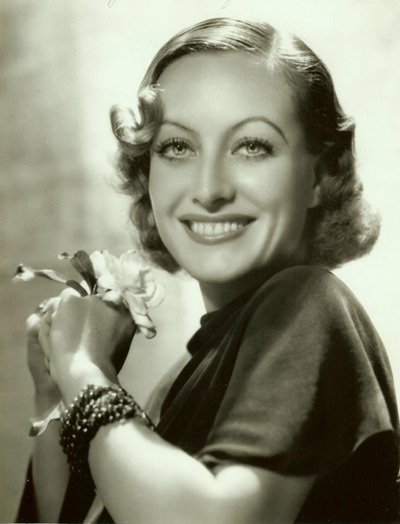
Lucille LeSueur would not achieve fame through a contest win; she got where she was going with a pinch of luck and a whole lot of grit and determination. However, a magazine contest too affected her life. Lucille had always had an inner drive and wanted nothing more than to distance herself from her turbulent relationship with her mother and her depressing childhood. Getting notice at a young age for her good looks, she got early work on the stage as a dancer, and she traveled around quite a bit in various shows. In time, she was discovered by a scout and subsequently landed a contract at the illustrious movie factory, MGM. It was here that she became pals with William Haines, who by now had taken to his new career path and was a huge screen star. Having mastered the art of film acting, Billy took Lucille under his wing and taught her how to play the part of the star on and off camera. After some minor roles and extra work, it was time for Lucille to renew her contract, but LB Mayer had a stipulation: he wanted her to change her name. He thought LeSueur sounded too much like Le-Sewer. At first, Lucille wanted to go by Billie Cassan, the name of the step-father who had shown her her only childhood warmth and whose vaudeville career had also introduced her to acting. In fact, all of Lucille's close friends already called her "Billie." However, Mayer didn't like it. Instead, to boost her public appeal and find an answer to the name question, he had the publicity department start a competition to find her a new one. On August 18, 1925, she received her new moniker: Joan Crawford (right). She was not happy. "It sounds just like Crawfish!" she complained to Billy. "Oh well," he quipped back. "They might have called you cranberry and served you every Thanksgiving with the turkey." (In the end, the contest got the new Joan Crawford two new names: thereafter, Billy always called her "cranberry"). Her first role as JC was with another JC, Jackie Coogan, in Old Clothes. Her new name soon became old hat, and twenty years later Joan Crawford would make the ultimate win, becoming an Academy Award winner for Mildred Pierce in 1946.

Wednesday, October 5, 2011

HISTORY LESSON: Follies Girls to Leading Ladies

Paulette Goddard in a very elaborate get-up when she was
part of the Follies.


Hollywood and Beauty are nearly synonymous terms; Hollywood and sex are perhaps even more interchangeable. Aside from invigorating storylines and their emotional relevance, the movies have always offered us perhaps even more profoundly another source of satiation for our very ravenous eyes. Hitchcock wasn't barking up the wrong tree when he made Rear Window, starting a discussion on the obsessive and at times creepy voyeuristic tendencies of mankind. Watching gorgeous bodies in motion, observing creative and aesthetically appealing mise en scene compositions and camera angles, has made us all rabid devotees of theaters, televisions, and now iPads. But we didn't always have the movies. Before that, there was theater, vaudeville, travelling acting troupes... But nothing would produce the glorious collaboration of beauty and sex appeal, nor unleash it upon a grateful public on such a grand scale, as the brainchild of Florenz Ziegfeld: The Ziegfeld Follies. Using the knowledge that men enjoy few things more than looking at beautiful things, and enlisting the aid of a myriad of women who enjoyed the power of being the objects of male desire and adoration, Ziegfeld started the Paris-inspired Follies in New York in 1907, renaming it the Ziegfeld Follies in 1911. By 1913, The New Amsterdam Theater had become its home, with 1800 seats and shows going all the way up to the rooftop, where The Danse de Follies took place. While some regarded these extravaganzas as rude, offensive, and exploitative, you couldn't argue with box-office revenue. The public had spoken; they liked what they saw.


Chorus girls light up the stage.


The shows weren't as simple as strip-teases: there was elegance, detailed costuming, fantastical imagery, and romanticized story-telling. Sure, every once in awhile girls showed up buck naked, but in these cases, they were always forced to remain stationary so that the show did not become graphic or "lewd." It was only the glamorously bedecked females that were able to move and shake. And these women weren't frowned upon; they were adored. Wealthy businessmen, most of them older, near to retirement and enjoying their years of hard work, spent the late night hours paying it off on the numerous lovelies who danced and sang for them on stage. Of course, performances by comedians like Eddie Cantor were also intermittently featured, but that's not what the public came for. Tickets to get in were expensive, so only the elite could afford them, which also added to the acceptance of the shows as "classy." Because of the glamour and fashion, women came too, and the shows became hailed as legitimate and invigorating entertainment... with a side of naughty. The same reception would not have resulted in poorer districts that lacked the cash for flash. Working girls fought their way into the Follies, both to have a job that often paid more than their fathers were making, but also to hopefully land a "sugar-daddy." For some, a little gold-digging went a long way. For others, their brief moments on the stage only served as a stepping stone to higher aspirations. Many Hollywood leading ladies got their start spanking the planks at the scandalous Follies. It proved to be a wealthy source of education in terms of how to use sex appeal and feminine charm to demand attention. While some may have been embarrassed at their humble, fleshy beginnings, they often had to admit that the experience helped them establish their later film careers. In this respect, the days with Zeigfeld were not merely moments of youthful folly.


Olive Thomas:
Olive arrived at the Follies in 1915. A great beauty, it wasn't long before she became a main attraction, of course her ongoing affair with Florenz also helped her rise in the ranks. She was assigned to more and more scenes, got to wear the most elaborate and elegant costumes, sang solos, and accrued scores of admirers-- including a German ambassador who once gave her a $10,000 string of pearls, (that's $100 grand today). The era when Ollie was a part of the Follies is often remembered as the best, due to the epic stage designs by Joseph Urban, but the shows would continue into the early thirties. In the 1910s, girls would sometimes stroll through the crowds of appreciative spectators wearing negligees covered by several helium balloons (see Olive left). The men in the crowd would use their cigars to pop the balloons, slowly revealing more girl and less latex. The girls also played games to entertain themselves while onstage, such as competing to see who could hit the most bald heads with their tossed garters. While performing in the Midnight Frolic, which was slightly more risque, Olive was also one of the many girls who danced on the infamous glass walkway, which Florenz had built so the men could sit beneath the high-kicking ladies with a... better view. Like most of the girls working at the Follies during these early, rebellious years, Olive didn't take the whole thing too seriously. She felt no guilt or embarrassment with regard to her employment; she was laughing all the way to the bank, and in an era when women still had little authority-- indeed, not even the right to vote-- a position in the Follies was one of the most powerful positions a girl could hold. Olive tarried at the Follies for 2 years, and then left the stage for the screen. But, during her time with Ziegfled, she was numero uno. As the "Most Beautiful Girl in the World," she was featured in a routine that showcased various women of different nationalities walking down into a large cauldron of sorts. Then, emerging from the melting pot came the sum whole of their parts: God's perfect creation, Olive Thomas. She was the ultimate, male dream.


Barbara Stanwyck:
Back when Barbara was still known as Ruby Stevens, she was a feisty and ambitious youth determined to overcome her impoverished lifestyle. Toughened up after her mother's death and her father's abandonment, Ruby spent most of her tender years escaping from foster families until she completely dropped out of school and started looking for work on her own. By the age of 14, she was already pounding the pavement, and having been inspired by her elder showgirl sister Mildred and the acting of silent film star Pearl White, she decided to become a performer on her own. Driven by an unrockable focus, there was little that was going to get in her way, which, despite her unconventional looks, allowed her to force her way into the mainstream. Allegedly, an audition landed her a gig in the chorus of the Follies for both 1922 and 1923, when she about 15 or 16-years-old. She also participated in various other chorus girl acts after leaving the Follies, but the hardened youngster wasn't satisfied with merely smiling and looking pretty, and her great strength and passion for honest and deeply felt work would soon take her from the stage to the screen, where even after her death she maintains a reputation as one of cinema's greatest, most professional actresses.


Louise Brooks:
Louise started out her performance career as a dancer with absolutely no ambitions to go into acting. As such, she was much more comfortable performing on stage under the tutelage of the illustrious dance instructors Ted Shawn and Ruth St. Denis than she would ever be before the camera. After learning from the masters, she performed with Ted and Martha Graham in the Denishawn company, but was later fired by Ruth for her inability to "co-operate." Louise then found herself a part of George White's Scandals, a contemporary of the Follies, but quit to follow her friend Barbara Bennett to Europe. When she returned, Florenz Ziegfeld scooped her up, and she began dancing at the Follies of 1925. Florenz was impressed with Louise, and soon she was climbing the ranks (literally) and was placed at the top of those notorious Follies girl-pyramids. During her time there, she also befriended fellow performer W.C. Fields, though his routines in the show were far different from her own. Will Rogers was also a member of the company at that time, as was Paulette Goddard. Louise was finally wooed by Walter Wanger to Astoria's Paramount Studios, where she begrudgingly started taking on film work. She considered it a mere experiment when she made her debut in Streets of Forgotten Men, however, she would soon become one of Hollywood's brightest stars. The city girl was about to move West.


Marion Davies:
Marion Douras too came to the Follies in her youth, but she may have had a little help securing a spot in the chorus. She was already working as a chorus girl in various shows, along with her sisters, by the time she met William Randolph Hearst in 1915. She was appearing in the Irving Berlin musical Stop! Look! Listen! at the time, in which she appeared in the number "The Girl on the Magazine Cover." Hearst definitely noticed her, despite the fact that she was an awkward beauty with a stammer. Her light personality and large eyes won him over, and he started flattering her with flowers and gifts. She wasn't the only lovely he was courting, indeed he had a reputation with show girls (he had even married one, Millicent Wilson), but soon Marion would become the only real woman of interest in his life. He arranged to have some special photos done of Marion at Campbell's Studio to test her star power and promote her. Marion was fairly clueless as to what was going on, and was uncomfortable when she spotted Hearst sitting by the camera watching her. Noticing her discomfort, he in turn got embarrassed and left. He would begin courting her in earnest and started heavily publicizing her career in his many papers, which eventually helped to land her a spot in the Follies in 1916. Marion, who had by now changed her name to Davies, didn't shy away from the attention; it was a way to support herself and her family. She later admitted that she had started out a gold-digger only to surprisingly find herself in love. She didn't tarry long in the Follies, for Hearst was determined to make her a star in the movies. As was Marion's character, she just kinda went with it, and it paid off in full.


Many other girls paid their way to fame in the Follies, including Joan Blondell, Mae Murray, Josephine Baker, Gyspy Rose Lee, Dolores Costello, Eve Arden, Irene Dunne, Mary Nolan, and Billie Dove (left). However, there too were a few who were turned down as being "not pretty enough," including Norma Shearer and Alice Faye-- of course, those ladies certainly proved their worth when the world fell in love with them on the silver screen. While the Follies shows at first appear to be nothing more than early strip-joints-- and perhaps when it all comes down to it, that's what they were-- somehow they remain something better. Before the great depression, they were an example of the grandeur, the wealth, and the glory of the almighty American dollar. Florenz Ziegfeld spared no expense when it came to his sexual extravaganzas, a flaw that would later send him into bankruptcy, but his big dreams echoed those of his thriving country. As America continued to play with the very thin line between artistry and deviance, between innocent sexuality and flat-out sin, the Follies reflected the most we could get away with. While some of the participating women may be mocked or criticized for their bartering of flesh for cash, the times they lived in did not promote the same sense of "wrongness" that today's feminists cringe at in retrospect. The female had not yet escaped her place in life as an object/wife/mother. The Follies were thus surprisingly a step in the right direction; a step toward female independence. For the first time, and on a grand scale on that large, vibrant stage, women were finally able to feel powerful. With men wrapped around their fingers and drooling at their feet, the Follies stage must have been one of the only places on earth that these ladies felt completely safe, completely in control, completely in command... even while scantily clad. After all, they couldn't very well have sold seats to a crude show if there weren't people willing to buy tickets.


An example of the mixture of sex and sophistication that
Ziegfeld brought to his shows.

Saturday, October 1, 2011

STAR OF THE MONTH: Olive Thomas


Olive Thomas: "The Most Beautiful Girl in the World."


As are too many of our fallen idols, Olive Thomas is famous for dying. However, unlike all of the other Movie Town tragedies history has accrued over the years, unlike all other saucy scandals and continuing tales of human debauchery, Olive maintains the notorious position of being the First: Hollywood's first major movie star death and Hollywood's first major "Uh-oh" moment. At her death in 1920, she also served as our first glimpse into the true power of cinema celebrity: immortality. While Olive's body made the transport from Paris to New York City to be laid to rest, her movies were being shown in theaters across the nation. How was it possible? She had died, and yet she lived??? Audiences gasped at the sight of her face-- once remarked upon as the "most beautiful" in the world-- still laughing and smiling, still vibrant, though her skin was ice cold. This was the start of a whole other level of human fanaticism and adoration for the screen star: we had at last tapped into the fountain of youth, and none of us would ever be the same.


One of Olive's many costumes in the Follies.


But who was this girl who started it all? She was just that. A girl. The girl. Even at a young age, growing up in Charleroi, PA, Oliveretta Elaine Duffy marched to the beat of her own drummer, though she more likely skipped and twirled. Life was a sweet nectar she chose to savor to the fullest extent, and she made big plans for herself from the get-go. After losing her father, a steel worker, in a tragic accident at work, Olive was forced to step up and help take care of her mother and two younger brothers. The naive, bustling energy of youth convinced "Ollie" that she was ready for the real world anyway, and she promptly dropped out of school and got a job. But small town life wasn't enough for a girl with such huge dreams, especially with her drop-dead gorgeous looks. More than one head turned when she passed by, including that of clerk Bernard Krug Thomas, whom she promptly married. After trying on married life for a time, Ollie decided it was a bit too glum, and though she kept quite a handsome home, her spending habits often cramped Krug's style. Divorce was the next logical step. Armed with nothing more than courage, Olive left her husband and struck out on her own to pursue life in NYC, having decided that-- heck-- she was just as good-looking as those Ziegfeld girls she kept seeing pictures of. The world would disagree: she was better. After spending some time working as a salesgirl in Harlem, Olive blithely entered a beauty contest for artist Howard Chandler Christy-- who was looking for the "perfect model"-- and won. She was thus labeled as "The Most Beautiful Girl in New York City," only to top herself when Harrison Fisher would name her "The Most Beautiful Girl in the World"-- Not too shabby for a teenager from Pittsburgh.


Simply Ollie


Olive's gorgeous features made her a popular model, and soon her face was on magazine covers and advertisements everywhere. It wasn't long before Florenz Ziegfeld came calling with an offer, and Olive found herself in the Follies (though she would protest that she brazenly had  asked for the job herself). An affair between the gorgeous new muse and her notoriously womanizing patron began, despite his marriage to the long-suffering Billie Burke. Due to her public appeal and her natural charms, she soon became a featured girl in the act, participating in several numbers. Wealthy men from all around the world would lavish at her feet and douse her with jewelry. She would thus strut around bedecked in accoutrement that was worth more money than most people would make in a lifetime. Only thing was, while Ollie enjoyed the pretty stuff, she never took any of it seriously, and she was constantly losing these baubles. As her popularity grew, she was moved to the new and uber-risque Midnight Frolic. While she could have had her pick of any of the many swooning men left gasping in her wake, Ollie would finally succumb to ladies' man and scalawag Jack Pickford, whose irresistible charms immediately won her over-- much to Ziegfeld's chagrin. In addition to her incredible beauty, Ollie's general goodness, wit, and spirit, won Jack over as well. The two fell madly in love. Ziegfeld was about to lose his main attraction, but not just to Jack.


Olive was a great animal lover.

The movies finally got a hold of Olive in 1916 when she appeared in an episode of the Beatrice Fairfax series: "Play Ball." That did it; she had a new obsession. Thomas Ince of Triangle scooped her up and put her to work in her first lead role in Madcap Madge. Olive was no great actress, and she knew it, but she wanted to be. Her ferocious energy was just as present in her mind as in her physicality. She quickly became known around the Triangle lot as "Miss Inquisitive" or "Miss Encyclopedia," for she asked endless questions about everything. Not just the filmmaking process-- EVERYTHING. She quickly learned the racket and mastered it, becoming as popular a personality on the silver screen as she had been on the Follies stage. Many friends predicted that with her temperament and knowledge, she would have gone on to direct pictures in the future. In the meantime, while honing her skills in films like Heiress for a Day, she secretly married Jack. She specifically chose to keep the nuptials from the public, because she wanted to prove herself as an actress without any help from the powerful "Pickford" name. After starring in film after film to great success, her popularity and box-office appeal revealed that she had paved her own way, and she finally announced that she was indeed Mrs. Jack Pickford-- though it is rumored that mother-in-law Charlotte and sister-in-law Mary never approved. 


One of many magazine covers she would grace.


On the surface, Jack and Ollie seemed to be the perfect couple. They both spent exorbitantly, buying expensive gifts for each other and for themselves. They enjoyed throwing caution to the wind and living loud and large. Both had "lead feet" and got into constant fender benders, both enjoyed the night life and party crowds, but only Olive seemed to possess the ability to keep it from affecting her work. There were strains: jealousy, fiery tempers, high-strung personalities... but these volatile qualities also amplified the duo's passions, and it honestly seemed that they were the only people who could keep up with each other. Distance was a contributing factor to marital discord: Jack was often making movies back West in L.A, always with Mary's help, while Olive was in New York. Her fame increased after she signed with the newly formed Selznick Pictures in 1918 as its first official star. With Myron Selznick at the helm, father L.J. and brother David  Selznick all put their faith behind Ollie and advertised her out the wazoo. She had the great honor of having her name up in electric lights for her film Upstairs and Down. In addition to being the center of the largest electric advertisement of the time, she had countless ads drawn up for her in magazines, and once had three billboards up in Times Square at the same time, setting a record in doing so. Not even Mary Pickford ever accomplished that. Of course, all of the attention may have had something to do with the fact that Myron, like many men, had fallen in love with her. She seemed to have that effect. Selznick Pictures certainly did its best to make her feel safe and loved, even sending her more cash when she (frequently) overdrew her accounts.


The Flapper


As a woman of firsts, Olive would also be the first "Flapper." Colleen Moore would later be credited with truly defining this version of feminine youth, but it was Olive who initially breathed life into one of the most notorious characters of the Twentieth Century. She still maintained her long, light-brown locks, no 'bob,' but what she possessed that would indeed translate to those eternal girls of the 1920s was her spirit. A new woman was about to be born in a new decade: one potently sexual, rambunctious, liberated, and independent. Her appearance in The Flapper seems like a far cry from what Clara Bow or Louise Brooks would later bring to the table, but the spark is still there, and the world would soon catch fire. After wrapping on the film, Olive decided to reunite with Jack, with whom she was still having problems, and the duo went on a well deserved vacation and shopping spree in Paris. Jack would return. Olive would not.


Ollie shows her fun side and goofs with a drum set.


Just what happened to Ollie remains a mystery. What is known is that she and Jack went on the town on Sept 5, 1920, partying and dancing with the Dolly Sisters at infamous Parisian hot-spots like The Dead Rat, before returning to The Ritz somewhere between 1 and 3am. In the early morning hours, Jack claimed he went to bed and was awakened by Olive's screaming. She had swallowed a fatal dose of bichloride of mercury and was dying. For years, it has been debated as to whether the act was one of accident, suicide, or even murder. The truth may never be known, since the only man to witness it all, Jack, had his own reasons for distorting facts. See, the only reason that the bichloride of mercury was even present in the room was because Jack, who was now popularly known around Hollywood as "Mr. Syphilis," had been using the substance to topically treat his disease. It has been alleged that when Olive discovered her husband's malady, and equally the fact that he had been unfaithful-- and perhaps had infected her-- she had killed herself. It too has been suggested that in the midst of one of their many turbulent arguments, the oft impulsive Olive had defiantly taken the poison as a way to enact revenge against her husband and end her own personal suffering. However, the idea of suicide to many just doesn't seem to be in keeping with Olive's light-hearted demeanor. This leaves murder a possibility, but though Jack was imperfect, this too is often ruled out-- the only person Jack ever really hurt was himself. This leaves the theory that it was an accident, and author Michelle Vogel suggests that Olive  stumbled into the bathroom in the night to take a sleeping pill-- as she often suffered from insomnia-- and mistakenly ingested Jack's concoction in the dark. Then again, perhaps there were darker corners to this bright, young woman's mind that may have driven her to a desperate state. The mystery continues...


Olive with Jack, leaving for Paris.


It took 5 days for Olive to finally die, during the span of which she both lost her ability to see or speak. Early attempts that Jack had made to have Olive regurgitate the poison had only served in burning her vocal chords further and prolonging her painful death. It was unfitting for a woman so full of life, so beautiful... On the morning of September 10, with friend Dorothy Gish and Jack by her side, Ollie finally succumbed to acute nephritis. Ironically, Jack would pass away 12 years later in the same hospital, The American Hospital in Paris, at only 36 years of age. Olive's death was ruled an accident, and the incident sent shock waves across the world. The first Hollywood tragedy, society had as yet no idea how to handle the situation. For now, Hollywood itself was safe, pointing the finger at dirty, debaucherous Paris as the true villain-- a nasty city of depravity who had seduced a young girl to ruin! Magazine articles vividly depicted and exaggerated Olive's last night, painting her as an innocent woman tempted by drugs and booze who had taken her own life in shame. But, in almost exactly one year's time, the death of Virginia Rappe would bring the finger of blame back to Hollywood, and this time there would be no scapegoat except for poor Fatty Arbuckle. Olive became, thus, our first martyr; a symbol of the highest of highs, the most beautiful of girls, brought to the lowest and ugliest of lows. After Fatty came William Desmond Tayor; after WDT came Wallace Reid, and so on and so on and so on. The train wreck continues.


Alberto Vargas's "Memories of Olive," finished after her death.


But there is more to Ollie than her death. Her life is just as forgotten as her silent grave in Woodlawn Cemetery, where she rests alone without her Jack, whom was buried in the family crypt in Forest Lawn of Glendale-- again, the lovers separated by a continent. Olive will never go down as an amazing actress, but she was one of Hollywood's brightest personalities. What she brought to the camera wasn't her grand emotional skill nor her malleable abilities of characterization. She brought energy and fun. She brought her "A" game and left plenty of room to play. Too few of her films remain, with only The Flapper being available to mainstream audiences. But still, in just this one film, or any of the meager scraps and scenes that haven't been ravaged by time and decay, you catch a glimpse of Ollie's magic; as in her life, you can't take your eyes off her. And so, Olive Thomas, dead too soon at 25, continues to live forever, and we continue to drink from the great silver screen chalice of her eternal youth. Before Elizabeth Taylor, Olive was the first girl with the violet eyes. Before Marilyn Monroe, Olive was the first sex symbol, influencing Alberto Vargas even after her demise in one of his most famous paintings. Before David O. Selznick, there was just David, who added the "O" to his name in memory of the woman whom he said had helped cement his family's reputation in Hollywood. Before now, there was then; and then, Olive was very "now"-- present, alive, vivacious, always.