FYI

Don't forget to refer to my Contents page for a more convenient reference to past articles.

For More L.A. La Land, visit my writing/art/film appreciation site on Facebook at Quoth the Maven and follow me on Twitter @ Blahlaland. :)

Tuesday, November 19, 2013

THE REEL REALS: Bela Lugosi


Bela Lugosi

Béla Ferenc Dezső Blaskó would change his last name to Lugosi after his move to the United States in the early 1900s to commemorate his Hungarian (now Romanian) birthplace of Lugos. This was a smart career move. His new, lyrical, and much shorter name would be easier for English speakers to remember, and they would indeed remember it... Although, they would often refer to him by his more popular nickname: Dracula. This film would be the greatest achievement and greatest burden of Bela's life. After bringing the Dark Prince to life on the stage, his totally unique, sexual, and fear-inducing performance of the caped crusader of death, reborn on the silver screen, would make him a bona fide sensation. Many assert that The Phantom of the Opera was the first legitimate horror film, but it would be more accurate to give that title to Dracula. Lon Chaney's films belong in a category all their own, while Dracula, when it first hit theaters, was a conundrum. No one knew what it was, how to feel about it, how to package it, nor how to label it. All they knew was that Bela shook them to the core, and they kind of liked it.


Bela's creation of the Count as his own was a groundbreaking moment in the history of film. The vampire had always been terrifying, but never before had this creature been so... seductive. Bela's regal presentation matched with his exotic accent, intensity, and total absence of morality, made him a somehow more foreign and yet more relatable villain. He was a more appropriately felshed out representation of man's dark side and the provocateur of his sexual nature. He did not hide in shadows. His Dracula bewitched with the eyes and commanded women to "come" to him, which they did, willingly. As such, his phenomenal performance and his creation of the supernatural monster changed the game of film, paved the way for a new genre, and introduced audiences to a side of themselves they may not have wanted to see...


His private life did not fare as well as the dark hero of his screen self. Forever trapped by the Dracula stigma, Bela would be continually typecast in horror films, which decreased in quality as the years progressed. A truly gifted actor who had portrayed a number of varied characters on the stage, he ached to fulfill his obligation to his craft, but was forever pushed creatively into a corner. His cape was his cross, one that he had to bear to pay the bills. The results of his acting projects were mixed.  The Ghost of Frankenstein, The Black Cat, and Abbott and Costello Meet Frankenstein remain positive highlights, but for every classic, there were plenty of clunkers. Most infamously, toward the end of his life when he was battling a morphine addiction-- that born as he battled a painful battle with his sciatica-- he teamed up with notorious director Ed Wood. While the director's films-- Glen or Glenda? and Plan 9 from Outer Space-- are not exactly quality material, they were generous opportunities for work that gave the impoverished Bela a small ray of hope in his deteriorating life. However, it was too little, too badly, too late. Bela would pass away from a heart attack at 73. He was buried in his Dracula cape. But did he stay buried??? His lost soul continues to wander, hunting the new, willing  victims that continue tofeed his immortality.

THE REEL REALS: Anna May Wong


Anna May Wong

Anna May Wong was a Hollywood deviant in every sense of the word. She defied the preconceived movie star prototype and surprised studios and the public alike with her automatic allure. However, she forever was forced to balance herself upon a tenuous beam of acceptance, both socially and personally. Shunned by prejudice in her home country of America, she was also slandered by the Chinese for being a "whore," otherwise known as an actress. Upon a visit to the nation of her forefathers, she was once pummeled with stones by an angry crowd. While she fortunately had more fans worldwide than villains, her choice to define her own life in her own terms would forever make her an outcast. The price of her independence would strangely be her liberty.

Anna's entry in film would be in the role of the featured servant girl or concubine. Naturally, her heritage would keep her from receiving leading roles or top billing in her projects. However, slowly but surely, her performances in larger supporting roles opposite big time stars like Lon Chaney and Douglas Fairbanks, and her alliance with director/lovers like Tod Browning and Marshall Neilan, would give her the opportunity to showcase her talents. The Toll of the Sea, The Thief of Bagdad, Peter Pan, Mr. Wu, and Piccadilly gave her increasing exposure to the audiences who fell in love with her almost spiritual essence. Her beauty was marked with an intelligence and profound depth that made her utterly fascinating to watch. As an outsider, she was able to move about as a free agent, deemed independent and often dangerous. She had a wisdom that was effective and even spellbinding, often distracting from her more popular Caucasian co-stars. 

She went to Europe to seek more opportunities and had some luck, returning to the states for talkies like the classic Shanghai Express, but despite her magnetic personality, she would always hit a brick wall of bigotry. She was never allowed to fulfill her total potential because of her race. Roles, like that of "O'Lan" in The Good Earth, went to white actresses like Luise Rainer, and censorship kept her from being given leading roles of her own. A failed attempt at TV and an attraction to alcohol-- a popular tool for many in burying sorry-- would prematurely end her career and her life. She passed away from a heart-attack at 56. Now looking back on her performances, she looked even then like a ghost-- a beautiful, haunting image from another place, another plain of consciousness, whispering tales and truths that many of us are still not open-minded enough to absorb.

THE REEL REALS: Ann Harding


Ann Harding

Ann Harding was once listed as one of the most beautiful women in Hollywood. With her soulful eyes and waist-length blond hair, she already stood out from the crowd, but her great intelligence, composure, and lack of pretense made her an even greater eccentricity in the super-sheeny world of cinema. Ann was raised to be a realist, traveling the country as what is popularly referred to as an "army brat." This childhood of exposure but constant uprooting formed her into a determined young woman, and a smart one at that-- she would graduate from Bryn Mawr. As a responsible, independent girl, she took odd jobs, one of which was a script reader for Famous Players-Lasky. She had dabbled in acting in college, but her fluke audition for and subsequent performance in the play "Inheritors" made her a smash Broadway sensation and solidified her new career path as an actress.

It wasn't long before Ann began working in film, her first picture being Paris Bound. Ann selected her projects for their intrigue, favoring good stories over box office. Nonetheless, she established herself as a bold and controversial actress, some of whose films were banned! In the pre-code era of cinema, which ended in 1934, Ann acquired an admirable and lauded reputation for  portraying complicated and more realistic, modern women-- women who had affairs, women who had children out of wedlock, and professional women. She wasn't just a love interest or a girl out for love. She played doctors,  artists, and women of both integrity and moral complexity. Her Private Affair, Animal Kingdom, and When Ladied Meet, are tokens of this fascinating period of film. 

When the production code came, Ann persevered, her eloquent diction and grace making her a shoe-in for the suffering, pure female lead in morality pictures. However, this was not as interesting as her prior work, and her career began its decline. She made impromptu returns to the screen and performed on television as well, but her inability to adhere to industry standards or play the part of the Movie Star leaves her almost totally forgotten today. But then, she probably wouldn't mind. She was more interested in doing the work and not recouping the benefits, fame included. As a lady who preferred to do things her own way, in the story of her life, she was therefore a phenomenal success.

THE REEL REALS: Anita Page


Anita Page
Anita Page was one of the great beauties of the silent film era and one of few who was able to transition smoothly through the talkie transition. With her soft, ethereal features and natural acting chops, she was able to hold her own opposite some of the top leading men of both eras, boasting co-starring roles in While the City Sleeps with Lon Chaney and Navy Blues with Williams Haines-- a lifelong friend. This high roller was often cast as the luscious girl-next-door, but her devious turn in the gem Our Dancing Daughters also stole the screen from the ever ambitious Joan Crawford. The saucy lady of integrity left acting and MGM behind purportedly because she refused to submit to the misogynistic, sexual advances of ol' LB Mayer. She remains notorious for her participation in The Broadway Melody, the first talkie to win Best Picture at the Oscars, and she was additionally the last living attendee of the first Academy Awards (1929) before her death in 2008.

THE REEL REALS: Angela Lansbury


Angela Lansbury

Angela Lansbury. One could nearly stop right there. Her name encapsulates so much about film and television culture. She has graced the stage, screen, the tube, and has been actively working in the industry from her tender teenage years to the present. She is a permanent fixture-- a living signature of the legacy of Hollywood. With her ethereal, pre-Raphaelite beauty and true actor's courage, she took her thespian training in England and easily translated it to the states. Her birth in cinema, her survival instinct-- that cultivated when her father prematurely passed away and forced her to step forward and be independent-- and her unavoidable but hopefully distant exit from this world, seem to bookend the very story of Hollywood itself.

With her talent, Angela could certainly have become a huge movie star had she so wished. However, her intelligent and curious nature was more intrigued by the interpretation of character than the fringe benefits (and pratfalls) of stardom. As such, her impressive collection of roles are both distinctive and diverse. Not only did she debut in one of the greatest psychological thrillers of all time, Gaslight, but director George Cukor was so taken with her cockney, bad girl that he declared she reacted better to the camera than anyone he had ever witnessed. Her innocent girl fallen in The Picture of Dorian Gray showed audiences that she could portray both sides of the coin, and not only that, but every side to every coin ever minted: ambition (State of the Union), romanticism (Samson and Delilah), and outright, diabolical, divine evil (The Manchurian Candidate). Whatever it took, this slugger didn't hold back, and when Television took over, she took "to the mattresses" and came out an even bigger champion than before in the iconic series "Murder She Wrote." 

Her graceful ability to hold a scene, her physicalized insight into her characters, and the depth of intelligence and emotion behind her large, dreamy eyes have kept this lady working for seventy years. If that's not impressive... I don't know what is.

THE REEL REALS: Allison Hayes


Allison Hayes in Attack of the 50 Foot Woman

Allison Hayes obtained notoriety by becoming the oversized embodiment of the old saying, "Hell hath no fury like a woman scorned." In fact, her presence in the film Attack of the 50 Foot Woman was a pretty bold, feminist statement. For once, a woman was big enough and threatening enough to crush the man and the world that usually mistreated her, objectified her, and condescended to her-- something impossible at her new height. Ironically, the movie gave excited male viewers plenty to look at and admire-- many of them probably hoping to climb over her luscious body like adventurers exploring everest. In any case, while inspiring women to assert themselves and take control (because men, after all, were secretly afraid of them), or entertaining appreciative science fiction fans, Allison's snarling, fed-up, disenfranchised heroine immediately became the eternal B-movie Queen.

Allison's voluptuous curves, sultry voice, and tough veneer (the look on her face always seemed to be a personal broadcast of cynicism), made her an easy fit in the exploitative films of the '50s. She was never given the major opportunities for serious or more glamorous work, perhaps because the aforementioned qualities held her back, but her brief career in film was a solid one. With films like  Zombies of Mora Tau, Disembodied, and Wolf Dog on her resume, it is doubtful that any of her work was artistically fulfilling, but at the same time,  the actress was holding her own and supporting herself in an era when women were still expected to be obedient wives and mothers. Her categorization of a less reputable B-movie actress perhaps afforded her more freedom in certain ways than the rigorous life of the polished studio actress. One doubts that Allison ever took anything she did on the silver screen seriously. She was just a girl playing the game and making a buck. She was eventually able to test the waters of her talents a little more on television in the '60s, where she kept up her hefty work pace in more dramatic and sometimes comedic roles. Yet, she was never taken seriously, which certainly took a toll on her emotionally. 

Toward the end of her career, she had to slow her participation as she started experiencing excruciatingly painful health problems. The source was the calcium supplements she had ironically been taking for her health. He complaints and her symptoms were ignored as the mere fictions of a hyperemotional woman, and Allison's sorrow further intensified. After years of being treated as a puppet, sex-object, and professional joke, her added personal struggles sent her spiraling into a depression that made her consider suicide. Fate beat her to the punch, and she passed away at a mere 46-years of age. Just as the vibrant, powerful woman that must be taken down, contained, or destroyed in Attack of the 50 Foot Woman, Allison  was existentially bullied into a corner and made to feel a fool for wanting more out of life. Still, her appearance in the iconic film has become her triumph. For manhandled, suppressed, and frustrating women everywhere, Allison continues to wreak havoc, kick ass, and take names. The freedom she found in those brief moments on the screen have made her immortal and unstoppable. Despite her defeat, she always comes back again, bigger and better than ever.

THE REEL REALS: Allan Dwan


Allan Dwan
Allan Dwan was a director extraordinaire during the silent era. While the Canadian (born Joseph Aloysius Dwan) had mild plans to enter the world of film, it is more justified to say that the movies came looking for him. His expertise as a lighting technician got him unceremoniously poached by Essanay, and after he made the transition to story-editor/writer, another twist of fate would put him in the director's chair-- or so the story goes. (Allegedly, he had to take the reins on a shoot when the original director disappeared on a bender). Well, thank Heavens for booze, because without any of these serendipitous events, one of cinema's greatest innovators never would have been!

During his career, one of Allan's many accomplishments was leading the Flying A Film Corp, one of the earliest and most important California film studios. Throughout his career, he worked with everyone from soon-to-be wife/ex-wife Pauline Bush, Wallace Reid, John Wayne, Shirley Temple, and Gloria Swanson. He also made an impression on the powerhouse couple Mary Pickford and Douglas Fairbanks, the latter with whom he made the iconic Robin Hood and The Iron Mask. Through a career that spanned 50 years, Allan allegedly lost count of how many shorts and features he was responsible for, but we know his stamp is on at least 400. His ability to use the camera as an extension of himself, the storyteller-- capturing the greatest source of action, inspiration, and intrigue possible-- kept him at the top of his game for this unprecedented breadth of time. Indeed, he is even responsible for devising something that all directors and cinematographers take for granted today: the Dolly Shot. 

Allan passed away a few years shy of his own centennial, leaving a profound level of accomplishment behind him. While less remembered than names like Griffith, Chaplin, or DeMille, he is an essential part of filmdom's backbone, his contributions laying the ground work for upon which all future directors would more easily tread.

THE REEL REALS: Agnes Moorehead


Agnes Moorehead
Agnes Moorehead may not be one of the most famous actresses who ever lived, but according to Orson Welles, she was probably the greatest. Agnes lacked the perfect beauty that could have made her a golden idol of her era, but this perhaps served her well. She was able to maintain a career as a character actress long after many of her contemporaries' fresh-faced youths had faded. 

An educated woman, Agnes brought her great intellect and passion for literature with her when she began her performance career, which was only bolstered by additional training at the competitive American Academy for Dramatic Arts. Her great passion and emotional instinct for her art was indulged in early singing and radio work. Indeed, she had a voice, one that she could manipulate at will to cultivate a showcase of all the shades, cracks, and fissures of humanity. Crafting a fully formed character with vocals alone, the microphone gave Agnes a power over her audiences that was uninhibited by what she deemed to be her unattractive appearance. (Not true, Aggie). It didn't take long for Orson Welles, the Boy Wonder of Radio, to find her, and she joined his Mercury Theatre program, delivering spectacularly, emotionally articulated performances in his many adaptations, including "Dracula."

When Orson went Hollywood, he brought his Mercury players with him, which led to Agnes's performances in Citizen Kane, Journey into Fear, and the Magnificent Ambersons. Those who criticize the films (pft!) for their coldness, almost universally draw attention to Aggie's characterizations, which some deem to be the only depth in Orson's otherwise very cerebral narratives. Though a insecure, conflicted woman, who remained intensely religious throughout her life, her personal neuroses did not effect her cinematic career, which later translated to television. She was to appear on countless shows, and her surprise hit gig on "Bewitched" made her a pop cultural icon. Tragically, she was one of the many actors who performed in the oddball John Wayne film The Conqueror to pass away from cancer (uterine)-- this eerie coincidence is accredited to the fact that the movie was shot at a nuclear test site. 

With her wisdom, edge, and gift for simply being in the moment, Agnes is often overlooked for her talent. She was too good at what she did. The intellectual underdog, she remains a hidden victor in the continuing story of Hollywood, still camouflaging herself in the story as one of its mere moving pieces, convincing us that she isn't there at all.

Friday, November 8, 2013

HOT SPOTS in CA: The American Cinematheque (and the "Dark Blood" of River Phoenix)


Exterior wall of The Egyptian Theatre, home #1 to the American Cinematheque.

The benefit of living in Los Angeles is the access to all things cinema. Hollywood, as the home of the Movies, honors the industry like nowhere else. It's the perfect landing place for movie hounds, as it has countless venues for junkies to choose from when selecting where and when they want to see what. Grauman's Chinese (now TLC-- the learning channel???), the Egyptian, the Silent Movie Theater, Old Town Music Hall, the Laemmle chain, LACMA, AMPAS, Fairfax Regency, Cinespia at the cemetery, etc, are some of the community's darlings. They screen the classics, the forgotten jewels, the restored, the cult favorites, whatever your flavor is. Each locale has its own personality and generally cheaper seats than the average movie chain, which only plays the latest block-bruiser. Depending on the monthly menu or retrospective that's happening, one can pretty much spread herself around like a celluloid slut (Oh, I get mine, trust me) and take advantage of experiencing films on the big screen-- the way they were meant to be seen and increasingly aren't.

The American Cinematheque has been in operation since 1981 and is a non-profit organization that presents films, historical or cinematically related lectures, and guest appearances at both the Egyptian and Aero Theatres. The Egyptian is much more notorious (and right in the center of Hollywood), as it was one of Sid Grauman's many over-embellished movie palaces. Renovated and technologically modernized, the interior has changed quite a bit. For example, the seats used to stretch from the screen all the way to the entry door, as there was no popcorn and thus no concession stands in the early days. However, remnants of the former glory remain, and much of the original artwork has been restored. The hieroglyphics outside and ornate pattern detail on the entry ceiling, as well as the still impressive ceiling décor in the theater itself, provide a bit of forgotten ambiance, though the result is nowhere near the original splendor. The Egyptian typically gives tours of the theater and screens a brief documentary called "Forever Hollywood" at least once a month on Saturday, if not every other Saturday, in addition to its many other screenings and programs.


The Egyptian Theatre ~ 6712 Hollywood Blvd. ~ Los Angeles, CA 90028

As its sister theater, the Aero directs its focus into honoring all the different filmmakers, performers, and genres by featuring varying retrospectives, whether these reference the cinema of various countries, time periods, movements, what-have-you. The look of the theater is less exciting and historically relevant than the Egyptian. Aside from the brightly lit marquee, the building is thoroughly contemporary. It's charm lies in the unlikely films it presents, as well as the plethora of celebrity guests it hosts for Q&A sessions regarding particular films. Anyone from Eva Marie Saint to Jane Campion and the Cast of Bright Star may show up, and the movie house plays everything from The Unknown (1927) to The Harder They Come (1972). Located between Brentwood and Santa Monica, it's a bit of a hidden treasure on the West side, and the intimate attendance at most screenings makes one (#me) feel like a member of a very select club-- the Cinemat 'Pack, huzzah!


The Aero Theatre ~ 1328 Montana Avenue ~ Santa Monica, CA 90403


Most recently, just prior to the 20th anniversary of River Phoenix's death, I was fortunate enough to attend a screening at the Aero of his last, uncompleted film with director George Sluizer: Dark Blood. The "lost film" is always a dagger in the heart to flicker aficionados, and-- similarly to James Dean-- River's premature death certainly makes every product of his work more precious. (He would pass away due to a drug overdose in the early morning hours of Halloween, collapsing on the street outside The Viper Room). As the film was left 10 filming days short, there are missing scenes from the finished project, as well as some that Sluizer had to remove due to their lack of coherence within the limited final product. Working with what he had, the director was able to save the film from destruction when the members of the Phoenix family tried to seize it and Ted Turner, the studio, et al refused to refinance further shooting/editing. It took the director some time to face this past demon, but he used the money from his own pocket to put the piece together, restoring the film himself, adding voiceover dialogue where needed to explain missing sequences, and editing the remaining images into a fluid and somehow fittingly detached but provocative story.


Poster handed out at the October 29th screening.

The plot follows a vacationing couple as they travel through the deserts of Arizona (actually Utah, I believe-- the cinematography alone is enough to make the film worth seeing). The brash and irreverent Buffy (Judy Davis) and her stoic but silently boiling actor-husband Harry (Jonathan Pryce) wind up stranded in the middle of nowhere after their vintage car breaks down. The playful tension between the couple quickly takes on a more sinister edge in this isolation, revealing the truth behind their disintegrating marriage. When Buffy spots and hikes toward a distant light in the hills, she finds the small cabin/tee-pee of a character known only as Boy (Phoenix), who takes the couple in and promises to fix their car and see them safely to their next destination. Unfortunately, their three lives become violently entangled as Boy's attraction to Buffy becomes not only threateningly potent but fearfully dominating, his obsession over her creating an oppressive atmosphere, which is only fueled by the sinister history of their surroundings...

The story takes place in the space formerly used as a nuclear testing site by the U.S. government. Many people, including Boy's young wife, died of cancer as a result of the contamination. Certain areas remain condemned-- sad, dusty ghost towns with the lingering stench of death upon them. This stain of history is echoed by the stain in Boy's blood. He is a quarter Native American-- his grandfather married a white woman. Additionally, said grandfather was allegedly an incredibly unbalanced and depressive personality. As such, Boy carries on this "dark blood." Proud of his heritage and unapologetically bitter against the yuppies who destroyed and forgot this wasted land, he frequently bursts out venomous torrents of his own invented wisdom. Crafting Kachina dolls to adorn his handmade bomb shelter-- complete with an extensive candelabra that doubles as a library (you have to see it to believe it)-- he knows that the great wave of man's error will come again. When it does, he wishes to go underground, taking Buffy with him to create a new age of man-- one totally pure and within his control.


Judy Davis and River in Boy's romanticized fall-out shelter of delusion. As she stares
at his altar of hand-made Kachina dolls, she is mesmerized by the deep focus and 

care he has put into this creation and turned on by his deepening fixation on her.
Allegedly, Davis was a nightmare to work with, and she and River were mutually

intimidated by each other, but there is a depth to their love
scenes that is quite compelling.

River is amazing in the role. Wavering between a raging, crazy old man in a 22-year-old's body and an innocent and vulnerable child, he uses his spiritual conspiracy theories to protect him from the loneliness of his isolation and status as an existential cast-away. He believes that he has willed Buffy to him, and when he delivers this information to her, you believe it. Judy Davis, as his increasingly willing and then terrified prey, is equally remarkable, providing layers of sexual tension and surprising softness that escalate into moments of sheer panic. Pryce, for his part, is the frustrated "white man," lost in the maze of his country's past poisons, cleverly exemplified as he literally wanders in the canyons of the desert, desperate to be freed of this collective residual guilt, but unable to escape it until it has had its vengeance on him. The film truly is something 'dark.' Mysterious, poetic, jarring, unexpected... It takes the viewer to places he or she perhaps doesn't want to go, but the voyage of this macabre Odyssey somehow rings so true that one can't help but be on the side of its surprising anti-hero, even when he rattles your bones.

In addition to watching the film, the Q&A with the now 90-year-old Sluizer proved very informative and equally soul-fulfilling, as his recollections, struggles, and triumphs revealed a lot about the process of bringing the film to the screen and additionally honored his departed friend. Also in attendance was author Gavin Edwards, who was signing copies of his recently released biography Last Night at the Viper Room: River Phoenix and the Hollywood He Left Behind. This, as with most awesome Hollywood book related events-- including another past Kirk Douglas one I attended at the Egyptian-- was provided by the Larry Edmunds Bookshop. (Keep your eye on these guys. They host cool things all the time). 


Oh this? This is Kirk Douglas' autograph. On my book. That I own.
This is why AC and LEB are awesome.

So, for those living in the area or those hoping to visit, you can add this to your list of things to do in Hollywood. This city can be as annoying as the traffic jams are long, but as my depictions of the aforementioned theaters hopefully prove, there is this one great condolence: there is absolutely no reason one should ever, ever be bored in L.A. La Land.

Monday, October 28, 2013

HALLOWEEN SPOOKTACULAR IV: Monster Mash-up Pt. 2


... Continued from Part 1

THE BRIDE: The Feminist


The success of Frankenstein made a sequel pretty much a foregone conclusion. What was unexpected was the intelligence with which the follow-up film would be executed. Some argue that Bride of Frankenstein (1935) is superior to its predecessor, but such is an impossible conclusion to draw. They are two very different films about two very different subjects. Where the Monster had horror, his Bride has camp; where Frankenstein had existential confusion, Bride has satirical humor. Dr. Frankenstein (Colin Clive) as God, created the Monster (Boris Karloff) as his Adam for his own egotistical entertainment. It was a narcissistic show of power if nothing else. But only consequently was he forced to create the Bride (Elsa Lanchester) out of the Monster's need for an Eve. The impulse was not his own. This ideology, long preached by the Bible, makes woman little more than unnecessary window-dressing in the creative landscape of both life and art. She is immediately deemed an object of pleasure without her own specific purpose. James Whale cleverly plays with the resultant mating dance of this cosmic crime, restoring some of womanhood's dignity in the process, by delightfully capturing the set-up/pay-off of the male-female sexual tango. It is a story as old as time itself: the battle for power, identity, and independence between lovers.

While Karloff returned with success and further emotional depth in the role of the Monster, he had to compromise some of his artistic integrity to do so. The Monster, against his wishes, was forced to speak, which is one of the reasons that Bride is much less chilling than the initial Frankenstein installment. However, this was tactical move. The Monster had to speak to proclaim his desire for a partner: his woman. His character had to mature past its former baby stage to leave the nursery room available for the child he hoped to play father/lover to. He needed a possession just as he belonged to the Doctor. Evolving to make way for more life, his entrance into manhood will be solidified-- as is generally expected-- by claiming a wife. The Monster, touchingly, reveals therein man's need for companionship-- a partner to anchor his existence and equally act as the nurturing mother he never had. As such, the movie is a sensual build up to those moments when we see the Bride (all dressed in white) at last. 


Unfortunately, the Bride is not submissive. She does not appreciate being immediately shackled to the dominant male. She hisses at him, rejects his advances, and after refusing the man she was made to serve, she clings tightly to the man who gave her life (liberty)-- the Doctor. Whale has fun showcasing the absurdity of the exaggerated but accurately ridiculous mating ritual. The Monster, as man, was born awkward, confused, and obedient in his infancy. As he tries to embrace his manhood, he grasps clumsily for the release of his most natural impulse: sex. He's a puppet for it; he follows the Bride like a slobbering dog for it. He has absolutely no finesse and is palpably perplexed by the Bride's rejection of him and his masculinity. What do undead women want anyway? For her part, Lanchester's striking interpretation of the Bride is instantly contemptuous of her sudden conception and the inescapable fate of enslavement that lies before her as a result. She is an erratic ball of nervous energy, twitching like a predatory bird determined to use her wiles to escape the larger, much stronger male beast. The Doctor is left to stand back in bafflement at his most horrid creation: the perpetual state of miscommunication between man and woman. There is no solution for it. Even after years of evolution, Adam and Eve as the Monster and his Bride, are condemned together to eternal Hell: "We belong dead." Love is pain. 

For her part, with the briefest screen time of any horror villain, the Bride still left an indelible impression-- someone that women could relate to as the bare reflection of their own conflicted but less explored natures. As the Bride's life was abruptly restored and just as quickly robbed back from her, she surely found her quick demise a welcome release from what must have felt like the worst of bad dreams. To restore some feminine respect, the film also reveals from the beginning that the Bride is not a mere creation of man's fantasy, but of her own-- the story is one within a story as told by author Mary Shelley. The female Shelley (Lanchester in a dual role) is thus the creator of the most infamous of Gothic heroines who wears none other than her own face-- her secret self. As such, she has her own identity and is not just a tool for man's trade after all.

THE WOLF MAN: The Accursed


The Wolf Man (1941) appeared as war ensued in Europe and the threat of America's involvement hovered in the air as the moon-- one which would soon transform average men into soldiers of fortune, sent to ruthlessly kill or brutally die. The paranoia of WWII was the perfect instigator for the genesis of Universal's next horror hero: a regular man, hoping to find and establish himself in society, prove himself to his father, and maybe even settle down with a warm-hearted woman. Unfortunately, his very sense of reality is blown asunder by a cataclysmic twist of fate. A bite from a werewolf-- an evil force too impossible to be believed-- condemns him to a killer's destiny. To add more dimension, the disease of his new monsterdom was passed to him by a foreigner (Bela Lugosi)-- an intruder on English soil who brought the curse of his people with him. There is no real rhyme nor reason for the lives that Larry Talbot (Lon Chaney, Jr.) takes when under the influence of the governing night sky. He kills because he must; it is an order, not his specific instinct. He simply wanders and stalks, an American in the menacing territory that is not his own but the land of his father (or forefathers).

The interesting thing about the Wolf Man is his very title. He is a wolf man-- a man who happens to be a wolf. The real guy, Larry, is still in there and just as present as the new supernatural force that controls and contorts his heretofore socially nurtured nature. Even when he changes into his beast self, he still wears his human uniform. While his face is fearful, his movements and manner are more clumsy and uncomfortable than truly intimidating. He is as uncertain of himself and the actions he must do as he is assured that he must commit them. Of course, Larry was capable of killing without this sudden, oppressive influence. In the film's early scenes, he beat to death the very wolf that passed the curse to him. Upon seeing this-- actually the most brutal killing in the film-- the audience knows that this level of darkness existed in him always. When pushed to the brink, man is capable of all kinds of evils. Now, as his stifled predilections are called forth by a higher power, his inner darkness becomes overwhelming, making him both an unconscionable villain and a disconsolate victim. As he battles over the terrain of his very soul, he also kills pieces of himself, chipping away at his conflicted and slowly demoralized psyche with every murder-- the same stress that haunts the soldier who must banish moral code to fulfill another pledge.


Aside from the socio-political implications of the wartime film, there too is the personal element that audiences continue to find relatable. A man's inheritance of adulthood comes with its existential woes. Lon Chaney, Jr. as the eternal, suffering soul steeped in depression is reflective of any man constrained by the demands of civilian survival. There are rules that are laid down before him that he can't control and is afraid to break. As such, he almost always becomes victim to them. He must abide by laws, both natural and societal, to function in the community. Those things that feed and continue the grind of communal/consumer society (as represented by his father- Claude Rains) too often take precedent over his more passionately driven dreams and aspirations (as represented by his girlfriend- Evelyn Ankers). His only solace is wisdom, in the film represented by Maria Ouspenskaya as the protective gypsy, mother-figure, and perhaps General. She is the wise one who has been there and knows the way. Still, the inability to quell the beast within, that which rages against the very machine that created it-- makes Mr. Talbot a tragic victim of the trappings of this so-called experience of life and duty.

THE PHANTOM: The Artist


Comparing the silent (1925) and sound (1943) versions of The Phantom of the Opera is a task that would require an article of its own, so focus will be given only to the latter interpretation. (My beloved Chaney's genius will be left in its sacred catacombs for another day). Just as Claude Rains' other monster character the Invisible Man, the Phantom is more compelling and effective a villain because he is no more than a man-- a psychologically decomposing madman, but a man nonetheless. Again, he is a character suffering under extreme circumstances, living in social banishment, and not handling it well at all. Also on par with The Invisible Man, he is the bad guy who "isn't there," intimidating his foes through the subtle suggestion of his presence, which he plants like little seeds of fear. These kernels slowly grow into his own personal mythology, his whispers, mysterious notes, and shadows becoming the breadcrumbs that lead the slowly manipulated masses into the acceptance of his existence and the hysterical fear of his ever-lurking legacy. The Phantom's great power, therefore, lies in his abilities as a magician. He is an illusionist, making himself appear larger than life by not appearing at all.

In contrast, whereas the Invisible Man was a mad scientist, the Phantom of the Paris Opera House is a mad poet. He is the ambitious lover of life that all inner artist respond to. A violinist driven mad by his passion for both music and the woman he loves, he commits murder of his own angered freewill and loses his face in the process (to an unexpected splash of acid). Now, with nothing to lose and his manic, creative spirit maliciously set free, he makes himself the lone guardian of honest art. For those at the Opera house, he decides the beauty and style with which all music is to be performed. The players and the audience are to be made humble before it, as they would have been before the majesty of his own genius-- had he been allowed to exhibit it. He places the finger of blame for the Opera's lack of creative integrity on the unworthy managers, the hack performers, and all other charlatans who offer chicken feed when the true romantics should all be feeding on ambrosia like Gods. His devious voice of criticism is that which the true aesthete loves to hear. He demands that a show be performed that is worthy of its audience, just as many of us throw metaphorical popcorn at the screen when unimaginative, regurgitated, formulaic garbage insults us at the movies, on Television, or on the radio. The Phantom is, therefore, the Superbadman of entertainment-- sniffing out the filth who threaten the integrity of our souls' purest expression.


The problem is, unlike Chaney's creature, who was born deformed, Rains' face was made-- irreparably scarred. It is his insulted vanity and not his broken heart that truly compels him to seek, at the very least, artistic vengeance. He plunges himself into sadistic darkness, wreaking havoc on the theatre that made a fool of him, thereby compensating for his equally damaged face and professional reputation by over-indulging in his creative conceit. He is the puppet master, the demonic God figure, making people dance for him, his way, to his tune-- the only alternative being death by his hand. His obsession for protege Christine Dubois (Susanna Foster), is not about love but possession. He yearns to be the orchestrator of the ultimate, orgasmic, theatrical experience-- his personal pornography-- and Christine is but one of the tools to be used to achieve this victory. In the end, he is destroyed by becoming what he hates most-- the faceless man in a suit determining the artistic menu and force-feeding the public. Still, despite his actions, his initial passion sticks. It is inspiring. He is one of the brave souls who dared cry out for more in this cesspool of a life. It was his misfortune that the Heaven he tried to create as the Angel of Music consigned him straight to Hell.

THE CREATURE: Nature's Vengeance


Creature from the Black Lagoon (1954) was the last addition to the Universal monster franchise. "Gill Man" himself-- played by Ricou Browning in water scenes and Ben Chapman (left) on land-- is also the less instantly remembered out of that exclusive and very intimate horror family, cropping up in discussion almost as an afterthought. The reasons for this are at least twofold. On the one hand, he is in no way human. He is from another branch on the evolutionary chain. Though there is certainly some shared link in the genetic code, he is a member of the reptilian or ocean dwelling class, whereas we and the other monsters are land-dwelling mammals. Gill Man is therefore not immediately relatable, which makes him a distinctive and fascinating presence in the generally man/monster hybrid cast. In conjunction with this discrepancy, there is the second distinguisher of his isolation: he is no more a monster than we are. He is a natural being, existing peacefully within his habitat and fighting for it only when necessary. He is not the film's villain. The invading scientists are. Nature has selected him as her son, just as much as she has selected humankind. He has survived, though the numbers of his brethren have clearly dwindled. Now he is outnumbered: explorers and cerebral adventure-seekers have arrived from nowhere, upon a boat no less, threatening to take and defile his sacred ground-- his home. Who wouldn't fight back? Well, we know how it worked out for the Native Americans...

In addition to the invasion of his environment, there is the complete disregard the intruders have for it. Cigarettes are thrown into the waters of his lake bed, the researchers soil the lagoon with their instruments or otherwise treat it like a playground. While there is little actual destruction of his wild fortress, the implication of the damage soon to come due to humanity's sloppy interference with the purity of nature is very apparent. (The film was very far ahead of its time in this regard). The innocence of non-human animals is also explored. Gill Man operates from a place of instinct, not agenda, whereas the motives that bring the scientists to the Amazonian jungle have nothing to do with their animalistic instincts but with their heightened, homo sapien curiosity. They take over his territory not because they need it to survive, but because they want it in an intellectually greedy while  unconsciously selfish sense. The Creature's curiosity is more like that of a child. When Julie Adams takes her iconic swim in the lagoon, Gill Man observes her swimming like a curious cat(fish) and mimics her movements, reacting to her as one of his own. Her submergence into his environment makes her unthreatening and welcome. 


The sexual nature of this event, however, causes some discomfort on the part of the audience, mostly on a xenophobic level. There is the resultant friction of the two separate species trying to co-exist and the knowledge that both cannot thrive within the same space. The Creature is therefore defined only as a fearful foe after he determines that his own livelihood is being undermined. Feeling himself being stalked by predators, he reacts in kind. To him, the men are the villains. To the men, the Creature is the villain. Their battle for survival is not one that could be described as shocking or terrifying to the viewer. It is natural. It is what is destined and almost predetermined to happen when opposing forces try to save themselves from extinction. The image people remember most is the Creature carrying Julie to his den (right). Though this could be read as a tactical move, using her as bait to reel in his enemies, this "monster" is not the calculating type. His instinct told him to grab the girl and save her-- she whom he has identified as one of his own. In the end, man must triumph. This last link on the evolutionary chain must be destroyed so that the stronger race can rise up, whether or not he be more deserving of that victory. While the creature is indeed terrifying to look at-- an impressive concoction on the part of the costume designers-- he is not horrific. Startling, yes. Scary, no. His blatant identification of man's evil against nature is perhaps why we choose to forget his sad fate. His death is convenient for us, and we can tidily cast his ashes into the water as if he never was. This makes him the most tragic of all the horror tragediennes.  


~     ~     ~

There can be no denying that the respect we have for the monsters of our dreams is due to the martyrdom they suffered on our behalf. We are both the villagers chasing them out of town and the monster being chased. We are the ones compelled with the heroic desire to destroy the bloodsuckers, yet we too are the ones sucking thirstily on the throat. The aspect most relatable within the genre is that of torment, whether we be the tormented or the tormentor or the tormented tormentor. Inside all of us is a caged animal, and outside is the human being merely trying to conceal it. We are inarguably complex beings housing both our private Jekyll and Hyde-- both equally potent and influential parts of our nature. Somehow, the strange beauty and almost musical articulation with which our dark sides were personified and presented to us, even decades after their initial appearances on the silver screen, continue to lend us comfort. 


"We are all in the gutter, but some of us are looking at the stars."
- Oscar Wilde


Our monsters, as ourselves, have dignity. They showcased the worst or otherwise the best hidden aspects of our character while exposing the vulnerability that is also ever-present. We worship our monsters, we root for them, just as we pray that we will someday experience some release from the pressure, judgment, and mortal shackles that can make life a living Hell. What one personally seeks in the experience of these odd undead gentlemen (and lady) is different for every individual, but the connecting through-line is the same. We relate to their freakdom, and while we relish watching the freaky, unheard of parts of ourselves being destroyed on the screen, we also weep for them. This is why we must exhume the bodies from the grave and re-watch them again, and again, and again, just so our secret selves may live.

Thursday, October 17, 2013

HALLOWEEN SPOOKTACULAR IV: Monster Mash-Up Pt. 1


The Monsters of Universal (and Masters of the Horror Universe.)

What is it about horror? A reasonable person would veer from any form of storytelling, visual or otherwise, that involves anything even resembling the realm of terror, yet we collectively, gluttonously feast upon such things like Tantalus unchained. While getting a chill up the spine or getting a little shock treatment can cause quite the pleasurable burst of adrenaline-- the heart races, the body sweats in a psychological sex tease-- I think the appeal of this genre goes quite deeper than the superficial, physical sensations it induces. Looking particularly at the epic success of the Universal Monsters of the '30s and '40s, one can't help but be moved by the passion the public still maintains for these immortal beloveds-- all in various stages of decay, sanity, and even inter-special transition. People don't line up at theaters or bulk up their DVD collections because they really look forward to biting their nails. They seek revelation of some deeper, forbidden part of themselves. They long for a cathartic release of the beast within or for a symbolic figure to rebel against society, which too often misunderstands and seeks to suffocate each individual's "otherness."


Mary Philbin comforts Lon Chaney's "Phantom." While his face may have
 evoked gasps of terror, his aching heart still garnered him sympathy,
despite his evil acts. He was less a monster than the broken
product of a life of isolation and societal hatred.


For example, the mystic gift of Chaney and his rapport with the public is attributed to the twisted natures-- physical and mental-- of his characterizations, which were in sync with the sometimes crippled, limbless, and scarred soldiers returning from the Great War-- altered men who in many ways were mere shadows of their former selves. Chaney gave them their spirit back, hence the success of the repulsive yet empathetic villain in Universal's "The Phantom of the Opera." No one blamed the malformed Erik for being mad. Life had slowly built him that way, one painful day at a time.

We are all monsters. We internally envision ourselves as outcasts, deviants, and madmen. Thus, when the perfect symbols of ourselves are given the liberty to wreak havoc and cause a little much needed destruction, we all breathe a sigh of relief-- even if it comes out as a scream. It is sometimes terrifying to look yourself in the face, yet you look, because something lives in that reflection that both beguiles you but is uncannily familiar. Looking into your double face just feels right, even when it's "wrong." The following is an analysis of these demon children who grew up to be the Godfathers (and mother) of our tragically lost souls.

DRACULA: The Sex Fiend

Dracula (1931) was the first official Universal "monster." Hitching their wagon to the star of the Broadway sensation of the hit play, the studio latched onto the tall, imposing, and frightfully foreign Bela Lugosi (left) and created a totally new genre. While Chaney had created freaks, killers, and hard-nosed tough guys with hearts, the anti-hero of Dracula was different. He wasn't interested in the heart. He wanted blood. While his appeal was seductive, emphasizing the ideology that sex is not about love but power, he didn't make choices based on any emotional reason. His methods were biologically fueled. He had to feed, and the exchange of fluids through blood--exposing the sexual act as a purely primal and shamelessly visceral experience-- suddenly became a thoroughly naughty, but not altogether unheard of, experience of both pleasure and pain. Dracula was the root of this natural impulse when not bedecked in lace and church hymnals. Only bad guys have that kind of dirty sex. Jonathan Harker was small potatoes next to the burning fury of Count Dracula. Lugosi's totally composed and supremely confident veneer could instantly transform to uncontrollable hostility when the mood struck him. The foreplay and interaction with the humans who would become his meal were mere entertainment for him-- a game. Like a serial killer/rapist, he craved the hunt and the orgasmic release of the final act. His guiltless conquest for it night after night made him both terribly fearful and deathly sexy.

Tod Browning's direction was not flawless. He did not have the technology or immediate know-how to create the special effects without his silent tricks to make Dracula's transitions from man to bat, or bat to smoke, seamless. These innovations would quickly improve over the coming years, but this new branch of the medium was in its infancy. So, when a rubber bat awkwardly flutters over Mina's (Helen Chandler) head, it's a bit laughable, by today's standards at least. The dialogue is  also awkward, and the actors seem self-conscious and stiff. This, in Browning's defense, was a mere result of timing. Tod was coming off an extremely successful silent film career, wherein he had created his own style with his particularly distorted perspective on life and art. Now, he had to learn how to transition his purely visual capabilities into the instantly permanent world of the "talkies." However, the skill of the director and his perverted sense of humanity is still palpable in the moments of stillness and silence. His capture of Lugosi's movements, the sliver of light cast across his hypnotic eyes, the camera dollying forward under his spell-- these are the touches that made this a phenomenon in its time, as it remains today.

Why do we still love Dracula? Bela, with his threatening otherness and his selfish, caveman depravity-- picking off beautiful women left and right, either leaving them for dead or making them eternal "bitches" in his undead harem-- is forever the Dark Pimp. He is our constantly subdued bad-ass penchants set hedonistically free. The subversive nature of the story and its inference into human lust and the sadomasochism of the male-female relationship-- the kinky dominatrix versus the submissive object-- make it identifiable on an innate but heavily cloaked level of brutal human understanding. Both the villain and victim roles are forms of rebellion and surrender. Each combats the chaos of the world in its own way, either by submitting to their baser nature by seizing control of one the visceral experience that remains pliable in their hands (I will destroy you!), or otherwise yielding to such an imposing counter-power and, in doing so, fostering their compulsion for self destruction, (Go on, destroy me!). At the film's end, we are of course instructed that such cravings are evil, which is why we must clutch the cross tightly to our breasts and keep these urges at bay. To do otherwise, would just be bad manners. Yet, it is not the victorious and cerebral Van Helsing that people hold up as a hero. We prefer the guy who gives life to fantasy, even in death. (Right with Chandler).

FRANKENSTEIN'S MONSTER: The Puppet

Boris Karloff's haunting interpretation of the most misunderstood of God's Godless creatures (left) in Frankenstein (1931) remains the fan favorite for most. He is a being who has been raped from the earth, forced into an existence he did not ask for, and programmed to ignore his instincts and obey his master. He was not supposed to be. He was not made of star dust; he was born of lightning, which makes him a product of the pagan divinity Jupiter, I suppose. He is also a mere child, one with a diseased brain that seems absent of any memory of its past life. There too we see that he is a reincarnation, a returned and damned man from the other side.  He knows not where he came from, nor where he's going, and he is baffled by what he is. Again, he did not come from the spirit world. He is a natural, unnatural character of the dirt. From his first step into the light before his audience, the haunted look in his eyes and the uncertain, clumsy, and sluggish movements reveal that he is not a threat. He is instantly a victim, one frowned upon as a freak for his innate divergence from the norm. In his struggle for identity, his initial acquiescence turns to rebellion against his enforced role as a pawn in the rich man's game (Colin Clive as the Doctor-- a man playing God because he can afford to and he believes that the ends justify his self-serving, pride-filled delusions of grandeur).

The doctor is the parent who thoughtlessly has a child because he thinks it will fulfill his own destiny. The gift of life is something to defy his own tenuous grasp on mortality, a reflection of himself, and his name metaphorically tattooed on the flesh of the genetic landscape of another: I was here. He's right to fulfill man's biological, creative urge, but his motives are so self-centered and misdirected that he nonchalantly refuses to take heed of the responsibilities this creation of life demands. He is not a good father. His child is a trophy on the wall-- something he has accomplished. He has made himself a man, but he fails to instruct his son of his own independent manhood. The Monster has no identity, no knowledge, he is helpless and reliant upon only his daddy and what serves as his own brutish instinct-- again, that cave man root at our core. He lashes out when frightened, when intimidated, or when fighting for a small corner of territory, but his maturity is stunted. "The Man" keeps him in chains. The pain and innocence that Karloff was able to incorporate beneath his heavily-lidded eyes, hulking form, and intimidating size is amazing. James Whale's portrait of this childlike nature is best exemplified in the iconic scene where the Monster tosses flowers into the lake only to become frustrated and toss his little girl friend in as well. This was not an act of malice. It was not premeditated. The Monster, vulnerable and unlearned, lashed out as the house cat that has been held too long and scratches at the face to be free.

Whatever way one chooses to unpack the many themes within the film, the questions of life and death, God and Man, and Man vs. Man, are the ones most obviously studied and shared within the mind and heart of the viewer. The Monster is a tool, robbed of divine, independent purpose as soon as he enters the world. He is to serve the mortal who made him, not his own spiritual enlightenment nor his own urges. In a world where we most often feel like dancing monkeys in another man's show, the Monster remains our sad, emblematic clown. He conveys our need for escape (right), to take what it is we have been given and explore life in our own way instead of being tailored to suit the greater needs of those who seek to control us. We are all lost babes in the woods, grappling with the painful experience of life, its brevity, its seeming purposelessness. To question what is beyond-- and the Monster is what is beyond-- is to inflict the heavy burden of the nature of existence onto your world weary back, where you will also find a target. Reveal any mark of societal disparity or greater questions, and you will have tossed a wrench into the well-oiled machinery of life as we (choose to) know it. As such, you will be chased out of said society with torches. Your life is not in your hands nor under your power. You were born to serve. You were born to die. When the Monster was killed (or so we thought), we all felt better. Not because the world was a better or safer place without him, but because he was free of it. God may not have blessed him, but we still do.

THE MUMMY: The Lover

"Karloff the Uncanny" delivered the second of his most popular creations when he returned (again) as the undead. The Mummy (1932), under unflinching the eye of director Karl Freund, is horror's most romantic tale. Sure, it's about a rotting corpse who is reawakened from ancient days by modern fools who have no respect for the living or dead. Sure, he's hell-bent on vengeance. Sure he's a creeper... But, Imhotep died for love. He waited for centuries-- in Hell? In silent suffocation? In misery?-- to find this love again and reunite with her. A man in love can be dangerous, particularly this one. He's already been buried alive, punished for defying the Gods, and robbed of his heart's desire once. He is the unstoppable wooer who woos the object into submission through sheer persistence and willpower. How can you intimidate such a person or stop him? You can't. He's indestructible. He possesses a power that cannot be fathomed, fueled by some sort of dark deal he must have made with the Devil himself-- or the Egyptian equivalent. His one frailty is the woman who has kept his tell tale heart beating within the tomb. Until he obtains her love again, he will have no satisfaction. He will remain a shadow, waiting in pain for her return and for the consummation of a love that even time cannot kill. He will not let you get in his way. When a guy meets the girl... game over.

The asexual quality of Karloff is what makes his Monsters so interesting. Imhotep, who reintroduces himself into the mortal realm as Ardeth Bay, is not an attractive man with his sunken eyes and cheeks, a strange lisping voice from the ancient days, and an odd choice of clothing. He is not the golden haired, muscular, masculine hero on overdrive that you read about in sappy love stories. He is just a man, and thus he possesses the romantic idealism of a real man-- a lovesick freak at heart. Love comes not easily to everyone, and Imhotep's unlikely winning of Princess Anck-Su-Namun so long ago makes the loss of that devotion even more devastating. He is a tragic hero in his normality and unimpressive looks. He is the geek that landed the prom queen. As such, he has not tasted the fleeting nature of emotion that most experience-- that tinged with lust and left to taper and die. He knows the effects of true love, and true love never dies. Imhotep, therefore, is every man who has ever fallen into the abyss of obsessive love. He too is every man who has asked the pretty girl to the dance and been intercepted by the hotter guy (David Manners). Why do girls go for shallow fools when there are impassioned vessels of desire waiting to play their humble servants? To treat them like Goddesses? To worship at their feet? This sexual/romantic frustration is what fuels Imhotep, who uses entrancement to get the reincarnation of his long lost love (Zita Johann) back into his arms.

Acting out on behalf of the underdogs everywhere-- the undead, the acned, the overweight, the undesired-- by not only taking down anyone who gets in his path-- descendants of the madmen who wrapped him up and shut him away (in what I consider to be the most terrifying moment in the film)-- but by locking his woman down (right). He has burned, he has pined, he has perished... It's her turn. It's her turn to serve him, in this life and the next. Imhotep has come back with swagger and centuries of desire have made him both desperate and immovable. Don't let his thin frame fool you. He is packing rage from the ages. If anthropology teaches us nothing else, it is that human being continue to do crazy, mad, even despicable things for love. Sadly, the Mummy does not get his way, and this makes both him and the movie poignantly tragic. True love stories don't always end as "happily ever afters." For we regular folks, there is just a fleeting possibility of great love. Some don't get a love story at all nor do they get to experience the exaggerated life or death intensity of it-- at least not while holding their beloved's hand. Thus, Imhotep's victory was in the trying. Most of us possess the same level of passion for life and love, but few of us are brave enough to embrace it. In this at least, the Mummy was victorious.

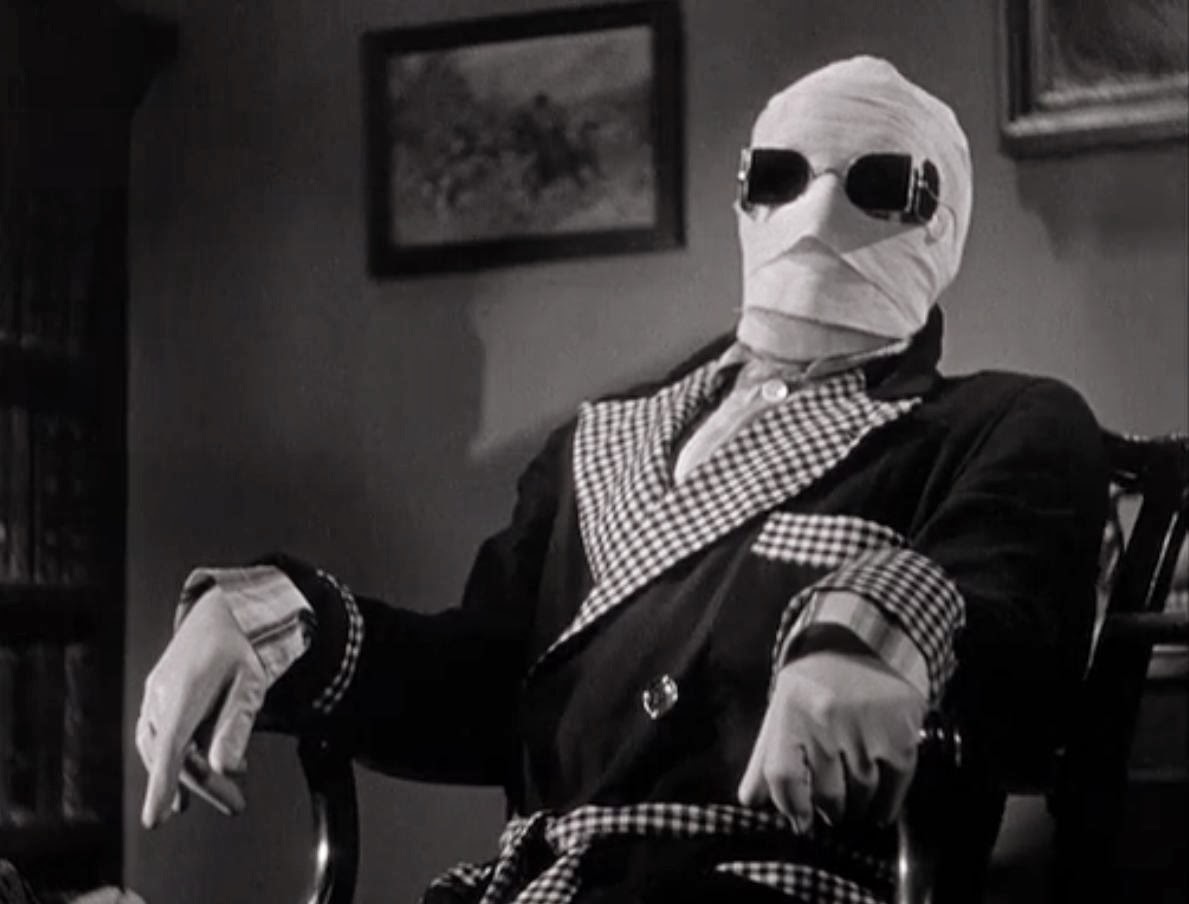
THE INVISIBLE MAN: The Id

The Invisible Man (1933) may boast the most truly despicable of all Universal villains (left). While it could be argued that Dracula was more evil, one could not say with all confidence that he was innately so. His origin, his turn to the nocturnal life of the God forsaken, is unknown to us, our theories of the source of his malice pure conjecture. It is as if he always was-- one of Heaven's fallen angels. He was, in whatever fashion, created, just as the Monster and his Bride. The Mummy was a banished soul, the Creature from the Black Lagoon was a soldier of and for Mother Nature, the Wolf Man was accursed... The Phantom of the Opera (1943), interestingly also a a faceless Claude Rains creation, is the only other psychopath on par with the invisible scientist Jack Griffin, whose downward spiral is a choice. The entity that is left when he surrenders his mortal flesh-- his appearance of humanity-- is composed entirely of wicked abandon, total self-interest, intense loathing, bitterness, and homicidal tendencies. He is known to frolic naked and cackle maniacally at the joke of human vulnerability and fear. His conscience, his compassion, his sympathy are as vacant as his form. From the original novel by H.G. Wells to James Whale's cinematic interpretation, we are left to deduce that the bare essence of humanity is a Devil. Griffin didn't need to be pushed, bitten, or condemned to become the morally deprived menace he transforms into. He just needed to chip away at the charade of civility to unleash the Hell hound within.

A man ungoverned and totally at liberty, immune to judgment, and possessing something akin to an omniscient power, Griffin can through his pure stealth terrorize for the sake of terrorizing, seemingly penetrate walls, be as the fly on the wall, and-- with no one to account to-- be as bad as he may, devil-may-care. He is thus our inner deviant child-- the little son of a bitch that whispers in the ear and makes us think sinful thoughts, enjoys pulling girls pig-tails, and bullying kids on the playground. This is why we find I actions at times hilarious-- a fact Whale picked up on with his ever astute sense of humor. We would probably perform pretty horrid actions were it not for the learned behavior of cooperation with decency. Imagine being free of the need to "behave." Every rude or politically incorrect thought one has ever had, can suddenly be spoken aloud when there is no shame of having to face the consequences. With no face, and nothing to hide, the lurking ghost that haunts our better judgment can easily take the wheel and use it to ram the car of reason into brick walls, over cliffs, or straight into a pool of sitting-duck pedestrians. Anyone who annoys you can be bitch-slapped. Anyone you've wanted to publicly embarrass, humiliate, or hurt, you are free to harass. There are no boundaries. Who wouldn't go drunk with power? The trouble is that this little demon child has run amok for too long. Just as loss of order turns people into looting, raping, and pillaging animals, so too does the complete lack of restraint birth a murderous, ravenous, incendiary character who has no remaining goodness to counterbalance his ever increasing catalogue of sins.

We all have certain vanities that, were they left unchecked, would lead us down a checkered path.  Griffin's flaw was his greed-- his need to indulge his God complex-- a popular theme in the Monster films-- by making a great scientific discovery. Using himself as his own test subject, because he lacks the patience or the ability to share the glory of his innovation, he further feeds his narcissism. Certainly, he will be remembered as Jonas Salk for providing the masses with his genius discovery. Be careful what you wish for... It is not the Devil with whom Griffin has made a bad deal, but himself. He made himself the God of science and is neither answerable to nor able to blame the God of Man. He concocted the potion. He performed the disappearing act. He condemned himself to shapeless limbo. He too is the one that chooses malevolence over humility when he arrives at a place of existential confusion. As such, he is the Devil we all have on our shoulders grown large. It is fitting that he disappear-- that this level of self love and selfish abandon be invisible to the naked eye. The more he submerges himself in his most insane desires, the more he loses touch with reality and banishes himself to some foreign and utterly contemptible level of consciousness. It is only after this demon is exorcised that the real Griffin reappears-- a malicious voice finally given a face. With Rains' tense and crazed movements when visible in his robes and bandages, and the perfectly snarky, heedless, and toying cadences of his voice, he creates one of the most sinister horror villains that never was. We recognize the crookedness of Griffin, and we even envy him for being able to be so unabashedly, unapologetically crooked for awhile. Still, man needs order to survive. The alternative is chaos. If this movie doesn't scare someone straight, I don't know what will. (The Invisible Man's skeletal face of absence, his soul already cast to the oblivion of his demonic mania, right).

To Be Continued in Part Two...