
Charles Spencer Chaplin
The spectrum of artists who built Hollywood is so wide and vividly populated that it is hard to generalize or define its true founders. The different talents and innovators who crafted the grandest level of artistic achievement-- a consummation of all artistry-- are incalculable. They wear many faces and many hats, some of which the audience never saw. However, when you whittle it all down, it isn't too extreme a statement to make that in the beginning, there were three. If Griffith gave the movies art, and Pickford gave it a face, then it was Chaplinwho gave it it's most useful and universal ingredient: heart. Marilyn Monroe once said, "If you can make a girl laugh, you can make her do anything." And so it was that Cinema's chief clown was able to endear himself to a worldwide audience and win their loyalty by giving them that oft sought and too little found human emotion: joy. But there was more to Charlie than his familiar "little tramp" schtick, for he too had art, and he too had a face-- one which has outlasted Mary's in its relevance. His comedy outdid Fatty Arbuckle's because, while he portrayed down-and-out and sometimes manic characters, he was yet a buffoon with an edge of class. He was conscious while innocent, as calculating in his movements as he was in his story structure. His films too thematically outdo Buster Keaton's, making him the unexpected silent voice of reason, compassion, and human understanding. Buster awed his audience with surprising gags and awe-inspiring stunts; but Chaplin used his creativity just as concentratedly to make people feel as to astound them. And this, he did accidentally. He didn't set out to take the world by storm, nor to become the greatest fighter the underdog ever had. That's just how life played out. Then, just as quickly, the world that he had brought to its feet in applause turned its back on him. Life is funny...
~ ~ ~
Charlie Chaplin started out as many folks do who learn to use laughter to overcome their personal pains. He entered the world on April 16, 1889 in London to parents Charles Chaplin, Sr. and Hannah Hill. He had an elder brother, Sydney-- a "bastard" from one of Hannah's earlier trysts-- and after his parents' marriage hit the rocks, he would be gifted another illegitimate brother, Wheeler, from whom he was parted and would not see for many years. He was, thus, his mother's only "legitimate" child. This made life no easier for him, and he never saw any difference between himself and the elder brother he adored. The family was impoverished, with Hannah earning money intermittently as an entertainer and a seamstress and Charles Sr. rarely pitching in while he enjoyed a measure of success as a singer. Charlie found himself growing up quickly, sharing the responsibilities of running the household with his equally responsible elder brother Sydney. Hannah, in Charlie's memory, was a wonderful woman: loving, tender, and talented. An uncanny mimic who put on shows for her two boys, telling them stories of the different townspeople she saw passing below their window, Hannah would give Charlie an early education in characterization. Sadly, she too was losing her mind, which was a part of her family's unfortunate legacy. Luckily, none of her sons seemed to inherit the gene that mentally crippled her. When times got rough, Charlie and Sydney found themselves shipped off to a workhouse and the London District Poor Law School of Hanwell, where Charlie received little more than a bout of ringworm and the pain of isolation from his loved ones. After Sydney decided to go to sea as a steward and bandsman (he played the bugle), dutifully sending money home to his family, Charlie became his mother's official caretaker. He took odd jobs selling flowers or working as a barber's boy to help supplement income. One night, he came home to the news that his mother had "gone insane." At the age of 13, he was forced to walk her himself to the infirmary where she was to remain for some time. The moment of goodbye was one he would not soon forget.

A young Charlie as Billy the Pageboy in "Sherlock Holmes."
The odds seemed stacked against him, but Charlie had a few things going for him. One was his drive; the other was his natural talent. He and Sydney both shared a love of performing. Charlie once said that his love of music, and thusly his love of entertainment, was born when he heard the song, "The Honeysuckle and the Bee" when he was a child. His first venture on stage occurred when he had to save his mother from disgrace when she was unable to finish what was to be her final professional performance before a rowdy, unforgiving crowd. Charlie stepped in, sang her song for her, and the coins started flying. He stopped singing mid-song to collect them all, telling the audience he would not continue until he had them all rounded up! Herein we see the mixture of Charlie the ragamuffin entertainer and Chaplin the businessman. Somewhere in his little boy's mind, he had discovered something very important: he had learned how to make money. Later, at the age of nine, he would travel with William Jackson and "The Eight Lancashire Lads." He continued intermittently, while still caring for his mother, to obtain various roles, including one as Billy in "Sherlock Holmes." By 1908, at the age of 19, he was making waves in the infamous "Inebriate" act in "Mumming Birds" with Fred Karno's troupe. His part was a "play within a play." He portrayed an intoxicated man watching the performance and making quite a scene himself. Naturally, his physicality and buffoonery stole the show and got him quite a bit of notice. His traveling companions would all remark at the strange juxtaposition in his nature. He was so alive, so unabashed, so warm on the stage. Afterward, he would quickly turn inward. He spent his time reading, trying to tutor the mind that had received no formal education, plucking on his violin, or staring solemnly into space, ever lost in thought. He was a loner. He kept to himself. He was distant... Hardly the bawdy comedian prototype.

the film that proved that humor could last for an entire feature.
By 1912, he found himself in America still touring with Karno. A year later, he was offered a contract with Mack Sennett, who had seen or caught wind of "the inebriate swell" gig. Mack had been expecting an elder gentleman, as befitting Charlie's make-up on the stage, and tried to renege on the offer. Charlie assured him that his age would not hamper his ability to contribute to Keystone. The rest, as they say, is history. In his second film, Mabel's Strange Predicament (released third), Charlie's beloved "Tramp" stepped before the camera. The legend of his birth is heavily contested, with everyone wanting a part of the glory. In some tales, his pants were borrowed from Fatty, his shoes from Ford Sterling, etc; in others, Charlie haphazardly assembled the costume and serendipitously created a phenomenon. The truth is perhaps somewhere in between. The eternal calculator, Charlie certainly put thought into the look and the character he was fashioning that fateful day. All that is known for certain is that he based his signature walk on an unconsciously hilarious neighbor from his boyhood: "Rummy" Binks. Looking back, it seemed as if the hand of God guided the formation of the Tramp: his dirty, ill-fitting clothes, silly mustache, jerky movements, yet prim disposition, created a character of both dignity and irreverence. The Tramp was a sweet soul deep down, but he too did whatever he he had to do to get by. Thus, humor and grace were enveloped under a dusty derby, and America was enthralled. Through films like The Immigrant, Easy Street, and Shoulder Arms, Charlie's career started soaring. A shrewd businessman, who was not so much in it for the wealth as for the security, he and his brother Sydney negotiated more and more creative and financial freedom into his contracts. He bounced from Essanay, to Mutual, to First National. His films became his own personal vehicles under his own direction, and the stories he chose to tell always sold well.

Charlie and Jackie Coogan developed an incredibly close
relationship during The Kid, Charlie's first feature-
length directorial effort. It was a smash success.
Feature films would take his visual narrations to a whole other level, and the work he did at his own Charlie Chaplin Studios would change cinema storytelling forever. His craft as an artist was dedicated, focused, and perfectionistic. A kernel of an idea would give birth to scenes, which led to plot-points, and soon he had built-up an entire story. He would work his stories out on the spot most of the time, trying out an idea, fashioning it in a new way, reworking it, implementing some lucky bit of business that happened on the spot, etc. His efforts were painstaking. Yet, as exacting as he was in his ambitions, he still made room for input, listening to others' advice or accepting ideas from everyone on the set. At the end of the day, what Charlie said went, but he never made a final take without weighing every possible alternative. He wanted to give his audiences the best product possible. All too often, he would awaken weeks after a scene had been filmed and decide that he had done it wrong or that it could have been done better. He was never satisfied. When these (imagined) errors could be corrected, he would drive his more penny-pinching brother Sydney mad with the expenses, retakes, and wasted film incurred. When too late, Charlie would have to live with the disappointment. And he was always disappointed. He always chased the perfect compromise between idea and execution and was interminably hard on himself when the result wasn't so. The effect was a very tired man. He worked all day, directing, acting, building scenarios, editing, composing music-- work work work. He worked to eliminate the painful thoughts and memories, the loneliness that haunted his private life. All too often, he would return home and have to be nearly carried inside by his chauffeur because he had exhausted himself to the point of muscle failure.
Charlies' private life is something to note. It is also something that remains a scandalous stain on his otherwise impeccable creative life. The opposition to Mr. Chaplin over time would be a combination of his romantic life and his political leanings. The source of the former is the story of his unconsummated love for Hetty Kelly, the young woman with whom he fell in love during his initial Karno stint in 1908. She was a "Yankee Doodle Girl," who by some curious method has was able to charm the emotionally evasive Charlie out of his shell and into a fog of incurable adoration. The stony exterior he had been building up after a harsh life was finally being penetrated. Hetty was initially receptive to his bashful, romantic overtures. Unfortunately for Charlie, it appears that Hetty's mother had other aspirations for her daughter, and didn't want her to wind up with an impoverished actor. Hetty, after an assumed reprimand from the senior lady, turned suddenly cold. She refused to see Charlie anymore. He was heartbroken. After he went to America, perhaps subconsciously driven by the hope that he'd make good and be able to win Hetty back, he received word that she had gotten married to Lt. Alan Horne. The courtship of Charlie and Hetty had been brief-- but eleven days-- and Charlie once calculated that they never spent more than 20 minutes together. Still, he never forgot her. Hetty would pass away prematurely after catching a nasty bout of pneumonia following the influenza epidemic.

Charlie and soon-to-be second wife Lita Grey during The Gold Rush. She would become
pregnant during early filming, which gained her a husband but clearly took her out of
the running for the lead role, which was awarded to Georgia Hale. The
marriage would not be a pleasant one.
Perhaps it was in the desperate hope of recreating his dream girl that Charlie seemed drawn to the same brand of young women. But, there is more beneath his disastrous marriages to the 15-year-old Mildred Harris (instigated by a fake pregnancy) or the 15-year-old Lita Grey (real pregnancy) than misguided devotion. His tendency toward young, unworldly girls insinuates more his need for a measure of control. He chose beautiful, assumedly uncomplicated vessels that would not make demands on him or his work. Unfortunately, this resulted in the opposite effect. Immaturity requires constant attention and consequently results in frequent fights. Charlie thus fell prey to his own romantic ignorance, becoming attracted to a princess only to be confronted by a monster of his own creation. Yet, he was not a cold-hearted, selfish person, and treated his wives well, giving them a good home, and providing for his sons (Charles Jr. and Sydney, both by Lita). What he couldn't give was himself. After Hetty broke his heart, he could only put his most ardent passion into his work. Thus, his young brides were left in a cold, empty home with a ghost of a husband. Of course, the ladies weren't innocent either, having latched onto Charlie for more fiscal than emotional purposes. Charlie seemed to forgive the Mildred fiasco over time, even after her lawyers tried to seize The Kid as monetary property, but hurricane Lita became a matter that Charlie would never discuss. His strongest relationship was with glowing third wife Paulette Goddard, a feisty, mature equal whose compassion and light-heartedness earned her Charlie's respect and two of the largest female roles in any of his films (Modern Times and The Great Dictator), but even this match was not to last. His friendship with Douglas Fairbanks always had a way of bucking him up, but Charlie had little outside his work. He wasn't a social butterfly, and despite his constant performer antics, he was quite bashful around people he didn't know, particularly people he considered far more posh than himself. He wasn't extravagant with his money, and it was years before he ever bought himself a tailored suit. He was sitting in the lap of luxury, but didn't know how to enjoy it. The quiet moments of his life were unendurable and lonely. In private, he remained an isolated little boy. At the studios, he was in total control of his genius. All the more reason to work.

Charlie's initial concept for The Circus sprouted from the gag of him
ungracefully trying to tight-rope while unruly monkeys climbed
all over him.
The body of work that Charlie compiled is beyond description or praise. City Lights, The Gold Rush, The Circus... Whatever issues he had in private, the public would never have known. Charlie was a man on a mission, whatever that mission was from project to project. He seemed to have an almost psychic ability when it came to the social stratosphere. In honor of his mother, he lambasted the hypocrisy shown against women in general, and particularly against unwed mothers in A Woman of Paris and The Kid, (the latter film in which he also expressed his own deep sorrow over the death of his first born son by Mildred). He lambasted the replacement of technology and profit over mankind in Modern Times. He confronted the ugliness of facism in The Great Dictator before most others had registered the dangerous tyranny surfacing in Germany. (Charlie later said he could never have made the movie had he known about the level of devastation in the concentration camps). Wherever he was in his life, whatever he was feeling, whatever direction he saw the world moving in, he allowed himself to make a commentary on it. This is what got him into trouble politically. Time and again Charlie was labeled as a communist. Why? Mostly because he gave a damn about humanity and didn't apologize for it. He would more appropriately label himself as a "non-comformist." Primarily, he was just a simple humanist. His work and its depiction of the mistreatment of the lower classes, the ambivalence of the wealthy, and the hypocrisy of society in general had always inadvertently ruffled feathers. Certainly, on some level, Charlie believed in what he preached, but his message was primarily subliminal. The point was always comedy.
However, his early advocation that we send troops to the German front during WWII caused a stir. For a society in turmoil and trying to escape war, the appeal to bear arms from the most popular man in the world made people nervous. After the war, when fear turned to the paranoia during the Cold War, Charlie's open-mindedness and curiosity about various people and politics too began to chafe certain government officials. Charlie was never a communist, but he respected a man's right to believe as he wished. Just as he brushed off accusations that he was Jewish, ("I do not have that honor") due to his loyalty to his half-Jewish brother Syd, he would be honest but evasive with reporters when they pressed him for information regarding his alleged "red ties," mostly because he didn't consider it any of their damn business. Changing tides and attitudes caused the once loving public to turn against Charlie. Suddenly, he was being harangued for not ever obtaining American citizenship-- a choice that he had made not of disloyalty to the Western country he truly loved but out of nostalgia to his boyhood home. He failed to cooperate with any government officials that badgered him, and he publicly stated his disagreement with the quickly growing HUAC madness. Most of his contemporaries remained silent during the tumult, whereas Charlie spoke up. He had faith that the mania would blow over, but it was not so. It is hard to imagine a world so irrationally misdirected that it would seek out and invent criminals to feel more secure, but history has led us down this road more than once. Charlie became one of the many bewildered victims of the movement. In a nation so anxious that it sought out cries of Unity from every corner, Charlie's continuing films-- which proceeded to ask society probing questions about its very soul-- was a boil on the butt of Joseph McCarthy's lack of "decency."

The maniacal gibberish that Charlie concocted for his German villain, "Dictator
Hynkel," was ad-libbed on the spot and totally captured and satirized
the vainglory and maniacal oblivion of men with God complexes.
The truth was that no evidence could be found to truly support that Charlie was in any way, shape, or form a communist, and his every effort (including his contribution to the war bond tour) clearly implied his loyalty to the United States and his desire to protect and serve its freedoms. Despite all this, certain far-far-right factions pegged Charlie as a threat. It is rumored that Hedda Hopper herself (Hollywood's number one anti-communist spokeswoman) urged his former lover Joan Barry to take him to court over his alleged illegitimate child (proven beyond a reasonable doubt not to be his, but no matter) in order to besmirch his otherwise spotless character. The man who had made America laugh for nearly forty years was, thus, suddenly the butt of the joke. He would continue on after the malicious scandal, film Limelight-- his poetic opus to the aging entertainer-- then set sail for Europe for its London premiere on Sept. 17, 1952. Once abroad, he was alerted that he was barred from returning to the land where he had built his life. Attorney General James McGranery had rescinded his re-entry permit with a little help from a US Code of Laws on Aliens, which "permits the barring of aliens on grounds of morals, health, or insanity, or for advocating communism." Later McGranery admitted that he had taken this abrupt action "without consulting any other government departments."
Charlie's heart was broken. America had given him a life beyond his imaginings, but it too is safe to say that he had given the nation just as much in return. Now, he and his young bride and love of his life Oona O'Neill were sent adrift with a brood of children that would grow to reach nine (11 counting his two sons with Lita). They eventually settled in Switzerland. During these tough years, Oona became a perfect counterpart to Charlie. Though thirty-six years his junior, she possessed a maturity, devotion, and independence that was infatuated with his genius, considerate of his needs, and tolerant of his flaws. The duo would raise eyebrows, but their marriage lasted until Charlie's death. While getting up in years, Charlie's most provocative and enchanting work was done, but he was still consumed by the creative process, making A King in New York to directly confront the witch hunt that had ostracized him from America soil, and finally directing Marlon Brando and Sophia Loren in A Countess from Hong Kong. The Tramp character was long since gone, having essentially been put to rest by the talkies, and the "art of pantomime," which Charlie had preached was the breath of life in cinema, died with him. The world of film had changed and the big shoes Charlie had left to fill no longer even fit himself. He continued writing and planning new epics, but his best work had become a memory of the land of long long ago. Eventually, he would be honored for his life's work in film with various recognitions and awards (including an Academy Award for Lifetime Achievement), and he was welcomed back to America with guilty, open arms. He too forgave, was touched that he was still remembered, and was reassured that the good in man will triumph eventually-- a notion he had preached in all his films.
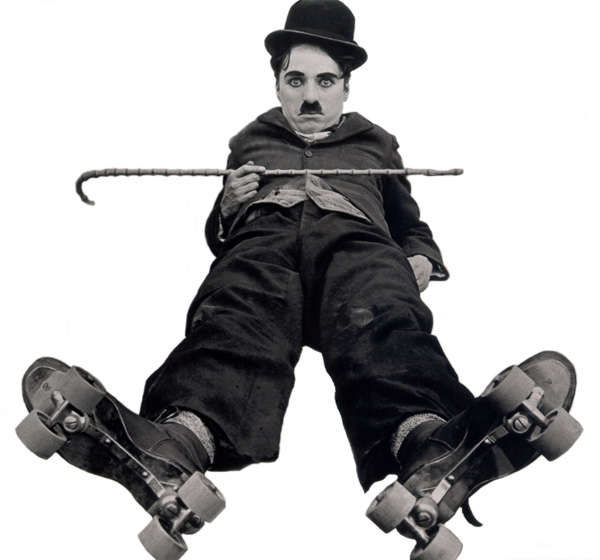
Charlie's infamous skating routine in Modern Times was accomplished with the help of
mirrors-- but his blindfolded abilities remain impressive nonetheless.
Charlie Chaplin died on Christmas day in 1977. That sentence alone required pause-- a moment of silence. It is hard to fathom that such an individual existed, let alone come to terms with the fact that a presence so strong is with us no more. For all of the controversy and mudslinging he suffered in his life, Charlie's true fans never forgot him. Generation after generation, when viewers are introduced to him, they are introduced to a man of great principle, honesty, and hope. One with a dark heart could not inspire a world to laugh as he did, nor share their joys together for those brief moments when their threadbare, floppy-footed hero convinced them that we are indeed not in this mess of life alone but together. As he himself said, "It is paradoxical that tragedy stimulates the sport of ridicule... Ridicule, I suppose, is an attitude of defiance; we must laugh in the face of our helplessness against the forces of nature-- or go insane." And so, a little boy from Great Britain who had endured madness, heartbreak, poverty, and intolerable loneliness, fought his demons off with laughter and let us join in with him. The world continues to laugh at him, with him, and to idolize him, because even in silence, his Tramp speaks the truth. He may walk off into the sunset alone time and again-- without a plan, without a hope in the world-- but he always disappears with a swinging cane and a skip in his step. His fight is never over, and his audience is left to believe that a better day will dawn and that, even better, they will see their delightful friend again somewhere down this windy road.


