FYI

Don't forget to refer to my Contents page for a more convenient reference to past articles.

For More L.A. La Land, visit my writing/art/film appreciation site on Facebook at Quoth the Maven and follow me on Twitter @ Blahlaland. :)

Showing posts with label Shirley MacLaine. Show all posts

Thursday, April 24, 2014

THE REEL REALS: Shirley MacLaine


Shirley MacLaine

On this, Shirley MacLaine's Birthday, it only seems appropriate to celebrate the great lady. And she is great. She's fab'. She's talented. Mostly, she's fun. Shirley's great allure as an actress is her immediate accessibility. She is a down to earth and open woman whose sincere presence and authentic approachability makes her more of a chum than a movie star. In truth, one doesn't really equate her with the grand glamour of the typical Hollywood goddess, and this certainly isn't because her effect is any less profound. It's because she wouldn't want it that way. Even in her characterizations, she cuts through all the BS and the posturing and gets to the meat of the matter, whether to do so she has to paint herself as a clown, a crab apple, a vulnerable child-woman, or simply a breath of fresh air. You can't help but fall in love with her. A member of the original Rat Pack, and a woman who was able to get Robert Mitchum to fall head over heels for her, she must have been doing something right.

I've always found Shirley's work much more fascinating than her actor/filmmaker brother's. What Warren Beatty was unable to totally strip off in terms of emotional exposure, Shirley did without effort. An intelligent and insightful actress, her smarts do not reveal themselves in pompous intellectualization but are rather insinuated through her actions and receptivity. Shirley openly indulges in her personal life in expeditions into a "higher plane" of consciousness and general existence, and this is evident in her work. Her accuracy in interpreting the world she sees around her is razor sharp, and indeed it hits you right in the heart when her gritty, earthy honesty is truly unleashed (Terms of Endearment, The Apartment). Like all the best actors and actresses, her craft is seamless. It effects you without showing its hand. Mostly, she is just enjoyable to watch, even in her dramas. There is a lightness to her spirit that elevates the viewer and provides a safe place in the theater, the living room, etc. When she's on screen, one can relax, sit back, and just let whatever brazenness or intensity is about to occur unfold, because what she gives occurs on the screen is delivered and shared through one of the most genuine of performers.

Shirley was (and is) a hard worker who earned her stripes on the stage, where she got her start as a dancer. When she filled in as an understudy for an indisposed Carol Haney in a production of "The Pajama Game," she was recruited by Hal B. Wallis and signed at Paramount, a little twist of fate that would change her life and reward her fierce persistence and devotion to her art. Her first picture was, in fact, with the notorious Alfred Hitchcock in the dark comedy The Trouble with Harry. Hitch was pleased to be working with a film acting novice, as Shirley's adaptability to his very specific directorial touches were unencumbered by the typically jaded experience of most stars. Her charisma was instant, as was her strange blend of innocence and ripe but natural sex appeal. Her reputation only grew as she showed that she was more than a pretty face, adding gravitas to her performances in The Apartment (as the jilted and suicidal lover), Some Came Running (as the "low-class" but adorable martyr), and The Children's Hour (as the deeply conflicted and unaware homosexual whose life is torn asunder by rumor).

Shirley had a gift for tragedy, which she often revealed through her comedy. Her heroines were never simple, one-level ladies. Even her big musical triumph Sweet Charity revealed this as she created a woman from the wrong side of the tracks with a heart of gold. She exposed a deep hurt that was combatted by courage, in this and all of her films. As she matured, so too did her work, and her abilities as a character actress were more fully realized as she entered the 1970s-- Two Mules for Sister Sarah, The Turning Point, Being There, Steel Magnolias, Postcards from the Edge, etc, etc, etc. The result of her compelling work has been a legacy of artistic integrity and resounding industry (and public) respect. The woman is still going strong, committed to telling stories, embracing life, and sharing the beauty of it through her performances.

Yes, I'm a fan. She's the bees knees. (Also has an awesome birthday. Just sayin').

Monday, April 1, 2013

STAR OF THE MONTH: Robert Mitchum


Robert Mitchum: Don't be deceived just because it's April 1st.
He's nobody's fool.

True story: when Charles Laughton began preparing for his first and last onscreen directorial effort-- the dark, fairy tale nightmare Night of the Hunter-- he became convinced that no one else on earth would be better for the role of the murderous "Preacher Harry Powell" than the snake eyed Robert Mitchum. He feared Robert's rejection, because Powell was an outlandish, bombastic character unlike anything the underplaying actor had ever performed. Still, he made his pitch:

Laughton: Bob, we have a story here we are hoping to turn into a little film, and I would very much like to talk to you about the leading role. The character is a bit different. He's a terrible, evil... sh*t of a man.

Mitchum: Present.

There you have it: Bob in a nutshell. Robert Mitchum kept it real. Never catering to expectations nor indulging in diva tantrums, he eschewed all forms of pretension or formality and openly indulged in his inner bad-ass. But Robert, despite being the King of Cool, was a bit of a pretender himself. His act of the cynical drifter who didn't give a damn was an exaggeration of his true self. His mask of devious detachment and impassion was a front to deter those around him from his secret vulnerabilities, his artistic drive, and his surprising intelligence. Still, girls went ga-ga for him, because he was "a little bit evil" and they dug it, and his same disenchanted, searching soul was the one that gave him incredible depth as both an actor and human being. 


Bob and wife Dorothy.

Robert Charles Durman Mitchum was born on August 6, 1917 to a Scots-Irish and American Indian mutt, the charismatic and combative Jimmy Mitchum of South Carolina, and the more easy-going and artistic Norwegian, Ann Harriet Gunderson of Connecticut. He would be equally endowed with components of both parents, inheriting the willful, fighting, liquor-loving penchants of his father and the more poetic and intellectual sensibilities of his mother. The middle child was sandwiched between elder sister Annette (who later changed her name to Julie) and younger brother John. At a mere 1 1/2 years of age, Bob's father was killed while working in Charleston's navy yard, crushed between two box-cars-- a common occurrence in those days. A deeply mournful Ann moved her family back to New England for a time, then back to South Carolina, and later to Delaware, where Bob spent the majority of his formative, youthful years. Already, the spirit of the gypsy was in him. His family would only ever know the warm, sensitive, romantic side of Bob's nature, and would be surprised when they learned that he had gotten into fights with local boys or had yet again been kicked out of school. The irony was that Bob was the smartest kid in his class. Adept with what can only be called a photographic memory and a highly intuitive, comprehending mind, he was often the one to point out the teachers' mistakes. School friends never saw him take a book home to study, because he already had his entire lesson memorized and figured. Yet, Bob was also the student to get in trouble for playing pranks on teachers, cutting class, or causing a general ruckus. As a poor kid, he had a well-ingrained distaste, not only for spoiled, oblivious people, but also any kind of authority figure. He would always carry a chip on his shoulder, yet as he matured, he at least learned how to pick his battles, probably knowing that he was smarter than any of the supposedly learned elite who were barking orders at him or making fun of his impoverished family.


Checking out the gorgeous merchandise of lifelong pal Jane Russell in
the comic thriller His Kind of Woman.

After he was expelled from his high school at the age of fourteen, Bob hopped to a train to... anywhere. There was no plan. There was no ending point. He just wanted to move around, see the country, and let it ride. He would hop trains with the rest of the hobos, often jumping off for his dear life when the cops on board discovered them and starting shooting! He would end up stranded in various places, work for a little food and money, roam a bit, then hop back on. Various poems and letters to home kept him mentally busy on quiet nights passing through the country, in addition to alcohol and a little something called Marijuana, or as he called it, "the poor man's whiskey." Eventually, he was forced to return home to his mother's care, (she was now remarried to Major Hugh Morris), after he was bitten by a poisonous snake, and his leg became infected. The doctor wanted to amputate his leg, but Ann, with her bohemian wherewithal, concocted her own natural potion of herbs and roots to save her son's life and limb. It was upon his return to Delaware, where he was limping around on crutches, that he met his brother's latest love interest, Dorothy Spence. Only thirteen-years-old, Dorothy didn't move as fast as the other girls. She was modest, unassuming, and thoughtful. Bob took one look at her and said, "She was it... And that was that." John didn't take it too hard when Bob started working his way into Dorothy's heart, but Dorothy thought Bob was a bit of a pompous nut when she first met him. Then, he started laying on the Shakespeare. And the lyrical quotations. And those thin, penetrating eyes... Soon, they were in love. 


Bob and Burgess Meredith in the groundbreaking Story of G.I. Joe.

Bob built his scrawny, slender frame into a muscular powerhouse when working with the Civilian Conservation Corp. at the age of sixteen. Then, he packed up with his family to try things out in California, where his entertainer sister was already making a go of it. He swore he would return for "Dottie," then headed for a new life as a beach bum. He had been earning a little dough here and there to support the family, including a brief stint as a boxer, when sister Annette literally pushed him on stage to audition at a local theater. Bob wasn't openly interested-- acting was for "sissies" after all-- but secretly he had a natural penchant for performance that had lain dormant for far too long. His family had also noticed his hamming, impressions, and general theatrics, and because of their influence, he accidentally earned himself a role in the play "Rebound." He would take on odd jobs and various roles after his debut, but he continued to avoid commitment to the craft. He was also making money on the side by penning songs, lyrics, and "patter" for local variety and musical acts. He was mostly focused on earning a solid living, so he could start building a life with Dottie. Yet, the signs were clear from the get go. Critics and cast members were blown away by his incredible stage presence and subtle acting style, not to mention his easy use of slang and incredibly verbose vocabulary. For now, he was getting by, so he and Dorothy got hitched, she relocated to California, and they moved into the former chicken shack in the family's back yard. (Dorothy probably had second thoughts).

It wouldn't be small potatoes for long. After his first son, James, was born, Bob nearly went blind working for Lockheed. His mother suggested he look into the picture business, and soon he had nonchalantly gotten himself an agent and a string of roles in B-Westerns, including the Hopalong Cassidy series. The laid-back, man's man world of this brand of cinema was a good place for the skeptical Bob to start. Had he been introduced to the more materialistic and inflated world of slick Hollywood filmmaking, he probably would have run for the hills. As it was, he easily grew comfortable in front of the camera. He would arrive on set, take a look at the script, memorize it in one reading, then hit his mark. Of course, more work went into it than he would ever admit, and many a director would confront him about his feigned indifference. Not only was his bold, distant, yet inviting onscreen persona getting notice and praise, but those he worked with knew that he was actually the hardest working man in show-business. He put great thought into his characterizations, making them somehow more authentic and real, whereas most studio actors gave essentially superficial, "get my good side" performances. After three years, Bob had his big break in Story of G.I. Joe, in which his human and heart-breaking portrayal of "Lt. Walker" earned him his first and only Best Actor nomination at the Academy Awards. He bounced from Westerns, to Noir, to Drama, and back again, proving his versatility and earning countless numbers of fans.


Bob and buddy Jane Greer in noir classic Out of the Past.

When he was signed with RKO, his "type" would be forever solidified. In complex thrillers and noirs, he would become the disenchanted outsider with questionable morals-- complete with cigarette and trench coat. His career would include a long list of impressive credits, including Out of the Past, His Kind of Woman, Angel Face, Night of the Hunter, and The Sundowners. These were his trophy pictures. Bob was always willing to "go there," to investigate a character with more cracks and fractures than the typical pretty boy role. He had no concern for his star power, his name above the title,  nor the size of his role. He was more interested in doing a job and doing it well. The surprisingly innocent blend of masculinity and slight ignorance he molded for Heaven Knows, Mr. Allison and the intensely sexual and sinister creature he created in Cape Fear are testaments to his profound capabilities as an actor. What enhanced his edge was his mystery. You can never quite figure Robert Mitchum out. Even his family would draw a blank when asked to sum him up or explain his behaviors. A traveling gypsy to the end, he was his own island, and this quality intensified his onscreen roles. That's not to say he didn't partake in his share of stinkers, he made quite a few of them with his career enduring its ups and downs, but in the end, he always improved whatever project he worked on just by being in it. He didn't care if a movie wasn't a hit; he didn't go to see them anyway. He was more concerned with the paycheck and putting food on the table to feed his brood of eventually 3 children: Jim, Chris, and Petrine.


Showing his true colors as the murderous "Preacher Powell" in 
Night of the Hunter.

In his personal life, Bob was also a conundrum. He could drink like a fish, and he occasionally turned violent or unexpectedly and confusedly enraged when under the influence, yet he would walk on the sound stage the next day, no worse for the wear, as if he had gotten 12 hours of beauty sleep. He was a brilliant conversationalist and orator, but he had few friends and even fewer in the entertainment business. He was able to strike up camaraderies with guys like John Wayne or Frank Sinatra, but his most enduring friendships were with women of class, substance, and smarts like Jane Russell and Deborah Kerr. He was very protective of women who were fragile, such as Marilyn Monroe or Rita Hayworth, whom he never approached in a romantic fashion but watched over like a brother. Some of his co-stars simply bored him, because they were self-absorbed "bimbos," but he worked well with and respected hard-working, down-to-earth girls who enjoyed his naughty, uncouth sense of humor-- like Janet Leigh and Jane Greer, who both adored working with him. That's not to say Bob always kept things platonic. Inheriting his father's demons and probably suffering from the lack of a real father figure, Bob would engage in many an irresponsible affair, including one with Ava Gardner and a more infamous relationship with Shirley MacLaine, with whom he fell deeply in love during Two for the Seesaw. Dorothy overlooked the indiscretions time and again, because she knew he would always come back to her with the same old excuse. Bob didn't seek out these infidelities necessarily; mostly, he just found himself unable to resist when a temptation was so energetically placed before him. Shirley was the only woman who ever accidentally threatened Dorothy's place as the only real woman in his life. Yet, as always, Bob came back. He and Dorothy remained married until his death in 1997. (He was just shy of 80-years-old).


A haunted, rare look at the cinematic tough guy in Where Danger Lives.

Bob's essential problem was his pair of itchy feet. He was a born adventurer with a fear of monotony, traps, or snares, (and he'd had his share of them with multiple arrests in his life, including the Marijuana scandal, which was coincidentally later expunged from his record after a set-up was uncovered). He would never stay anywhere for long. He was a loving father but an unemotional one. He was there when someone needed him, but he was mostly distant and lost in his own thoughts. One of the reasons he liked acting was the ability it gave him to travel-- to get going before things went stale. Back and forth, here and back, home and far and away, the native blood in him couldn't stand still. The philosopher in him couldn't sit idly nor ignorantly. His cross to bear was his need for more and his own secret fear of rejection-- his unfortunate theology that opening up fully or being truly emotional was wrong. What he felt, what he carried within him, he carried alone, wandering, seeking, and solving all of life's mysteries before his own life was over. The little snippets of his personal discoveries can be gleaned from the identities he created in Dan Milner, Max Cody, Preacher Harry Powell, Jeff McCloud, Lucas Doolin, and Charles Shaugnessey. Moviedom's master poker player, Robert Mitchum never showed his hand. But then, when you're holding aces, you don't need to.

Wednesday, July 4, 2012

MENTAL MONTAGE: Movie Stars on the Radio


The body (minus the leg warmers) that inspired America to "do the
Jane Fonda..." and Mickey Avalon to write a hit song.


When it comes down to it, movie stars are nothing more than romanticized human beings: romanticized in their dramatic performances and romanticized in the public consciousness. They put themselves before the camera, and we place them on pedestals. And so, it is not really surprising that so many of our beloved celebrities become muses of song. In Byron's day, we would have read about some random, faceless damsel whom he was lusting over in one of his lyrical opuses. Today, instrumental inspiration often comes from a more obvious source, and so songwriters, rock-stars, and pop-idols reveal their own personal fanaticism by penning ballads and hit songs about the grand stars of cinema's bygone glory era. When these musical offerings are not straight-forward dedications to the Gods of Mt. Olympus, they are at least homages to the singular figures in our ever-growing pop culture.


Buggy Bette


The best celebs always have a trademark. For Harlow, it was her flaxen hair. For Flynn, it was his debonair mustache. For Bette-pop-eyed-Davis (left), it was her large, invasive peepers... (and perhaps a cigarette). Bette's luminous eyes did a great deal of her acting, taking her characters even in moments of stillness from anything from dewy wonder to murderous intent. As such, her baby blues inspired the lyrics to the 1974 Jackie DeShannon song, "Bette Davis Eyes," which described a dangerous coquette who knows how to use her sensuality to get what she wants: "She's precocious, and she knows just what it takes to make a crow blush." The song became more famous when it was re-recorded with minor lyrical changes-- crow became pro-- by Kim Carnes in 1981, where it became the #1 hit of the year. Bette was so flattered to be initiated into yet another generation of fans that she personally thanked Carnes for the "shout out." It meant a great deal to her that, years past her prime, she was still looked upon as the staple of female sexual power.


Jack White's Red-head


Alternative rock musician Jack White has enjoyed success in a number of realms: in various bands, in a solo career, as a music producer, and even as a film actor. His work is often interesting for its articulate yet untidy homages to different artists of the past. He makes no secret of his adoration for heroines like Loretta Lynn or Wanda Jackson, for both of whom he spearheaded new albums. His appreciation of the musicians of yesteryear is always apparent, and his respect blends mediums. Nursing a clear crush on the gorgeous Rita Hayworth (right), he made her the leading lady in the song "Take, Take, Take"-- his perspective on the draining and abusive side of celebrity. Released in 2005 on the White Stripes album Get Behind Me Satan, Rita Hayworth is described as being accosted repeatedly by an increasingly demanding fan whose obsession finally chases her away: "Well it's just not fair/ I want to get a piece of hair." The question both raised and answered is: "What price fame?"


Jack also pays a very direct homage to Rita's hubby Orson Welles in a Citizen Kane tribute. From the 2001 White Stripes album White Blood Cells, "The Union Forever" is totally comprised of pieces of dialogue from the Kane script. A seemingly impossible feat, White weaves the story of Charles Foster Kane (left) into a macabre translation of destructive capitalism and the ravages suffered by its most famous cinematic victim. "The union forever" is thus illustrated as a death sentence, and the painful life of isolation-- "It can't be love, for there is no true love"-- that Kane is left to suffer in his untouchable castle on a hill is sonically translated by White. In listening, movie fans can connect to the otherwise unrelatable character on a whole other level.


Hello, Norma Jeane...

Marilyn Monroe's (right) name pops up everywhere, so it barely joggles the mind anymore when she presents herself in song. However, the most famous and direct offering to Hollywood's sacrificed movie angel is Elton John's "Candle in the Wind." Released in 1973, Elton composed a cathartic release for a world still in mourning for the luminous star who died too soon. The song is particularly fascinating in the way Elton's empathy for the fallen idol and his poignant childhood memories reflect the powerful impact that she had and has maintained on the universal culture. Marilyn was as American as apple pie, but her beauty and vulnerability crossed over borders and oceans to reach people around the world. Few people can have such an amazing effect. Elton would alter the lyrics in 1997 to honor the death of another far-reaching woman, Lady Diana, after her equally shocking and affecting death, but the fact that Sir Elton's feelings of loss were as palpable for a starlet he never knew as they were for a close friend speaks volumes: "I would have liked to have known you,/ but I was just a kid."


In Thine Honor


The tragedy of Frances Farmer (right) has become one of the most famous cautionary tales about Hollywood: if you come here and try to maintain your independence, you will be lobotomized. I am hearing Marilyn Manson's "Beautiful People" in my head as I say this, as he has been known to make a commentary or two on celebrity (Hello, "Dope Show" and ass-less pants). But, a much less dramatic and equally tortured musician added his two cents to the Tinsel Town blood bank. Kurt Cobain continued the saga of fame's destruction with his own drug overdose in 1994. One of rock's most complicated and raw poets, his personal demons certainly found a soul mate in Frances, to whom he penned an ode in 1993's In Utero. The song "Frances Farmer Will Have Her Revenge on Seattle" not only explored Cobain's empathy for the destroyed muse, but reflected his understanding of her inability to compromise. At the time, his internal battle to maintain artistic integrity with the growing popularity of his band caused him to draw a connection between himself and the actress, who fought the same losing battle so many decades before. He would too lose his fight by succumbing to his addictions, but through his words, they both come out victorious, leaving an indelible mark on our cultural history: "She'll come back as fire, And burn all the liars,/ leave a blanket of ash on the ground." We're still burning.


Not Too Fast to Leave a Mark


James Dean (right) remains the poster boy for his generation and a symbol to every generation of youth that follows. He carries the torch of existential confusion, youthful rebellion, and the sort of obstinate bravery that gets us all through puberty. As such, he has influenced many people. Many would try to copy his look to replicate that James Dean cool, but The Eagles tried instead to synthesize his sound. Their 1974 offering "James Dean," from their album On the Border, is an example of a direct star tribute. There is no metaphor; there is no mystery in the lines. Don Henley et al simply wanted to write a song about pretty much the coolest person in their personal recollection. The impenetrability of Dean's bravado on the screen gave him a great power that many an adolescent wished to possess, hence the remaining fascination with his persona: "James Dean, you said it all so clean/ And I know my life would look all right/ If I could see it on the silver screen." Herein too does the band solve the mystery behind Dean's immortality: tragically killed in an auto accident in life, on the screen he still survives. Behind the shield of cinema hides the eternal elixir of life. Too fast to live, too famous to die.


Music in Silence


Not all the glory went to our more contemporary idols. Even in the days of silent films, movie stars were making a lot of noise. One of the crazes of the day was to write songs in honor of popular, current figures. In keeping with this mindset, the world's first movie star, Florence Lawrence (left), got her melodious comeuppance while at the pinnacle of her career. In the days of vaudeville, barber shop quartets, and fox trots, music had a very different personality from the one it bears today-- which is very schizophrenic at times. But, imagine an era where you could actually identify the instrument you were hearing-- I know, it's a long shot. While visiting with friends, one might hear a musician tickling the ivories to "Sweet Rosie O'Grady." A drunken night with friends might end with a house band encore of "And the Band Played On." In 1916, Carl Laemmle hosted a company party for the employees of Universal-- a masked ball no less-- to which his ace star Flo was invited. Imagine her surprise and delight when the MacDonald and Steiner Company's most recent hit, "Florence Lawrence," started echoing through the air and extolling the virtues of her "eyes like the violent, lips like the cherry." Had she any question that she was famous, it was quickly answered, and one can imagine she waltzed it up-- in between blushes, of course.


The Great Profile


Montgomery Clift was pretty (see right). Pretty talented, but also just really damn pretty. Before his tragic car crash, which marred his otherwise perfect visage, it was fairly well agreed upon that he was born with the right profile. Hence, The Clash's 1979 London Calling offering, "The Right Profile." The entire song is written about the public's agony, confusion, and even cold-heartedness after witnessing the movie star's altered appearance in Raintree County: "Monty's face is broken on a wheel/ Is he alive? Can he still feel?"  Monty's downward slide and addiction to pain pills and alcohol are also melodized, as is the hypocrisy of a world that turned its back on one of their prettiest people when he wasn't so pretty anymore. As the idol of Red River and A Place in the Sun, Monty had overcome the crutch of his good looks to bring forth great performances of depth and feeling. After his car crash, Monty in one respect found himself unbound-- as an actor, he was now able to pursue more character roles that would have been denied him in his pristine condition. But too, he suffered the ego blow of his fall from grace when he lost his face. In his life, he became both beauty and the beast, a point that The Clash illustrated with their typical howling and hard-hitting rhythms. 


Quick Hits:


As Lon Chaney (right) is "The Man of a Thousand Faces," it is fitting that he too become "The Man of a Thousand Songs." Countless numbers have been written for the sad actor whose continuing pain and influence never seem to wane. He has been mentioned or directly written about in songs from multiple artists: from Vetiver, to Garland Jeffreys, to Rob Zombie-- not to mention the hit from The Hollywood Revue of 1929, "Lon Chaney's Gonna Get You If You Don't Watch Out!" From Lon's martyrdom to his grotesquerie, he continues to inspire like-minded sufferers, freaks, and idolaters. Over 80 years after his death, his growing legion of fans hold tightly to his memory, as if hoping that he will emerge from the grave and perhaps in turn wear their faces too when they become too heavy. At the very least, these different musical artists return the favor by taking turns wearing his.


When John Ford's The Searchers hit theaters in 1956, he probably hoped at best to have made a great film. Little did he know that it would become an instant classic and the movie that future filmmakers like Steven Spielberg would look to as the prototype of perfect filmmaking. The success of the flick centered around the layered and complicated performance of John Wayne (left), whose hardened, prejudiced cowboy reflected the political unrest of a society undergoing change. His stubborn behavior was clearly indicated in his constant retort: "That'll be the day..." By the film's end, the day of reckoning did come... and so too did Buddy Holly's hit "That'll Be the Day," which was lyrically if not thematically inspired by the film and Wayne's performance in it.


This one remains nameless, but the song "The Second Time Around," which was penned by Sammy Cahn and Jimmy Van Heusen in 1960, was dedicated to one very special lady. While the song made its debut via Bing Crosby, it was more heavily associated over the years with King Crooner Frank Sinatra. This is not just because Frank recorded and performed the song himself many times, but because it was through him that Van Heusen met Shirley MacLaine (right), an often forgotten female member of the infamous Rat Pack. Van Heusen fell in love with Shirley, who unfortunately was married to Steve Parker. While he pined, poor Jimmy wrote the ballad for his lady love, whom he prayed would leave her husband. She did, but not until the '80s. Jimmy didn't get Shirley, but at least Frank got a hit out of it.


And the bands play on...

Wednesday, April 11, 2012

HISTORY LESSON: Royal Wives


Rita Hayworth weds Prince Aly Khan May 27, 1949-- and becomes a 
bona fide Princess!


America has always been its own land, influenced by the East but varied in its interpretations. We have no ruler, but we do have some guy we appoint every four years to help guide this ship. We have no palaces, but our richest society members can afford extravagant mansions at which we can marvel. We have no capitol Kingdom... but we do have Hollywood. As Tinsel Town grew into a burgeoning community of wealth and fame, our stars became the Kings and Queens of our universe-- the cream of the crop, the most beautiful we had to offer. As our economy boomed and we proved our mettle as builders, entrepreneurs, and even master businessmen, this little punch of public appeal lent us even more respect from the more aged countries across the sea-- who seemed antiques to our brave new, and finally thriving world. Hollywood would help put us on the map as a definite competitor in business, for as the world wars ensued and stalled filmmaking in the initially, equally prosperous German and French cinematic worlds, America's cameras kept rolling, and rolling, and rolling. As film continues to be one of the most far-reaching mediums in existence, so too do the faces that grace the silver screen remain the most famous and the most adored. These American idols, thus, became idols the world over, and soon, more historically rooted royal families started rubbing elbows with our own invented, ordained beings.


The first King and Queen of Hollywood, Mary Pickford and Douglas Fairbanks, bridged this gap when they began entertaining the Duke of Alba, the Duke of Sutherland, the Marquis of Vienna, the King of Spain, the Prussian Princess, and the Prince of Sweden at their own illustrious, colonial style castle: Pickfair. Different curious foreign figureheads too began visiting the stars on the film set to see how they created their magic pull. Lon Chaney once entertained the Princess of Sweden in between shots on the lot (see his hamming here), and Russian government leader Premier Nikita Khrushchev later came to visit Shirley MacLaine on the set of Can-Can (right)-- he would memorably say, after watching the high-kicks, "The face of humanity is prettier than it's backside." (Can-can you believe it)? Some may have poo-pooed celebrity appeal, declaring that these newly appointed social rulers were not given their position through generational inheritance, as true royalty was, but the grit and determination of self-made American men and women somehow made their new, elevated status seem even more deserved. After all, true Kings and Queens were simply famous for being famous, wealthy, and guiding the general course of their nations. How were Hollywood idols any different? At least they didn't pretend to be entitled. They had worked hard, and publicly, to earn their places in adulation. They too were not chosen by a metaphysical God, but were chosen by the people and for the people. They were not creatures of tradition, but creatures of change: modern, alive, now. At the very least, they made things interesting... and much more aesthetically pleasing.


In no time at all, as if Hollywood had just discovered a great new plot, true royalty began romantically courting this new American royalty. Not surprisingly, the male heir to the foreign throne was usually the one who came to woo a beautiful American Princess back to his Kingdom. The movie starlet, after all, was the ultimate, two-dimensional sex object. A Prince was just a regular man in the end, and he saw marriage to a film goddess as the culmination of all his fantasies, just like any other guy. The only hiccup, of course, was that the perfection on the screen was an illusion, and these gorgeous screen creatures were actually three-dimensional, full-blooded women. Life with them would prove to be much more complicated off camera. Of course, the ladies too would make the mistake of getting involved with a real Prince as a result of their own yearning Princess fantasies. As such, more often than not, the glass slipper would prove to be a little too tight, and an alliance between the various Kingdoms and the world of America seemed not to be, if only because America's modernity is naturally averse to old-fashioned values and traditions. American movie stars are working women, not housewives nor the placid trophies and ornaments that the magazine covers make them to be. Nonetheless, more than one couple would defy reality, try to bring a fairy tale to life, and marry in the name of Love (aka delusion). Almost always, they would divorce in the name of War. (Marilyn Monroe tries to win Laurence Olivier's heart (and crown) in The Prince and the Showgirl, right).

The Love Goddess Becomes a Live Princess


Rita Hayworth met Persian Prince Aly Khan in Cannes through Elsa Maxwell. Much like her second husband, Orson Welles, Aly was on a mission for Rita, in his case after seeing The Loves of Carmen (left). Rita wasn't a fool. She knew why men were interested in her: her stardom, her sex appeal, her screen persona. She knew too that it was all bull-hockey. Just as she had Orson, Rita initially rebuffed Aly's advances-- after all, she was already dining with the Shah of Iran and King Farouk-- but she finally agreed to meet him for an afternoon visit. Yet, to show that she was no easy sell, she showed up late from another date and dressed in a casual pair of shorts as if to say, "Look bud, I'm just a regular girl-- but not a daft one." Of course, her moderate attempts at self-preservation started to crack due to her natural, maternal nature and sensitive heart. Aly was persistent and charming. Most importantly, he was attentive. During the early days of their courtship, it was as if there weren't any other people in the world. Aly even proved to be a devoted father figure to Rita's daughter Rebecca, giving her much more affection than her own father (Welles). After Rita's recent divorce, heartbreak, and her growing, increased antipathy toward Hollywood, an escape with an exotic Prince seemed to be just what the doctor ordered. After a fortune teller encouraged Rita to dive into the relationship, that's just what she did-- although certain people believe that Aly paid the "psychic" in advance for every premonition she would foretell.


Despite their love for each other, matrimony wasn't going to be as simple as a swapping of vows. First, Rita had to win over Aly's father-- Aga Khan III, the head of Ismaili Muslims. A very shy person, Rita was afraid she wouldn't be able to impress him, but Aga was immediately enchanted with the American beauty, whom he deemed incomparably lady-like. Step-one completed, Aly had to clear up one final snafu- a divorce from his wife Joan Yarde-Buller, with whom he had already had two sons. The divorce was obtained after much effort and protest, and Rita was unceremoniously dubbed a homewrecker-- this despite the fact that the wedded couple had been separated for some time, and Aly had been unfaithful with a slew of women before Rita. Needless to say, Joan should have been grateful for the release and sumptuous alimony, and Rita should have been more skeptical of her suitor. But, as they say, love is blind. The wedding of Rita Hayworth to Aly Khan was held in May of 1949 to much ballyhoo, despite their attempts to keep it quiet and private. The paparazzi party-crashers and the chaos of the day was nearly enough to send super-shy Rita into a nervous breakdown, but she made it through the ceremony. Little did anyone know that she was already a couple of months pregnant with her daughter with Aly, Princess Yasmin, who would be born in December of the same year.


Almost immediately, the beauty of their love affair became one beast of a burden. Rita was not cut out for politics nor the party life, which is what Aly's somewhat immature existence was all about. Instead of a quiet life away from the cameras, she seemed to be even more scrutinized and imprisoned than ever. Aly would throw or attend lavish get-togethers, often leaving Rita surrounded by strangers or else completely alone at home. He too did not give up his wandering eye. After Rita had had enough, she smuggled her daughters out of Cannes and back into America, fearing that Aga Khan would try to stop her from taking his heiress granddaughter. Such was not the case, but once the divorce proceedings commenced, a great debate was waged regarding custody, as well as what religion Yasmin (with mom and sis Rebecca, left) would be raised to practice. The Aga wanted her to receive Muslim instruction; Rita wanted her to be raised a "normal, Christian, American child," although she probably used the religion issue as a bargaining chip to maintain U.S. public sympathy. Aly, for his part, tried unsuccessfully to win his wife back, but despite her vulnerabilities, Rita was not the shrinking violet that she was sometimes believed to be. She wanted her freedom back and hopefully a chance at happiness with a man who could give her the life she'd always dreamed of. Aly, nice guy though he was, was not it. He would return to his wayfaring ways, seducing Joan Fontaine, Yvonne De Carlo and Gene Tierney, all while still legally wed to Rita. Rita would endure two more failed marriages, never finding her Prince Charming. You go to bed with a Prince, and you wake up with a frog...

Gloria Swanson and the Guy with a Long Name (Henri le Bailly, the Marquis de La Coudraye de La Falaise)... and Constance Bennett


She was the ultimate silent screen siren. He was a French nobleman who had inherited his title (Marquis de La Coudraye) from his grandfather. There was much appealing about Gloria Swanson-- diminutive but almost dangerously beautiful, glamorous, and noted for her embrace of a decadent lifestyle (see right). It seemed that she was only waiting for a like-minded man to make her healthy brand of business-savvy narcissism an official Queenship. Henri was equally intriguing. Born into privilege-- but not money-- he had to work for a living, which made him a rare, down-to-earth regal. The legendarily handsome man, who preferred to be called "Hank,"  became a war hero then set his sights on Hollywood. He served as a translator on the set of  Madame Sans-Gêne (1925), where he met his leading lady, Gloria. Though he took on jobs as her assistant, he lacked the business smarts of his wife, and Gloria remained the family breadwinner. Clearly, she hadn't married him for money, so it must have been his title alone that she found so hypnotic. The marriage only lasted until 1931, by which time both were already thoroughly involved with their replacement spouses: Irish sportsman Michael Farmer for her and Constance Bennett, another actress, for him. But some believe that it was the appearance of business partner Joseph Kennedy in Gloria's life that put the final nail in the relationship's coffin. Joe sent Henri to France to work at Pathe simply to get him out of the way. Joe wasn't the gentleman Henri was, and he wouldn't stick around too long after Gloria's career took a dive after Queen Kelly, particularly since her financial woes were partly his fault. By this time, Henri had already written Gloria a letter suggesting that they amicably call it "kaput." Thus, Gloria turned to Farmer, whom she accidentally wed while still technically married to Henri-- thus instigating a bigamy charge. Oy. Vey. Henri and Gloria remained friendly, though, unlike her former two spouses Wallace Beery and Harry Samborn. Henri was a great guy, just not husband material.


Constance Bennett would disagree. Henri's marriage to Constance (left) would last a few years longer than his partnership with Gloria, and at first they seemed a good team. Constance was herself true "Hollywood royalty," having come from a family of esteemed thespians, including father Richard and sister Joan. Her beauty was as famed as Gloria's, as was her impeccable sense of fashion. A shrewd business-woman, she too had a love of controversy, which is perhaps why she jumped at the chance to wed a nobleman, and most importantly, a nobleman who was still married to Gloria Swanson! Always ambivalent toward the press, this royal wedding probably seemed like more of a game to her than anything else, and the fun-loving Henri simply enjoyed being along for the ride-- with beautiful company, of course. The duo had some successes as a couple, such as establishing a production company, Bennett Productions, through which they produced two films together, but by 1940, both their business and personal institutions hit the skids: too much flash, too little substance. Connie quickly moved on to actor Gilbert Roland (for awhile) before settling on army Gen. John Theron Coulter. Henri would marry again to a Colombian divorcee, but would die with no heir to pass on his notorious title. Just as well, for the moniker hadn't served him too well in the end. Heavy is the head the wears the crown... 

Mae, Pola, and Those Damn Mdvanis


The noble Mdvani family hailed from Georgia-- not the American State, but the Eurasian country nestled between Eastern Europe and Western Russia (ironically, a Georgian Prince, Gregory Eristoff, would tutor Rita Hayworth in royal etiquette during her marriage to Aly). While the Mdvani name and their country are little familiar to the ears today, they caused quite a scandal in the 1920s that would make them, briefly, both famous and infamous. The family was understandably unnerved during the Russian revolution of 1917, which encouraged the five offspring of parents Zakhari and Elizabeth Mdvani to flee to Paris. Of course, woeful times of war were not going to knock this highbrow family off their pedestal, and the killer instinct-- or rather lady-killer instinct-- led to them all finding safe harbor through fortunate marriages-- emphasis on the "fortune." They were thus referred to as the "marrying Mdvanis." The three sisters Alexis, Isabelle, and Nina did well for themselves, the latter of whom married Denis Conan Doyle, son of author Sir Arthur Conan Doyle, but it was the two brothers, Serge and David who would make the greatest claims to fame by wedding Hollywood starlets. David found a paramour and partner in Mae Murray (right). The "girl with the bee-stung lips" was hit by Cupid's arrow, and the duo wed in 1926. Unfortunately, after David had bled the movie queen dry and bankrupted her, he abandoned her for better prospects.


For his part, Serge attached himself to drama queen extraordinaire and exotic film siren Pola Negri (left) in 1927, but after she too lost her fortune in the stock market crash, he quickly ditched her to find a more profitable union. This proved to be more than enough impetus for Mae and Pola to spend the rest of their lives single. Mae had already endured three prior marriages, including one to director Robert Z. Leonard, and her heart was officially finito. Her acting career would too become non-existent, and she ended her days in near poverty at the Motion Picture Country Home. Pola, memorably devastated (and overstated) at the funeral of lover Rudolph Valentino, had too suffered through a previous marriage to Polish Count Eugene Dambski-- oh yeah, she was married to a Count too, and thus was temporarily a Countess, which she happily publicized. Anyway, after the debacle with ol' Serge, she opted to forevermore avoid the sacrament of marriage... and allegedly men. She was rumored to favor only the fairer sex throughout the rest of her life (though indiscriminately). Temporarily, Mae and Pola were regal sister-in-laws; afterward, they were separately, equally, and thoroughly disenchanted.

The Near Miss (Flynn)


Errol Flynn had no shortage of women to choose from. While in his early Hollywood days, this was a welcome bonus to his celebrity, which only enhanced his already irrefutable charm, as he aged, he seemed to favor a quieter, less pretentious lifestyle. Of course, two failed marriages (to actresses Lili Damita and Nora Eddington) had certainly weathered him, particularly the first. After the notorious statutory rape trial that dragged his name through the mud and left his reputation forever sullied by the popular phrase "In Like Flynn," he felt that he had been through the ringer. Despite public perception, he was not proud of his reputation as, what he found akin to being, a gigolo. This was particularly embarrassing for him as a father, a job that for once he was totally devoted to. The skills he lacked as a faithful husband, he made up for as a loving dad. As he tried to leave boyish hijinks behind in pursuit of more mature aspirations-- a career in writing, an acting reputation of repute-- he too thought it time to man-up in the ways of matrimony. Perhaps in a further need to class-ify himself, he drew his attention to Romanian Princess Irene Ghika. The two became engaged (right), with Errol perhaps hoping that some of her royal blood would rub off on him. He, in turn, made suggestions about getting a career started for her in film. However, the nuptials never came to pass. It took one mere look at newcomer Patrice Wymore on the set of Rocky Mountain for Errol to forget all about that royal bird, Ghika. He would settle for being a mere Hollywood Prince by marrying Patrice in 1950. They remained married until his death, though at the end they had become estranged. All of the hard living in Errol's earliest years had fractured his chances at love and happiness, perhaps because he had never truly learned to love himself. But, as he would say, he had still had "one Hell of a time."
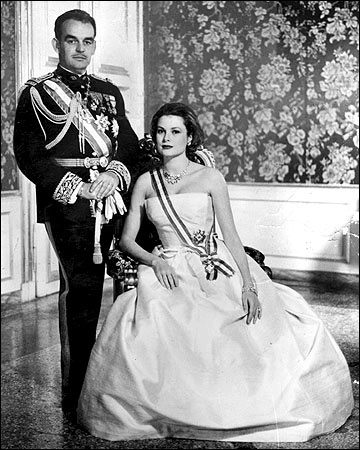
The Happy Ending


The one royal wedding that has gone down in history as a true fairy tale is that between Grace Kelly and Prince Albert Rainier III of Monaco (left). Having met on May 6, 1955 while Grace visited Cannes (strangely where Rita and Aly had met), Grace had not been interested at all in meeting the Prince, and was a bit miffed that she was expected to take time out of her vacation for, essentially, a publicity ploy to meet some guy who happened to be royal. She was still engaging in a fling with Jean-Pierre Aumont anyway, so romance was not on the agenda. Begrudgingly, she agreed to the meet n' greet, so imagine her annoyance when Rainier showed up late for his personal tour of the palace. Despite this, Grace made nice, and Albert was cordial, but no one would exactly say that sparks flew at this meeting. Still, something had been ignited. Unlike the fiery, passionate affairs that both had engaged in previously, this romance began slowly. The two found themselves still thinking of each other after they had politely parted, and a correspondence began. What could a little love letter or two hurt? After all, Albert had, from Grace's own lips, been "charming." While Grace began performing her role as the conflicted Princess Alexandra in The Swan, few people knew of her secret affair with a man who would in time make her a real life Princess!


After coming to know each other through their letters more than most people ever do, and meeting clandestinely when appropriate, they fell in love, and Albert proposed. He was under the wire and in need of bringing an heir to the throne. He saw his meeting with Grace, therefore, as fortuitous. Her natural aristocratic air, intelligence, and poise made her a prime candidate for a royal wife, which is why she said "Yes" and then "I do." Grace finished filming on High Society, then boarded the S.S. Constitution for her new home across the sea in April of 1956. The wedding was extravagant and the event of the season, not to mention one of the most memorable movie star moments of all time. As a woman of discipline and duty, Grace would fulfill her obligations as a political wife, including mothering three children (right) and enduring the snooze-fest schmooze-sessions she had to attend as Rainier's arm candy. There would be a tinge of regret in her choice to leave her career behind, and unfulfilled roles and opportunities must have hung heavy on her heart. Nonetheless, she remained Princess Grace of Monaco until her dying day and proved to little girls everywhere that impossible dreams do come true.


Paramount was ecstatic about the publicity Gloria Swanson's
marriage to Henri de la Falaise generated.


When it comes down to it, all of these marriages or attempted marriages were about dreams. Everyone is looking for his or her perfect soul mate-- a fellow traveler who will walk this crazy, winding road with them and give them peace. Too often, the illusion of what one wants is far from reality, which is why most of these regal pairings wound up royally screwed. Yet, you can't hold it against them for trying. When offered the chance of a lifetime, one is bound to seize it, even at the cost of not thinking it through. You can't blame the stars for trying to solidify their own powerful but somehow unsteady existence by "marrying up;" nor can you blame movie-loving royalty for literally reaching for the Stars. In either case, the film performers who failed at the altar still reign supreme on the silver screen. Since many of them will be remembered long after names like Mdvani and Ghika are forgotten, I think we know who really rules the world.