FYI

Don't forget to refer to my Contents page for a more convenient reference to past articles.

For More L.A. La Land, visit my writing/art/film appreciation site on Facebook at Quoth the Maven and follow me on Twitter @ Blahlaland. :)

Friday, July 1, 2011

STAR OF THE MONTH: Carole Landis


Carole Landis


It is funny what celebrity death can do... both to the public and to the deceased. The masses were so distraught after Rudy Valentino's death that at least a couple of the broken hearts tried to take their own lives as well. The tragedies of James Dean and Marilyn Monroe, instead of ending their time on earth, brought them eternal life and the love of devoted fans. Yet, sometimes, despite one's fame, to die is to die. Such is the sad case of Carole Landis, who despite her bright light, her profound beauty, and the fanatic adulation she received during her lifetime, is now remembered-- if at all-- as a sad and balled-up corpse on the bathroom floor. After she took her own life in order to ease her wounded heart, the world was left in shocked silence. Slowly, she became all but forgotten outside the halls of Hollywood's macabre trivia. The time has come to unearth her and give her the respect and embrace she always wanted but was forever denied. As the anniversary of her death approaches on July Fourth, it seems befitting to dedicate our most patriotic month to the woman who, in her life, was America's favorite patriot. Carole Landis, God shed his grace on thee...


Carole was naturally photogenic... and a brunette. 
She went blonde when she went Hollywood.


Just as mysterious and saddening as her end was her beginning. Frances Lillian Ridste was the youngest of five children born to Clara Zentek and Alfred Ridste of Wisconsin in 1919. Yet, from the beginning there was controversy, including a debate as to just who her real father was. While the family was temporarily living in Montana-- due to Alfred's job with the railroad-- Clara met farmer Charles Fenner and, it is assumed, had an affair with him. Since Alfred obtained a divorce from Clara not long after Frances's birth, credence can be given to the rumor. Clara wed Charles after her first divorce, but that union would only last 17 months. Thus, Carole inherited two absent fathers and an equally absent mother, who was forced to spend most of her days working to feed and clothe herself and her 4 children (one of whom, Jerry, had tragically already died). Carole was often left to her own devices: both to entertain herself and to fend for herself. Her childhood lacked the innocence that every youth is owed, but she never belly-ached about it. In fact, her fortitude and her selflessness were well-honed qualities that she would carry with her into adulthood, where their repercussions would eventually and vengefully take hold. A naturally friendly, light-hearted, and popular child, Carole was laid-back and easy-going. After the family moved to San Bernardino, CA, she enjoyed the pleasures of going to school and socializing, excelling at both. She could easily chat with the girls, despite their jealousy over her growing beauty-- which her sweet demeanor rendered non-threatening-- but she preferred to play sports with the boys. Athleticism was always a major part of her life, and the glamorous gowns and delicate figure that she showcased in her later film roles would eclipse a tom-boy's energetic and shapely body. In her youth, the only "dangerous curves" Carole concerned herself with had to do with softball.


In a wardrobe fitting.


Feisty and independent, Carole would survive many tragedies and mature rapidly as a result. She lost another brother, Lewis, when he was accidentally shot at the kitchen table while playing with a neighbor's gun. After her mother suffered a ruptured appendix, Carole, despite being the youngest member of the household, was the only child who neither panicked nor cried. She did what she always did and "got to gettin'." Nonetheless, the scars of these early experiences increased in her a need for escape. One option for relief was through the movies, of which she very quickly became enamored. Singing was also a talent she indulged in, possessing a beautiful voice to match her gorgeous physical features. It was this latter beauty that led to another possibility of escape: men. At 14, she passed for 21, and the fellas noticed, especially after she started winning beauty competitions (for which she had to lie about her age to enter). Luckily, Carole was completely lacking in vanity, and saw this all as a fun joke. She was more focused on creating the first powder-puff football team at her school, (though the Principal didn't go for it because it was "unwomanly"). Then, at the age of 15, she met 18-year-old Irving Wheeler and fell in love. He offered her a life away from her increasingly dependent mother, and more importantly a life of their own. Carole took the bate, and the two eloped on January 14, 1934, though the marriage was soon annulled when both sets of parents found out. Defiantly, Carole wed Wheeler again, whose intentions were more physical than emotional, only to walk out on him by September of the same year. It would not be her last tumultuous relationship.


Twentieth-Century Fox definitely cashed in on Carole's sex appeal, 
which was at times devastating to her sense of self.


The self-starter herein made her first big move: to San Francisco. Still only fifteen, she left school, her family, and all of her friends behind and travelled to the city that was known for its artistry and culture. She hoped to make a name there for herself as a singer. She did. First, she changed her name, taking "Carole" from one of her favorite actresses, Carole Lombard, and "Landis" from baseball commissioner (of course) Kennesaw Mountain Landis. Many have alleged that Carole spent her early days in San Francisco as a call-girl, but these seem to be nothing more than slanderous rumors cooked up by a jealous and unforgiving world. In truth, Carole had no time to engage in this type of vocation, because almost as soon as she stepped off the train, she marched into the famous St. Francis Hotel and asked the manager for a job. When he heard her sing, he was stunned and gratified to hire her on the spot. By working the smaller St. Francis bar, Carole was soon scooped up by the "Carl Ravazza Orchestra," and after enjoying a great deal of success and adulation, she possessed enough confidence to give Hollywood a go. In 1936, now seventeen, Carole was primed to take the industry by storm, though she would have to edit her age again to do so. With the same fearless determination and zestful work ethic that she had shown in San Francisco, Carole made the rounds to different studios and obtained numerous extra jobs until being offered a contract. 


Her athleticism served her well in the physically demanding 
One Million B.C. Eat your heart out, Raquel Welch.


Her first big break came when she was cast in the special effects, B-movie triumph One Million B.C, in which she outmaneuvered dinosaurs in scant clothing alongside costar Victor Mature. It was her athleticism that won her the role. D.W. Griffith himself was brought on board to help cast the film initially, and he hand-picked Carole because, as he put it, "She's the only [girl] who knows how to run." Soon, she was using her natural talent and knack for both comedy and drama to climb the popularity polls in films like Turnabout, in which she plays a man in the body of a woman, I Wake Up Screaming, in which she plays Betty Grable's morally questionable, murdered sister, and A Scandal in Paris, in which she plays such a sexy and devious villainess that she literally sets the screen on fire. Her beauty made her a prime candidate for some of the most popular pin-up photos of the day, though some of hers didn't make it to print due to censorship-- not because they were naughty, but because she was too well endowed. In fact, she became the first "sweater girl," before contemporary Lana Turner took the title. She was so innocently provocative that at least one particular photographer warned her before a shoot, "For God's sakes, don't inhale!" to try to diminish the appearance of her... gifts. Though Carole thought all of this objectification was a lark, she went along with it, simply because she was easy-going; not because she put stock in her sexual appeal. It wasn't until they tried to label her as the "ping" girl that she completely rebelled. She wanted to be a great actress and studied Bette Davis's performances with an eager ferocity, hoping to lend the same depth to her own roles. Sadly, because of her beauty, she was rarely afforded the privilege. Yet, she remained popular, especially among her contemporaries who constantly became smitten by her kindness and conviviality. She counted Patsy Kelly, Cesar Romero, "Mousie" Lewis, and Burgess Meredith as close friends. Even the most temperamental actors found safety in Carole's presence; she just had one of those auras that put people at ease. 


In Turnabout with John Hubbard.


All was not rosy, however. Carole's private life, if not her career, was always a failure. After finally obtaining a divorce from first husband Irving Wheeler, she then married and was divorced from Willis Hunt. She too was in a damaging relationship with Busby Berkeley and an abusive one with Pat DiCicco. Her many gentlemen friends led to rumors that Carole was just another of the many young women sleeping her way to the top. Yet, there is hardly any woman in Hollywood untainted by such a rumor, nor many who are completely innocent of it. Los Angeles doesn't breed angels. Though Carole was free-spirited and far from prudish, the assumption that she was, for lack of a better phrasing, a "studio whore," is unfounded and unfair. This is evidenced by that fact that she was able to make a legitimate career for herself, whereas so many women were simply used and discarded. It is, however, reasonable to assume that she did use the Hollywood game to her advantage, as many did, at least until she achieved enough power to extricate herself from the misogynistic system. It is generally accepted that she was one of the many ingenues Darryl F. Zanuck used for his own pleasure, but she eventually either grew tired of or outgrew this accepted station, and uttered the unfathomable word, "No." Consequently, this led to her casting in silly supporting roles beneath her talent, a tactic for Zanuck's vengeance. Ironically, the thing that saved her was WWII. Just as Carole's desire to please and bring joy to others had pulled her into a life in the entertainment business, so too did her big heart drive her to become the war effort's number one hero-- at the time above and beyond even Bob Hope or Jack Benny. Her tireless efforts in entertaining the troops at home and abroad made her America's Sweetheart and favorite patriot. Due to this, her popularity boomed, particularly after she penned a novel of her war experiences, Four Jills and a Jeep. Zanuck was begrudgingly forced to produce a film version-- albeit a Hollywoodized one-- starring herself and her three female compatriots, who were also worthy of much praise, Kay Francis, Mitzi Mayfair, and Martha Raye.


Entertaining the troops with Jack Benny.


The war changed Carole. Seeing brave men fight and die, befriending them and then losing them, and witnessing first hand the terrors of war, awakened in her a deeper knowledge of herself. No more did the glitz and glamour of stardom matter to her, not that it ever did much anyway. Now she wanted something more meaningful and fulfilling in her life. Most particularly, she yearned for a love that would lend her life gravity and comfort. She sought to attain this goal by wedding a soldier whom she met in England, Thomas Wallace. However, after their whirlwind, mid-battle courtship and wedding, the two returned to American soil and realized that they had little in common. Tommy had married her to fulfill a dream-- to wed a movie star-- only to realize that a determined woman with a career was far too belittling to his own masculinity. Carole's pipe dreams again went up in flames. After Tommy broke her heart, she moved on quickly and wed businessman Horace Schmidlapp, though that marriage too was not to last. The construction of her happy home was thus based on rocky soil. Love is found, not manufactured. The fighter in her believed a little elbow grease and work would create the life she wanted, but in reality she could never really build with anyone the love that she was looking for. 


Carole lies dead, beneath Det. Emmett Jones.


Then, she met Rex Harrison. Handsome, educated, talented, (and married), he wooed her quickly and efficiently. The only trouble was that, besides the Missus, Rex had a dark side. His feelings for Carole were superficial and sexual where hers were deep and emotional. Finding herself lost and unhappy in her career after the war, which left her feeling undernourished and useless, Rex became her all. Making movies, and bad movies at that, was a far cry from the deeply fulfilling humanitarian efforts she had offered up in Europe and Africa. She trucked along, never revealing her inner pains, remaining the devoted and beloved friend every one knew and loved, but inside she was crumbling. There is speculation that Carole tried to end her life more than once but had always been stopped before the mortal damage was done. These attempts, if true, were cries for help from a woman who was unable to articulate her own weaknesses; who knew only how to serve others and not take selfishly from them. The ability she had to push past her pain, slowly but surely crept up on her and reached a climax with hurricane Rex. Finally, tired of being used, of always being the other woman, Carole confronted Rex after a Fourth of July party that she had hosted. It is assumed that the two quarreled and the relationship was abruptly ended. That night, Carole packed all of Rex's belongings, photos, and memorabilia into a bag and left them by the mailbox at Ronald Culver's house, where Rex was staying. Then, she drove home, swallowed 30-50 Seconal tablets, and was not found until the next morning when a stunned Rex appeared before her maid and said, "I think she's dead." He, coincidentally, ran from the scene after the discovery. The eternal image of Carole now is that of a girl in a pretty summer outfit, lying on the floor in a ball, her arms frozen in an awkward, bent position. This posture suggests that she was trying to raise herself back up. She would not make it. Carole Landis: dead at 29 years of age on July 4, 1948. 

In one of her girl-next-door in one-helluva-sweater poses.


This sad, tragic tale is like so many in Hollywood, but is perhaps the most tragic because of the girl it involves. Of all the tormented souls wandering La La Land, or those who are immersed in their own demons, Carole seemed on the outside to be the least likely of its victims. Strong, vibrant, endearing, sensitive, giving, sweet... She was beloved by everyone in the community, save for those salacious studio wives who enjoyed spreading slanderous rumors about her. For her corpse and not her film work to be more remembered, for treacherous lies to be recalled and passed on and not her good deeds and selflessness, is the height of shamefulness. In every role she played, Carole brightened even the dullest of duds. She stole every show, not through effort, but from pure, unadulterated charisma and charm. She was the girl-next-door every service man in America fell in love with, and the compassionate lady every soul-sister wanted to give a big ol' hug. Yet, she forever remained apart. In her youth, she was the "other" child, and later, she became the pretty girl in Hollywood who, no matter how surrounded she was by people, was always alone. You cannot invent love, you can either give it or receive it. Too much of Carole's nature was in the giving and not the receiving, until she gave all that she had and was left with nothing. Her offerings to us, her remaining films, are cold comfort to a world who at one time idolized her and now only sits in ignorance. But, for the precious few who do recognize the true jewel that she was, her entertaining films and performances shall have to suffice. 

Tuesday, June 28, 2011

DIDJA KNOW: Part I

The latest addition to the L.A. La Land blog is the article category "Didja Know?" This quick-takes column of cinema trivia will hopefully introduce little known facts and miscellaneous brain food for the ever-hungry, movie-savvy devotee. Dig in!


Didja know, on this famous "I Love Lucy" episode, the co-worker Lucy is left 
alone to work with was an actual candy maker, cast by Desi. In the scene, the
 focused, yet inexperienced, bit player was not acting when she slapped Lucy. 
She really let her have it, and left Lucy seeing stars 
(with chocolate running down her face).

TV Loves Desi:
Though the success of "I Love Lucy" is accurately credited to the zany performance of Lucille Ball, her paramour and partner Desi Arnaz had a great deal to do with the show's popularity, as well as some new innovations that he introduced, not only to "I Love Lucy," but to television in general. Firstly, CBS insisted that the show be filmed before a live audience-- which in itself was a first for a sitcom. Consequently, the now familiar cue cards were invented for the audience: "APPLAUSE," CHEERS", and "LAUGHTER." However, it was quickly noted that the 'LAUGHTER' card was unnecessary. The audience guffawed ably enough on their own thanks to the comedic sensibilities of the entire cast: Lucy, Desi, William Frawley, and Vivian Vance. Desi added his two cents to this novel idea by stipulating that each episode be filmed with three cameras filming simultaneously, thus cutting down on shooting time. It was not an easy sell, but with Karl Freund's photography, it worked so efficiently that the three camera setup became a staple of the televised situation comedy. Another added piece that Desi contributed related to the commercials. After watching the first season's episodes, he concluded that the transition between the show and the advertisements was too awkward. Thus, he contrived to have an animated segue added before each commercial break to inform the viewer of the brief intermissions. So, one now sees in re-runs the cartoon versions of Lucy and Desi smooching at the drive-in or playing with the camera before the interruption of the latest miracle toothpaste, cleaning fluid, or (at the time) cigarette brand.


Rasputin and the Jury:
Ever wonder where those annoying disclaimers in the opening credits come from? You know, the ones that say, "Any resemblence to persons alive or dead is complete coincidence..." yadda yadda yadda? Well, we have director Richard Boleslawski's Rasputin and the Empress to thank for that. When the film-- which dramatizes the notorious Grigori Rasputin's relationship with the last Czar (et familia)-- was released in 1934, MGM was sued by Princess Irina Alexandrovna Youssoupoff for libel when she claimed to recognize herself  in the character Princess Natasha. In the film, John Barrymore's character too represents Prince Chegodiefl, who had a direct part in Rasputin's (played by Lionel Barrymore, with John right) murder. It was not this macabre revelation that bothered Chegodiefl and his wife-- he in fact took pride in his part of the assassination; it was the idea that the Princess, or rather her character, was presented in the film as having been seduced by Rasputin, like the many other Russian women of the time. Because of this, the disclaimer was added, and to protect their backsides from future financial attacks, MGM and other studios started adding these shields of dissociation to all films based upon biographical material. Another interesting tidbit about the film is that it is the only time all three Barrymores appeared together onscreen. Though Lionel and John would work together in films like Dinner at Eight and Grand Hotel, Ethel (portraying the Empress in this film) was too attached to the stage to be wooed into too many Hollywood pictures, with her brothers or not.


The "Dirty" Lie:
Since I have been on a bit of a gangster kick lately, I thought I would introduce the following tidbit. Many of us have heard the phrase, "You dirty rat..." which we associate with mobster flicks. Commonly, this derogatory exclamation is attributed to the eternal Movieland hood, James Cagney. However, this credit is undeservedly bestowed, as Cagney himself would attest. The true source of the now iconic utterance is none other than Lon Chaney, whose Black Mike Silva said it, albeit silently, in the 1920 Tod Browning picture Outside the Law (left with Priscilla Dean and Wheeler Oakman). Before Lon became associated with his outlandish makeup concoctions and the macabre and sometimes monstrous performances that would become his token, he popularly played the character heavy and bad guy in a slew of early silent films that explored the dark underbelly of city life. His contribution to the slowly evolving genre of the gangster pic set the groundwork for later cinematic derelicts like Cagney, Robinson, and Raft to tread upon. Other films depicting Lon in a similar vein are The Blackbird, The Wicked Darling, and The Penalty.


Miss Quoted:
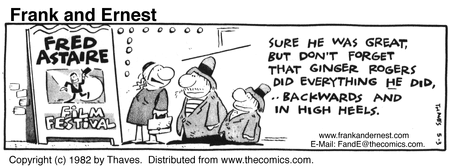
Another incorrect quote credit involves Ginger Rogers (right), that saucy lady of steps. Beautiful, graceful, and possessing both acting chops and a biting humor, Ginge' made everything she did look seamless and easy. Obviously, this was not the case. Behind all of her street smart characters and effortless dance moves, opposite Fred Astaire, went a hefty bit of diligence, rehearsal, and training. For this reason, because of the woman she was and the success she was able to accomplish, she was in her time, and still today, a popular feminist icon. It is often recalled that she said: "I did everything Fred Astaire did, but backwards and in high heels!" However, she never made this statement herself. The true source was the popular comic strip created by Bob Thaves, "Frank and Ernest," and in particular the cartoon printed in 1982. Yet, because it bore the ring of truth, the famous quote became one of the continuing slogans for girl power. Whether Ginger said the actual words or not, she did indeed live the example, for which women everywhere remain eternally grateful.


The famous Ginger comic strip.  


City Noise:
In the early days of the talkies, directors were trying to find new and innovative ways to not only record and synchronize sound appropriately, but also use it to a film's best advantage artistically speaking. All of a sudden, in addition to awkward staging to allow recorded dialogue, filmmakers began toying with sound effects, atmospheric sound, audio transitions, etc. It was all a little rocky, which explains why so many silent film players were certain that the latest invention was just another fad. Yet, the transition carried over, and slowly the kinks were ironed out and new ideas perfected. One such example comes via Rouben Mamoulian's City Streets (1931) starring Gary Cooper and Sylvia Sidney (left). Mamoulian is credited through the film of introducing the wonder of the "inner monologue." For the first time, a character's thoughts are heard by the viewer while the character herself remains silent. In this case, Sylvia Sidney ponders worriedly about her lover, Gary Cooper, and she hears his voice in her mind, as does the viewer. This technique was poo-pooed by many at the studio, who thought it came off as ridiculous and would never work, but it became a landmark moment. In the same year, Fritz Lang employed the same practice in his first sound film M, starring Peter Lorre as a twisted, child murderer. At one point in the film, Lorre covers his ears and rocks himself back and forth. The audience hears the whistling of "In the Hall of the Mountain King," which is occuring only inside the psycopath's head, both calming him and firing him up for the kill at the same time. This method was soon copied by others until it became a commonplace staple of cinema narrative. No longer does an audience have to guess what a character is thinking. We can hear it too! (Another interesting bit of info from City Streets is that originally, Gary's former lover Clara Bow was to appear in the picture, but she was replaced by Sylvia after she suffered one of the tragic nervous breaksdowns that would send her career on a downward spiral).

Thursday, June 23, 2011

MENTAL MONTAGE: Use Your Clout


The ultimate film about the entertainment "cat" race, Stage Door:
Kate Hepburn, Lucille Ball, and Ginger Rogers.


Clawing your way to the top of the entertainment ladder is no easy feat. After completing the seemingly insurmountable task, which not all are able to do, one can either be left with a deluded feeling of euphoria, which erases all memory of the aforementioned climb, or one can continue to bear the cuts, bruises, and war wounds of his battle, which serve as daily reminders of his lengthy diligence and hard work. The former group can at times get lost in the twisted web of fame and fortune, drifting into the annoying abyss of entitlement and egotism. This outcome is rarely good. The latter group, however, usually maintains a devout gratitude for their good fortune and thus a dignified sort of humility. This creates a better path, one possessing clear-headedness, good business sense, and a compassion for the underdog. In the history of Hollywood, there are several tales of various stars sticking their necks out for other struggling artists-- using their "clout" as it were-- to help someone in a position from which they themselves have fortunately evolved. These instances of professional aid are at times minute, but the effect is always profound to the object in need, who will forever remember a small moment of kindness that-- if he or she was really lucky-- changed everything.


When Lucille Ball was still making the rounds at various studios, she landed a contract at RKO, where she primarily wound up in featured roles and bit parts. Despite the fact that, as far as the studio was concerned, she was just another one of the dime a dozen hopefuls, she was able to ingratiate herself to different people on the lot by being forever professional, completely willing, and incredibly funny. Hard work was not something that she ever had a problem with. Perhaps fellow nose-to-the-grindstone actress Katharine Hepburn took note of this. The two didn't have much a friendship, for Kate was higher on the acting echelon and being primed for stardom (in constant competition with another RKO leading lady, Ginger Rogers), but the duo would come into direct contact one fateful day-- which, coincidentally, could have been catastrophic for Lucy. Lucy was in the makeup chair, being prepped for yet another publicity photo to help test/boost her appeal, when all of a sudden, she was unceremoniously ushered away to make room for Hepburn, who was being readied for her daily shoot on Mary of Scotland (in wardrobe, left). Hepburn, through no fault of her own, took precedence over Lucy's cosmetic needs: Mary was a huge project for the studio. Lucy, pursing her lips, made her way into the next room, only to realize that she had left her tooth caps behind. Trying not to make a fuss or disturb "the Queen," Lucy tried to flag down the beautician who was working on Kate. She waved her arms at him through a dividing window, but to no avail. Though he saw her, he directly snubbed her flailing and continued with his work. Insulted, her temper grew red-hot, until she threw a steaming coffee pot at him! Unfortunately, the pot hit the table only to splatter all over Kate and her regalia. Lucy's eyes surely bulged as she began to panic! With Kate's dress dirtied with brown coffee spots, the shooting for the day couldn't be done and the studio was out thousands of dollars. Yet, when the top dogs came for blood, Kate stood by Lucy and refused to blame her for the incident. She used what little power she had to diffuse the situation instead of engaging in the expected diva-temper-tantrum. Lucy was also aided by Lela Rogers, Ginger's mother, who had been giving her acting lessons at the studio's behest. Lela believed that Lucy was one of the more promising young hopefuls and made this known to the enraged higher ups. Because of these two ladies, Lucy's job was saved-- temporarily. Interestingly, though her time at RKO would not last, she was there long enough to appear in Stage Door with both Hepburn and Rogers.

After RKO, Lucy would have help from another lady of the screen. Struggling to find work, and being told over and over again that her time was past-- that there was nowhere for a woman in her thirties to go in her career but down-- Lucy was having trouble holding onto her dream. Her self-confidence was at a bottom low, which was effecting her mentally and physically. She had even developed a stutter. Out of nowhere, she couldn't get through the most normal of sentences without breaking into stunted syllables. Just as suddenly, Olivia de Havilland (right) entered the picture. The two were not pals, barely having exchanged more than the usual "Hello, how are yous" at various parties and social affairs, but for some reason Olivia had taken a liking to Lucy. Perhaps she saw in the woman a another version of herself-- a fellow female fighter. As such, when word reached her that the funny, bubbly red head was on a downward spiral, she stepped in. She told her agent, Kurt Frings, to take Lucy on as a client and help to turn her career around. She just knew that the girl had "it" and only needed the right project to reach the stardom she deserved. Since no one said "No" to O de H-- a lesson Jack Warner learned all too well-- Frings agreed and added the stunned Lucy to his roster of clients. In a whirl, Lucy was still a nervous wreck when she began shooting on her first Frings induced project, Lover Come Back, opposite George Brent. Yet, she pulled it together, and once the cameras started rolling, she lost the stutter and regained her swagger. She remained eternally grateful to Olivia for her helping hand. It didn't turn out to be Lucy's big break, but it did help her get one step closer to success and kept her afloat during a confusing and back-breaking time.


Husband Desi Arnaz had also received a little help in his early career from none other than fellow crooner Bing Crosby. With Bing (left), judging from various accounts, you either loved him or hated him. Desi was one of the lucky ones who caught him on a good night. A very good night. Desi was a struggling musician touring with Xavier Cugat and his band, for which he played the guitar. Their itinerary eventually took the troupe to Saratoga, where Bing happened to be in attendance. Bing must have been impressed with Desi's playing, because he gleefully introduced himself-- in Spanish no less-- to the starstruck young man. Very friendly, and perhaps aided by a little too much liquor, "Bing-o" got congenial quickly and started asking the tongue-tied Cuban what he was earning for his talents. Desi responded with the sad truth: a measly $30/week. Bing, who knew Xavier, suddenly became Desi's champion. "That cheap bastard!" he roared. "Come on! Let's get you a raise!" He took Desi by the arm and the two marched right up to Cugat. Bing demanded that Cugat up the ante on Desi's paycheck. After being placed on the spot by such a huge superstar, Cugat was forced to agree... With one stipulation: that Bing perform a song with the band that night. Bing agreed, and Desi got his raise. Soon enough, ol' Dizzy had the money and confidence to tour with his own band, which inched him closer to Hollywood and his soul mate, Lucy.

In 1943, Van Johnson was just another struggling actor. Minor roles and extra work were the daily grind, until through a stroke of luck, he found himself cast in a supporting role in a major motion picture: A Guy Named Joe. Van was ecstatic! This could be his big break-- the opportunity of a lifetime. Enjoying his good fortune, he was out driving with friends Keenan and Eve Wynn (Van's future wife, but that's another story) when he was broadsided by another car. It was a serious accident, which left him badly injured. Very badly: a metal plate had to be put in his head! (In his future film work, you can see the noticeable scar). This tragedy couldn't have come at a worse time. His role as Ted Randall in the upcoming film was in jeopardy, for he needed extensive time to recuperate. Victor Fleming was put in the unfortunate position of looking for a replacement, until two angels came out of the wings. Both Irene Dunne and Spencer Tracy were impressed with Van and believed he was perfect for the role, and they went to bat for him (all three in the finished film, right). Through much persuasion, they convinced Victor and the studio to postpone until Van was completely healed, promising that his performance would help to make the picture a hit. The big wigs surprisingly listened. It turns out that Van, despite the conflicting evidence, was a lucky man, and the film helped to skyrocket him to Stardom. His accident turned out to be a pain and a pleasure, for due to his injury, he was unable to serve in the military during WWII. As one of the few fellas left at home while other stars went off to battle, his capable leading man potential made him a top box-office star. Thanks to Irene and Spence, he had had his breakthrough and would never look back.


Sometimes, the scuffle for a fellow comrade becomes more than a professional courtesy. It's personal. This is something that Betsy Blair knew all too well. Married to the triple threat actor/dancer/singer Gene Kelly, her own career took a back-seat to his, especially after he found success in Hollywood with his breakout role in For Me and My Gal. Betsy didn't mind. She was fine with playing the role of the supportive spouse and loving mother and putting her own career on hold (see happy family, left). A talented actress and dancer herself, she did make the intermittent film but never achieved the same success or notoriety as her husband. At least, not the same kind of notoriety. During the "red scare," Betsy found herself the focus of the HUAC witch hunts. Though not a communist, her leftist politics, outspoken position on African American rights, and her part in the SAG anti-discrimination committee landed her on the blacklist. Her husband, Gene, who was equally liberally minded if not as outspoken, was safe from the same attack because of his growing box-office appeal. Seeing his wife so mistreated and outcast was difficult, to say the least. Her sadness enraged him, particularly when the role of Clara in Marty-- which he thought she would be perfect for-- was kept out of reach due to the current political tide. Tired of seeing his wife held down, Gene marched into studio head Dore Schary's office and gave him an ultimatum: let Betsy off the hook and give her the role, or Gene would simply stop coming to work! This was a bold move and could have quite easily gotten him into legal trouble for breach of contract, or worse, fired and blacklisted himself. However, Gene Kelly's name on the marquee meant guaranteed money, so Dore took the bait. Betsy landed the role of a lifetime in Marty, which would be the most memorable of her career, and received an Oscar nomination for her heart-wrenching performance. Sadly, this would prove to be one of the last happy moments in the Gene-Betsy marriage, which finally collapsed under the tension two years later. Yet, however the relationship may have ended, Betsy would always speak admiringly of her first husband, his courage, and the bold move that deepened her love and respect for him.

Wednesday, June 15, 2011

NOW, THAT'S FUNNY: Part IV


Lucy does her usual scene-stealing for laughs 
on "I Love Lucy."


To get ahead in Hollywood, one really has to stand out. This was a lesson Lucille Ball learned early on. An observant girl with an uncanny knack for funny, Lucy would take note when she found something hilarious and would later use it in her own work. When a teenager, she would once have the awestruck honor of witnessing a funny tidbit via silent screen gem Dorothy Gish. While modeling at a Carnegie fashion show, Lucy happened to see both Dorothy (left) and sister Lillian with their two dates. When Lillian and the two gents walked away for a pace, Lucy watched while Dorothy calmly ripped her red program apart and stuck the little pieces to her face. When the trio returned, and Dorothy's pimpled face greeted them, they all burst out laughing. Lucy did too, and she would remember the moment. Later, when trying to land a spot as a chorine in the Eddie Cantor flick Roman Scandals, Lucy would steal Dorothy's gimmick. Applying the pieces of red crepe paper to her own face, she waited as Eddie went down the line of lovely girls, scanning their ripe figures and eying their legs. When he came to Lucy, he stopped in his tracks and started cracking up. He asked her name, and as he walked away, she could hear him say, "That Ball dame-- she's a riot!" Needless to say, she made an impression and got the gig.

"I Love Lucy" co-star William Frawley was also a natural comedian. If anyone on the show knew how to deliver a line, it was Frawley. In fact, he added a lot of gags and one-liners to punch up the already hilarious scripts. Because of this, he was constantly winning the "funny race" backstage. All of the names of the cast and crew were listed on a poster, and when they contributed something side-splitting to the show, they received a gold star next to their name. Frawley's name always outshined the others. However, he sometimes didn't "get" the jokes assigned to him. This is obviously not because he lacked a good sense of humor, but because he only ever memorized his own lines. So, during rehearsal, he would come up to Desi Arnaz and say, "You know, this line isn't very funny." Desi (with Bill on the show, right) continually had to explain, "Well sure, not by itself, but after the build-up it makes a great punchline." He would then describe the scenario, and suddenly the comic button that William's Fred Mertz added made sense. "Oh," he'd say. "Yeah. I guess that is funny." 

Back in the days before personal stylists and make-up artists, an actor was pretty much left up to his or her own devices to contrive the perfect look for a character. In addition to providing your own wardrobe, so too must you possess the ability to "put your face on," because no one else was gonna do it for you. This was information that aspiring young ingenue Leatrice Joy (left) knew all too well. The silent film actress was a novice when she started performing before the camera, but then, in 1918, so was everyone else. However, her jitters got the better of her before the camera started cranking on One Dollar Bid. Panicked about looking her best, in addition to adding cosmetics to her face, she decided to add a white paste to her arms to give them a smooth, porcelain look. When it came time for her to give her co-star and latest crush, John Gilbert, a tender embrace, her hug left white blotches all over his brand new jacket. Since John was also a struggling actor-- as evidenced by his thin-from-starvation frame-- the fact that one of his few personal suits of clothes was ruined was enough to send him into a tizzy. Poor Leatrice was humiliated, but after John sent her into tears, he apologized. When daughter Leatrice Gilbert Fountain later asked her mother what had made her make such a strange cosmetic choice, the elder Leatrice simply said that she thought it would look "pretty." The result was pretty awful.

Leatrice would later make another make-up foul-up when, after making peace, John started courting her. Both actors, while not famous by any means, had by now established some level of stability in the acting world, and Leatrice was flattered that the handsome, growing star was paying her such steadfast attention. Once again nervous, she went to a trusted source of feminine wiles for help: neighbor Theda Bara. The Queen of Sexual Potency (see right) had plenty of advice for the delicate young Leatrice and allegedly gave her a makeover that completely altered her appearance. One might have likened her to... a "harlot." Since John was a couth gentleman, Leatrice doubted that he would take to her new appearance and wiped most of its evidence away before he arrived to pick her up. However, she had neglected to remove the rouge from her earlobes, which Theda had assured her was all the rage-- certain to indicate to her suitor her secret, sensual passion. While dancing, John couldn't help but notice Leatrice's ears, which appeared to be inflamed and infected. When he asked her about them, she fessed up. All John could do was laugh. He helped her to remove the last of Theda's influence, and the two enjoyed the rest of the evening. Leatrice made a pretty good impression on her own. John would marry her in 1922. Despite their divorce two years later, and John's tumultuous romance with Greta Garbo, he would always attest that the sweet, naive Leatrice was the one who got away.  

Ernest Borgnine is not the typical leading man. Yet, after serving some time in the military, the perplexed young fella' was nudged into acting by his mother, who saw a talent that he had never realized. Slowly but surely, the character actor honed his craft and became a dependable and capable commodity to the stage. The next logical step was Hollywood, which was very far from Ernie's roots, but he was willing to give it a go. A fun-loving but old-fashioned guy, he would always recall one of his early screen tests with humor. Richard Siodmak saw some real potential in him, and asked him to come in to audition for The Whistle at Eaton Falls. "Audition" was a very strong word, for Ernie's performance was relegated to basically sitting in a chair and smiling. Awkward and still in a whirl about it all, he was confused when the director gave him his one simple direction: "Say 'Sh*t,' then smile." "What?!" Ernie replied. "Just do it. Trust me." So, Ernest lit up a big grin, looked directly into the camera and said with great joy, "Sh*t!" Cut. (See similar effect, left). Afterward, Richard took the screen test to producer Louis de Rochemont. When he saw Ernest's footage he asked, "What is he saying?" Richard lied: "I don't know, but he's got a great smile!" Louis must have agreed, for Ernest Borgnine was cast in the movie, which was his film debut.

Charlton Heston (right) also made a great impression on director Cecil B. DeMille. But not a great first impression. Cecil wasn't interested when he first saw the actor, considering him too "sinister," but then Cecil was an eccentric guy. After writing Chuck off as just another run-of-the-mill actor, one day, Heston happened to drive past him on the back lot and flash a wave. Suddenly, Cecil had a change of heart. Turning to his assistant, Gladys Rosson, he said, "I like the way he waved just now." Maybe there was something to this kid after all... He seemed to have the confidence and charisma that Cecil needed in a leading man. Chuck was soon put to the test when he was cast in The Greatest Show on Earth as Brad Braden. But, his first role with DeMille might have initially had Cecil rethinking his choice. For his first scene, Chuck had to drive up and jump out of a jeep. Instead, he drove up, hopped out, and fell flat on his face. One can almost imagine Cecil closing his eyes and shaking his head in annoyance. Luckily, Chuck was able to shake off the initial embarrassment and churn out a strong performance. Cecil too was impressed, and he would recast Heston in the pinnacle success of his career The Ten Commandments. It was because of this movie that Chuck's unique place in cinema was solidified. Thanks to that simple wave, Charlton Heston became a star. A little friendliness goes a long way.

Norma Talmadge was one of the divas of the silent film era (as seen left). Sadly, she is too often forgotten amongst her contemporaries, along with her sisters Constance and Natalie. In her hey-day, while married to none other than production chief Joseph Schenck, Norma ruled all. In a powerful position, she had her choice of roles and was able to rake in the dough. She could be seen around town looking very regal in her fine furs and elegant gowns. During the brief time that these untouchable celebs were seen as royalty, she more than played the part-- on and off screen. Yet, it was all a game, and while her more smart-ass sister Connie aka "Dutch" seemed to latch onto this, Norma sometimes seemed to be completely lost in the oblivion of her own narcissistic delusions. It was an "I think, therefore I am" kind of attitude. However, there were times when the aloof veneer would come down and the Brooklyn girl would come out with full force. If there was one man who loved to identify and skewer hypocrisy, it was Groucho Marx, which is why he loved having his pal George Jessel reminisce about the Grande Dame... who apparently had a bit of a drinking problem. To Groucho's amusement, George would recount how he and Norma had been chummy in the old days and had run in the same circles. While George would say that Norma was, indeed, a fine lady, he would stipulate that this was only until she had had her third drink. As he put it: "She was wonderful. Until the third drink, she had the manners of a princess. Courted, she was like a Queen. Third drink, she'd pee on the floor." Groucho loved that part.