FYI

Don't forget to refer to my Contents page for a more convenient reference to past articles.

For More L.A. La Land, visit my writing/art/film appreciation site on Facebook at Quoth the Maven and follow me on Twitter @ Blahlaland. :)

Thursday, June 6, 2013

STAR OF THE MONTH: Ingrid Bergman - Part Two


Hitch discovers his new muse. He probably thought Ingrid's
face was made just for him, and his love of it is shown in
their three collaborations.

When Ingrid arrived in the United States, she very quickly learned the film industry motto: "Hurry up and wait." While languishing in New York to await her first project- a remake of the Swedish hit Intermezzo, Ingrid did her best to stay occupied with sight-seeing, reading, and falling in love with ice cream. However, she would consistently pester David O. Selznick to put her to work! Unlike the average person, who groans when peeling themselves from the covers each morning and longs for the lazy clock to reach 5pm, Ingrid wasn't happy unless she was on the move and either preparing a character or performing as one. Her regular calls and telegrams to David and Kay Brown were desperate pleas: "Put me to work!" Finally, she got her wish. Intermezzo: A Love Story would prove to be less poetic than its foreign counterpart, but in reprising her role (as the romantic and ambitious younger lover and protégé of a married master violinist aka Leslie Howard), Ingrid did not come up short. Indeed, in this musically driven tale of the complications of passion and duty, she fittingly struck a chord with American audiences.

Already off to a great start, Selznick began establishing his campaign to promote Ingrid. Confused by her lack of pretense and low-maintenance upkeep-- Ingrid tried to refuse apartment accommodations, thinking that her dressing room/trailer provided more than enough space for her-- as well as her clear-headed drive, David didn't know how to capitalize off her regular girl persona. This issue was further complicated by the fact that Ingrid  refused to play games. When Selznick suggested that Ingrid make certain changes to her appearance, accent, etc, she-- very Garbo-like-- basically said, "Either you want me for the role or you don't. I guess we can call the whole thing off." Ah, the lightning bolt: the singular thing that made Ingrid so irregular was her regularity. She was down to earth, modest, kind, unspoiled, sincere... Thus, she was touted in all the papers and magazines as the (obscenely beautiful) girl-next-door-from-another-continent. The ploy worked. The public was quickly in love.


Ingrid's sexually provocative, humiliated, and defeated turn as Ivy in
Victor Fleming's Dr. Jekyll and Mr. Hyde turned more than
a few heads. There are rumors that she and Tracy had an
affair during filming, but it seems unlikely, as it was
Victor on whom Ingrid had a school girl crush.

The film that would tip the scales in Ingrid's direction to all out fanaticism was Victor Fleming's Dr Jekyll and Mr. Hyde. Eager for complicated work and displeased with the lackluster films she was given so far, Ingrid refused to play Jekyll's vanilla fiancé (later assumed by Lana Turner) and fought for the role of "Ivy" the prostitute. It was a wise decision, and her performance not only knocked Spencer Tracy's socks off but stole the entire film out from under him. Her mixture of provocative sensuality, later broken and disturbed by the diabolical Hyde, was both powerful and pitiful. This portrayal also started the character type that Ingrid consciously or unconsciously would be attracted to throughout her career, or likewise the persona that audiences would most identify her with. Her most popular performances remain that of a woman on the cusp of insanity. Her fragility, while shrouded in madness, is constantly tested, but her inner strength always seems to carry her back to lucidity and even triumph. While Ingrid projected an incredible amount of vulnerability in her roles, there too was a toughness. You may break my mind, but you'll never have my heart! This made her relatable as an actress, which made her the ultimate martyr and someone her audience would energetically root for.

For several years, Ingrid was untouchable. Casablanca was surprisingly a misery to make behind-the-scenes, especially for a perpetual craftsman like herself, as so much of it was created in the moment with little subtext to build upon. Her need to dig for the depth of "Ilsa Lund" was thus met with little help from director Michael Curtiz. To her amazement, the hackneyed approach to the film resulted in a classic that remains one of the most celebrated films of all time. Forbidden love, the temptation for both romantic and political escape, the tragic but brilliant ending when one impossible ending is sacrificed for another... From the casting, to the direction, to the frame composition, Casablanca remains perfect to film lovers. Gaslight was soon to follow, as was Ingrid's first Oscar, which she won for playing the mentally terrorized, paranoid, and desperate "Paula Alquist" opposite Charles Boyer's brutally sadistic (and magnificent) "Gregory Anton." With the help of George Cukor, Ingrid was easily able to project both the taut mania of her character and her cathartic retribution, resulting in one of her greatest performances.


Ingrid intensified the effect of "Paula's" paranoia and increasing madness
in Gaslight by showcasing her wholesomeness and rationality in the
film's beginning. This made the character's deterioration all the
more painful to watch. When she realizes that she has been
deceived, the tigress she unleashes on her tormentor
(Charles Boyer) is much more fearful because of
the brink to which she has been pushed.

In between various films such as The Bells of St. Mary's and Hollywood dinner parties, Ingrid was able to make the acquaintance of another director whom she truly admired: Alfred Hitchcock. His equal admiration and fascination for her would turn into complete and utter obsession while filming their first collaboration, Spellbound. An intricate mystery with complicated, psychological underpinnings, the finished product remains fascinating and thankfully manageable due to the sturdy execution of both Ingrid and her leading man, Gregory Peck. However, it is Notorious that remain not only 'notorious' but sanctified as perhaps the greatest Hitchcock film ever made. Of course, that label is hard to bestow, considering the many different pictures, techniques, and experiments that he made throughout his career. Still, with the Ingrid-Cary Grant combo and the tangled plotline of espionage and romance, it is a definite front-runner. Hitch's school-boy adoration for his leading lady also turned into an aesthetic achievement, exemplified by the caressing light, shadows, and fixating close-ups that allow us to capture every nuance, eye-shift, and tick of Ingrid's portrayal of the fallen, redeemed, destroyed, and resurrected "Alicia Huberman." Ingrid made two lifelong friends in both Cary and Hitch during filming, and their names remain eternally, artistically entwined as a result.


The success of Notorious, aside from Hitchcock's artistry at one of its peaks,
was due in large part to the astounding chemistry between Ingrid and Cary.
Quickly becoming good chums in real life, their onscreen characters,
while often spiteful in their actions, had an attraction of mutual
fascination, with one character watching the other with

laughter in the eyes. It  is still refreshing to watch
 Ingrid poke fun at the super serious
"Devlin" and cut him down to size.
Sadly, Ingrid's personal life was not faring too well, and things were about to become worse. Her marriage to husband Petter had been disintegrating for some time. Ingrid relied on Petter's judgment greatly, particularly at the beginning of their marriage, thus he held the reins in terms of all major decision making. This patriarchal structure soon made her feel like more of a servant than a wife. Petter, perhaps to combat his own insecurities over the fact that his wife was such a success, made himself her de facto manager, consultant, and accountant. Ingrid was essentially given an allowance for the work she so willingly did to support her family, while Petter handled the cash-- including payments for his continuing medical education-- while consistently meddling in and complicating her professional relationships. He insisted on overseeing Ingrid's contracts, instructing her on which projects to take, bartering for better deals, and he equally saw to it that he was given a financial cut directly from the studio. Selznick himself became irate at Petter's intrusion into Ingrid's affairs, as the latter had no education whatsoever in the film business. As such, while Ingrid started twisting beneath her lover's thumb, acting became her only escape. She asked for a divorce, but Petter refused. Eventually, as the two remained passionlessly separated but together, Ingrid sought emotional comfort elsewhere, finding lovers in Victor Fleming, Robert Capa, and Larry Adler. Then, Petter asked for a divorce. The couple decided, for the good of their marital "corporation," that they should keep up appearances. They had no plans to marry others anyway.


At least, the didn't until Ingrid saw the great neo-realist accomplishment of Italian cinema, Rome, Open City. Blown away by the filmmaking, authentic acting, and brutal storytelling, Ingrid became determined to work with the film's director, Roberto Rossellini. As he was looking for American money to finance his foreign films, he jumped at the chance to work with Ingrid when he received her fan letter. Despite the fact that Roberto was married, having an affair with Anna Magnani, and simultaneously sleeping with a plethora of other women, he fell in love with Ingrid, and she was as smitten with him. Finding a man who supported her creativity instead of condescending to it, as Petter had, the two quickly started a quiet affair that turned into the Mt. Vesuvius of scandals. Ingrid filed for divorce, Petter sued for custody of daughter Pia and won, and the public turned against the angelic actress whom they had once adored. She had betrayed them by making the crystalline image of perfection that they had projected upon her counterfeit. Ingrid found herself unceremoniously blacklisted. As she refused to play ugly, as Petter did-- ignoring his own faults in the marriage and shamelessly slandering her in all the papers-- Ingrid was fingered as the guilty party. Strangely, it was her own sense of decency and loyalty that was the nail in her coffin. She actually felt an incredible amount of guilt, and in recompense ,never spoke out in her own defense to combat Petter's accusations. After filming Stromboli in Italy with Roberto, the duo wed, and Ingrid soon announced that she was pregnant. To America, she was just a fallen woman in exile.


Ingrid, Roberto, Robertino, Isotta, and Isabella.

Strangely, Ingrid was not loathed at all by her new Italian compatriots. They found her glamorous and fascinating, and they celebrated her presence in their country. Despite Ingrid's hopes, her professional alliance with Roberto did not prove to be felicitous. None of his films ever measured up to the groundbreaking Rome, Open City, and despite Ingrid's performances, Roberto's "naturalistic" style proved to be little more than a symptom of his lack of organization and creative incoherence. While he spent money like water, she had to work twice as hard to earn her growing family's keep. The growing Pia now had three step-siblings: brother Robertino (Robin) and twin sisters Isabella and Isotta!

Ingrid's children became her only blessing. As a mother, Ingrid was always emotionally present and protective of her children, yet her number one devotion remained her work. She would often grow stir-crazy after being inactive for too long, and her need to work made her a loving but inconsistent mother. Her latter three children, growing up in a household with two artistic parents, took no offense to Ingrid's comings and goings nor their father's. It was the norm for them. However, things were different with Pia, who rarely got to see her mother due to her social exclusion from American shores and Petter's resistence to their meetings. With Petter filling poison in her daughter's ear, Ingrid's relationship with her eldest child would remain tense and guilt-ridden. It would take time for her two separate families to coalesce into one.


Mysterious and hypnotic photo of Ingrid which explores
the dark inner turmoil of the classic beauty.

Photographer: Sam Shaw in Rome, 1963.

Finding herself soon in the same place that she had been with husband #1, husband #2 slowly became just as judgmental and controlling, not to mention philandering. Ingrid considered it a deserved punishment. Yet, as her marriage to Roberto started to die, Ingrid's artistic life was coming back to life. After performing almost solely for Roberto, due to his possessiveness, she finally made a creative partnership with Jean Renoir and performed in his Elena and Her Men. This peaked interest from other filmmakers. Was she finally going to come out from hiding?

Almost immediately, Ingrid would get an offer from old pal Kay Brown and 20th Century Fox to appear in Anastasia. Ecstatic about the opportunity and nervous about the public's reception, Ingrid took on the project and churned out her first smash hit in 6 years. Suddenly, the tides were starting to turn and public favor tipped in her direction once more. As time heals all wounds, people began to forgive and forget. Likewise, public governmental figures who had once lambasted Ingrid for her "indecency" were soon muttering apologies and supplicating themselves at her feet due to their reawakened respect for and awe of her work. Fittingly, at the Academy Awards in 1957, it was the loyal Cary Grant who bestowed the Best Actress Oscar on Ingrid in her absentia. It was the perfect way for Hollywood to welcome her back. But would she come???


Ingrid and Michael Redgrave in "Hedda Gabler."

Sadly, Anastasia would be the straw that broke her marriage's back. Roberto was threatened by Ingrid's career, which would continue in its excellence without him over the next quarter century. Mixing her projects between the stage and screen, she would complete compelling work abroad in "Tea and Sympathy" and "Hedda Gabler" and return to the America stage for the first time in 20 years in "More Stately Mansions." She had also returned to business on the silver screen, reuniting with Cary for the delightful comedy Indiscreet and teaming with Walter Matthau and Goldie Hawn in Cactus Flower. Ingrid proved that age was not something to hide from, but something to embrace. She had already shown herself to the world anyway, warts and all, so all that was left to re-introduce was her incandescent beauty. Ingrid Bergman was back, and she continued to brighten movie theaters and earn critical kudos, including her acclaimed work in The Visit and her third and final Oscar-winning performance in Murder on the Orient Express. Autumn Sonata proved to be a poignant and personal piece of film, showing Ingrid's craft at its finest. The tale of an emotionally bitter and tension fraught relationship between mother and daughter, it too became her love song to her daughter Pia, with whom she had slowly reconciled. She also married for the third time to producer Lars Schmidt, who understood and embraced her eccentricities and personal needs like no other before. While her work ethic, as always, drove a wedge between them-- leading to another divorce, done secretly--Lars remained a consistent friend and ally for the remainder of her days. Indeed, her friendships with Roberto and the majority of her ex-lovers was quite remarkable. Ingrid had no malice for anyone. She always made her piece with the past and moved forward.

Unfortunately, there was one thing that Ingrid could not escape-- death-- and she would become ill with the same disease that had claimed her father's life: cancer. Her many years of chain-smoking certainly hadn't help matters, but it was the growths in her breasts that would torment her. After enduring two mastectomies and feeling her body weakening, Ingrid was in constant pain during her final performance in the television movie, "A Woman Called Golda." As ever, she refused to complain, arrived on time, and gave a performance that both honored the real-life character she portrayed and her own lifetime of deep and conscientious work. As usual, she put aside any medical issues during her sickness to make things easier for the crew. For example, when close-ups of her hands had to be shot for one particular scene, Ingrid insisted on performing the snippets herself, and she willingly drained the fluid from her swelled arm for several days to do so-- a pro til the end. Ingrid would sadly pass away on her 67th birthday (Aug. 29th, 1982), after spending the evening having a final champagne toast with jovial friends and loved ones. Thus, having completed a perfect circle, she faded out of this life as bravely and gently as she had lived it.


"Be yourself. The world worships the original." Ingrid
had no qualms with "roughing it" during For Whom
the Bell Tolls
. In fact, she enjoyed fishing
between takes.
I have noticeably devoted a lengthy retrospective of Ms. Bergman, her life, and her art, and hopefully my words have been able to indicate why. Ingrid was stunning. Her art was sublime, pure in its motivations, and uncontaminated by the pollutants of public scrutiny, industrial disingenuousness, and personal pain. Instead, just as when she was a little girl, she carried her worries, shames, fears, and passions with her deep inside, only opening them up as her own Pandora's box when they would be most useful-- and even helpful. Every time she approached the camera, "[her] old friend," she purposely disappeared into the same dream world that she had once created with her father and willingly left her guts on the floor every take, every time. As such, we continue to worship the characters that she birthed, die beside her in each martyrdom, and come back to life with each redemption. Her humanity, her scrupulousness, and her virtue were as true in her personal life as in her work. Ingrid was not a movie star. Ingrid was-- and is-- everything.

Sunday, June 2, 2013

STAR OF THE MONTH: Ingrid Bergman - Part One


Ingrid Bergman


Over the years, after multiple movie viewings and adventures in cinematic history, it has become difficult for me to decide who should top the list of the "Best." How could I? This industry, though often malicious, has also birthed and introduced countless amazing artists, craftsmen, and masterpieces to the world. Clearly, based on my Label list alone, Lon Chaney can be singled out as my favorite actor, but the cluster of men that keep company with him as my top favorites is always expanding and changing-- sometimes Clift is there, sometimes Holden... Strangely, the women on said list have never changed, and with this blog (and my former home at MySpace), I have tried to give my top five divas-- including Katharine Hepburn, Jean Harlow, Barbara Stanwyck, and Carole Lombard-- what I consider to be the proper attention they deserve The last Lady (in no particular order) on that list, is a woman for whom I have sincere respect and who grows more impressive every time I watch her work. It seems appropriate that I make her June's "Star of the Month" and, coincidentally, the last official member of the L.A. La Land club to bear that title. Dear Readers, I give you Ingrid Bergman:

*     *     *

Ingrid followed in the footsteps of another very important Swede: Greta Garbo. Indeed, Sweden was home to many cinema greats who physically or artistically crossed the Atlantic to make an impact on Hollywood. Victor Seastrom (Sjostrom), Ingmar Bergman (no relation), and even the ultimate 60s pin-up Ann-Margret (Olsson), have done more than their share to contribute to the world of film. Like her predecessor Garbo and other fellow countrymen, Ingrid was passionate yet realistic. She loved America, but she was not taken in by its garish extremities nor the world of luxury and glamour it offered her as a film star. She was a gracious and grateful swan among cockeyed cockatoos who made few friends in the entertainment industry aside from Alfred Hitchcock, Cary Grant, and Katharine Brown. Thus, similar to Garbo, she was a private and practical person who possessed a fiery inner life bursting with creativity and the desire for artistic release. Yet, unlike Garbo, her public persona was not that of ice and mystery but of wholesome warmth, fragile beauty, and a light and welcoming demeanor. 

Ingrid's bright, genuine presence was like a breath of
fresh air to worldwide audiences. She was real from
her head to her toes, both in life and on the screen.

Ingrid did not play hide and seek with the public. She would participate in the publicity needs that naturally coincided with the acting business while masterfully keeping her own head. To her, the film was the thing. The film was what mattered. Due to her dedication to her work and the all-driving energy she put into it, she is not remembered as a distant Goddess like Garbo, nor is she referred to as a typical "star" at all. She remains outside that category of celebrities. She was an "actress" who was famous. The integrity of her work and the public's response to her beauty and depth made her something beyond the general perception of a Movie Star. She was idolized not for her extravagant lifestyle, or wealth, or the mythological existence most celebrities are given. She was genuinely worshipped for her talent. You hear Ingrid Bergman, and you don't think "Oh, she was a HUGE star!" You think, "Oh my God, was she good..." 'Good' and decent was also her projection. As a person, people saw her as good. Until they didn't... And then they decided that she was good again. Yet, over the years while the public's perception of Ingrid changed, came, went, and returned, Ingrid never changed. Ingrid was always honest. This is why she is still revered: an artist you can trust.

The dual impact of Ingrid's work is composed of both her intensity and her vulnerability. A versatile actress who didn't even know the definition of "vanity," Ingrid gave her soul to her work, resulting in her complicated and nuanced performances of both sexual hunger and vulnerable innocence. She was both a woman and a little girl. In truth, there was a part of her that never did grow up; a part of her that escaped the uncertainties of life by hiding in characters that she could absorb, meld with, and release. To Ingrid, her characters are akin to her children. She would approach them with utter sincerity and lack of judgment, and when she found a role she adored, she had a compulsion to rip the amorphous being from the page and exorcize it from oblivion with her own voice and body. Acting was her religion. Her devotion was inherited from her Swedish father, Justis Bergman, who was an artist and aspiring Opera singer. His dreams were put on hold when he fell in love and consequently adjusted his bohemian ways to support his straight-as-an-arrow, level-headed, German wife Frieda Adler. As a young girl, Ingrid remembered her father running a camera shop and bringing home the latest invention, which she loved mugging for.

As a Swedish ingenue, Ingrid captivated with her soft, doe-
like beauty and uninhibited, instinctual performances.

It was Ingrid's father with whom she would most identify and emulate in her later life, not because she did not love her mother, but because Frieda died far too young to pass on her own orderly and constructive influence. Frieda had fought and lost a grueling battle with a violent fever when Ingrid was but three-years-old. Due to her painful loss, Ingrid would grow up sharing only the dream world of her father, whom she adored, which was both beneficial to her creativity but stifling in terms of personal growth. She missed the impact in her early years of learning what a mother was, as well as the general facts of life. For a time, she worked through her depression with her father, performing her skits and impressions for him, while he taught her to sing. When Justus too suddenly passed away, Ingrid was abruptly robbed of the two pillars that were meant to establish the foundation of her very being. For a time, she became very introverted, disappearing in her mind perhaps to a place of fantasy that she had dreamed up with her father-- a place where she could see a mother she barely knew. She would live a large portion of her life in this safe place, cloistered from the world, where she knew she could depend on nothing and no one but herself for salvation. Eventually, she would find a way to bring this imaginary realm to life by becoming an actress.

Ingrid lived with extended family through her adolescence, being sent to whatever Aunt or Uncle was available to take her in, while attending the Lyceum School for Girls. Ingrid was an awkward girl by the age of thirteen, having already reached her maximum height-- 5'9",  which was tall for any woman, let alone a young girl. Yet, she won her classmates over with her friendly, helpful nature and surprising sense of humor, often asking the other girls to join her in an impromptu performance. Still, she generally spoke very little in class, considering school to be boring if not an altogether horrible experience. When the time came to settle down and look for a simple job to hold until she could find a supportive husband, Ingrid opted for a different path. She had always known what she wanted on the inside, but it wasn't until she found herself performing as an extra in the film Landskamp that she knew that she had received her calling. She was accepted at the Royal Dramatic Theatre School (alma mater to Garbo, Lars Hanson, and later Max von Sydow) wherein she went to work impressing her teachers and classmates. 

Ingrid's performance in Intermezzo with her childhood idol, Gosta Ekman,
was the first major turning point in her career. Overnight, she became
a lauded actress and local celebrity.

Insecure about her body, tall stature, and long arms and legs, she was aware that she didn't look like the typical leading lady, and certainly, people agreed with that idea when they first saw her. Her golden hair and bright blue eyes won her some points back, of course, as did her amiable personality. The review of her audition piece had been the following: "While she has too much the appearance of a country girl, she is very natural and is the type that does not need makeup on her face or on her mind."  As indicated, Ingrid's full charm and beauty was easily made clear to those who saw her as little more than a lovely young woman only when she acted. Any second-guessing would fade away once she exposed those around her to her unexpected and affecting presence on the stage. Her talent carried her quickly from the school's curriculum, to roles in the legitimate theater-- a fact over which the other students were not so happy. Allegedly, after one of her castings, a jealous schoolmate tossed a book at her head! Ingrid did not let this sway her, for she possessed, as another more appreciative classmate would recall, an "iron willpower." Ingrid decided to leave school after she had adventured into the world of motion pictures. Her first role was a bit part in Monkbrogreven, during which she eagerly observed the entire process of filmmaking-- even if she weren't on call for the day. She went on to peform opposite her idol Gosta Ekman in both Swiedenhelms and her later coup Intermezzo. Her charisma and hypnotizing performances quickly made her a a sensation! 

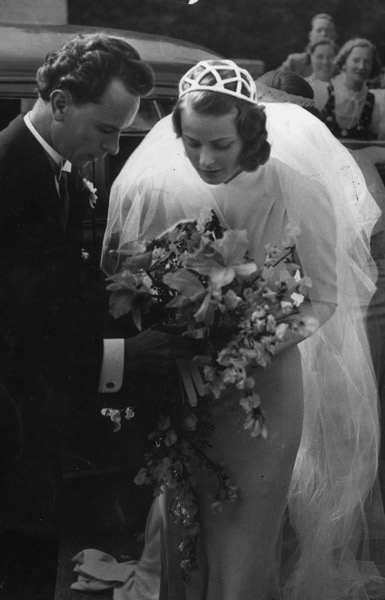
Petter Lindstrom and Ingrid Bergman on their
wedding day in 1937.

In the midst of this, Ingrid had fallen in love, ironically with a man whose pragmatism mirrored her mother's. Petter Lindstrom was a handsome and intelligent dentist who would eventually work his way up to being a neurosurgeon. Naturally, Ingrid was attracted to his intelligence and stability. He was a man who took action, made decisions, and was the imaginative but unromantic yin to her rational but whimsical yang. Thus, she found in him both the father figure she had been searching for as well as the ostensible opposite that would make her complete. Attracted to men older and more experienced than she and equally reliant on their worldly knowledge, Ingrid had taken her (alleged) first lover at the age of eighteen: Edvin Adolphson, with whom she had worked in various plays and films. Yet, as adoring as she initially was of the gifted (and philandering) actor, she also knew that her only true love would ever be acting. A famous and temperamental performer, therefore, was not someone she wanted to bind herself to. She needed someone as focused and devoted to his own life as she, who needed little mothering or coddling, and would thus allow her the independence of her own career. She believed that Petter fit the bill. After all, he was as ambitious about science and medicine as she was about acting. They were married in 1937.

Ingrid had no inhibitions about playing the mutated leading lady in
A Woman's Face, a dark film which showcased her as the female
Lon Chaney (and you ask why I love her). The film was
re-made in America with
Joan Crawford, but it possessed
 the usual Hollywood-ized errors and flaws.

Ingrid's career would continue to thrive, as would her reputation as a powerhouse actress as she collaborated with director Gustav Molander in Dollar, Only One Night, and A Woman's Face, playing every type of woman throughout-- bitter, broken, reborn, martyred, comedic, frigid, erotic, vengeful, and outcast. With Petter increasingly navigating the course of her career, Ingrid soon was looking for better contractual opportunities. She signed with Germany's UFA Studios while simultaneously discovering that she was pregnant. Additionally, the increasingly threatening nature of Nazi politics was starting to take over Europe. Fortunately for Ingrid, Kay Brown, David O. Selznick's talent scout extraordinaire, had just seen the American debut of Intermezzo, and she subsequently badgered her boss to sign the amazing ingenue to his roster of talents. What better time to move West?

To Be Continued...

Tuesday, May 28, 2013

HISTORY LESSON: TV Movie [Stars] - Part 2


The beautiful Ava Gardner shows her versatility as a special celebrity
guest on the quiz show "What's My Line?"

I Have to Be Home by 8:00, Because...!

There were definitely some major successes in the Movie to TV migration. Whether certain personalities were simply better suited for the small screen or were likewise more seemingly approachable and likable, there are a handful of Lords and Ladies who amplified their power simply by taking their comfy place in people's living rooms. One such person was comedian extraordinaire Groucho Marx (left), whose grease-painted mustache had long been replaced by the real thing. Always a popular guest and the hit of every party he attended, it only make sense that he be the favorite part of any piece of television he poked his ever-rolling eyes into. Not only was he regularly offered guest host spots on the likes of "The Tonight Show with Johnny Carson" or "Tonight with Jack Paar," he also participated on "What's My Line?" and even an episode of "Hollywood Squares."

Clearly, America was still Coconuts for him. Thus, after an improvised radio broadcast with Bob Hope sparked the idea, he became the host of his own game show on NBC: "You Bet Your Life." If you've ever noticed that a duck is often associated with Groucho, look to this show for the reason-- in addition to Duck Soup, of course. The format was simple. Average, American guests would be invited on the show where Grouch' would improvise, make conversation with them, and poke fun (right). In essence, he used his wit to draw out many a laugh from the viewing audience as the embarrassed participants turned beet-faced at his shenanigans. Finally, the guest duo would be asked a series of questions from a category of their choosing. In addition to this, there was a "secret word" that Groucho would try to get the players to innocently say in the midst of conversation. If they accidentally uttered it, the infamous duck would descend from the ceiling with a $100 bill in his bill. The show was such a success that the metaphorical ball was later passed to Bill Cosby as host in 1992, but Groucho-- as usual-- was the instigator!

Women in particular seemed to have luck with television, as in the following two examples. Perhaps this is because actual housewives and stay-at-home moms were able to use TV as a daily gateway to the outside world, which their husbands so often took for granted. Having classy, strong, and relatable women telling their stories for them seemed to be a gift from heaven for den mothers, but the fellas enjoyed these shows too. The case of Donna Reed is particularly fascinating. In a little over a decade, Donna had worked her way up from supporting roles in Shadow of the Thin Man and The Courtship of Andy Hardy to an Oscar win for From Here to Eternity. A shrewd business woman, she experimented with television cautiously as it slowly gained its dominion, and in 1958 she signed on for her own series, appropriately titled "The Donna Reed Show" (left). 

Very similar to the recent hit "Leave It to Beaver, " the show was a tribute to the all American family-- or at least the all American family dream-- where misunderstandings and common family problems are humorously and touchingly dealt with. The moral of the show hit home for most viewers with its uplifting storylines, which boosted morale on the home front, and promised not so much that good will come if you do the right thing, but that doing the right thing is just the right thing to do. It was a huge hit that earned Donna a Golden Globe and ran successfully for 8 seasons. Finally, after preaching that a family that sticks together stays together, Donna was burnt out by the weekly demands of the show, and the series came to an end. Donna worked intermittently on other series-- "The Love Boat," "Dallas"-- but with the unprecedented success of the show behind her, she soon put TV behind her too.

Doris Day was always a fan favorite. With her cheery onscreen persona, bright and crystalline singing voice, and average American gal disposition, she became a huge movie star and an obvious candidate for television success. Yet, with a surprisingly complicated and sometimes devastating personal life contrasting her public identity, Doris's entertainment career was both an emotional saving grace and a hefty burden that added to the intensifying pressure cooker of her sanity. But, a girl's gotta eat. Thus, when her contribution to cinema came to a halt in 1968-- after television had more than injected its influence over the American way of life-- she made the jump to CBS to star in her own series: "The Doris Day Show." Despite the show's title, Doris's character was not named Doris Day on the show but Doris Martin-- just as Jean Arthur was Patricia Marshall on "The Jean Arthur Show" and Donna Reed played Donna Stone on "The Donna Reed Show." The lack of creativity in the show's title was simply a marketing ploy by the network to benefit from the celebrity's star power and get viewers to tune in. (Doris in the Season 2 Christmas Special, right).

With Doris, CBS knew they were getting plenty of bank for their buck. Doris's program ran for five seasons but progressed in a very peculiar fashion. The fish out of water plot line essentially followed Doris's widowed character and her two sons as they moved to the country from their posh city lives and bunked up at her family's farm. The usual chaos and hijinks ensued. Strangely, every season altered after the first, with Doris and her sons changing locales, she changing careers, and eventually the sons disappearing from the story completely. Still, the awkward nature of the storyline did not stop viewers from watching one of their favorite celebs every week. It did surprisingly well, and due to its lengthy run (in a world where most series were lucky to make it one season if any), it can be reasonably considered a bona fide success. 


After "The Doris Day Show" came to an end in 1973, Doris basically retired from acting, though she did have another series as a talk show hostess on a program entitled "Doris Day's Best Friends." On the show, she would reminisce with old showbiz pals about the good ol' days on the silver screen and, once again, allow the production company to capitalize off aging nostalgia for Hollywood gone bye-bye. Her first guest on the show was none other than Rock Hudson, her three time collaborator and good friend (left in Lover Come Back). This was, of course, a remarkable moment for viewers and Doris herself, who hadn't seen her former co-star in years. Unbeknownst to her, Rock was already deep in the throes of his battle with AIDs. He had been aware of his illness for a year, having been diagnosed in 1984. When he made his appearance on the show in 1985, his shocking weight loss and sickly disposition had a shattering effect on Doris. Rock would announce his disease mere days after the broadcast and would pass away in less than three months. Thus, what was meant to be a beautiful reunion was practically the bittersweet final note to her pitch-perfect career. "Doris Day's Best Friends" would continue for one season and 26 episodes. Aside from occasional personal appearances, Doris would bid Hollywood farewell, and much like her earlier Doris Martin character, return to a simpler and more private life away from chaos in Carmel, CA.

It's Show Time!

The business of Television is hard. No matter the talent behind the show's writing, nor the creativity of the storyline, nor the appeal of the performers, the comprised efforts don't always result in a hit. Nothing is surefire. All sorts of factors can effect a show's reception-- a competitive time slot, varying audience tastes, a poor chemistry amongst the cast, etc. What seems a possible runaway hit on paper can often tank on the air. Famous or not, TV is a gamble for anyone. A bunch of unknown, struggling actors shot to fame on "Friends" in 1994, and the show ran for 10 seasons; acclaimed actor Dustin Hoffman took at stab at "Luck" in 2011 on HBO only to receive poor ratings, and now the show's tenuous second season hangs by a thread. To even produce a pilot is a success. To be picked up by a network is a glory rarely received. To make it through an entire first season is astounding. Those few programs that run for years and really grip the public are pure miracles. There aren't many, and there are even fewer that will be remembered as classics after the series finale, but some of our superstar wonders were actually able to dine on an exclusive slice of TV heaven instead of sulking over a plate of humble pie.


Loretta Young was a lovely and vulnerable looking young girl when she landed her first major role in the Lon Chaney film Laugh, Clown, Laugh in 1928. Over the next 25 years, she would develop into a powerhouse female lead in numerous major motion pictures. Known as the "Iron Butterfly" for her killer combo of delicate, pre-Raphaelite beauty (left) and a tough and ambitious business savvy, Loretta boasts one of the most impressive resumes in cinematic history. Realizing quickly that television was the wave of the future, she wasted no time in jumping head first into the new medium. Her series, "The Loretta Young Show," was another anthology series that produced a fresh drama every week. She was the first woman to host her own show, and her grand entrance at the beginning of every episode in a new, drop-dead-gorgeous gown was the perhaps the most eagerly anticipated moment of the program.

Like Errol Flynn, Loretta would do an introduction at the episode's opening, and the story would commence with a different plot each week-- akin to the TV movie-- with varying actors. She sometimes would appear in an episode herself. The glamour plus the salivating drama made Loretta's show a huge success that ran for 8 seasons on NBC from 1953-1961. In 1963, she switched networks to CBS to appear in another series, "The New Loretta Young Show," this time strictly acting as a widow who supported herself as a freelance writer. Yet again, though the title bore her name, Loretta played character Christine Massey. The tone of the show bore touches of both drama and comedy, but it only lasted one season. Audiences apparently wanted Loretta to appear only as her glamorous self. Fifty-years-old by the time filming ended, Loretta enjoyed working on a few TV movies and settled into retirement a very wealthy woman-- not to mention a big and small screen legend.


The award for consistency and duration goes to one of the great funnymen of history-- and good pal of Groucho Marx-- Jack Benny (right). From vaudeville, to radio, to film, Benny seamlessly translated his humor to any given outlet. With his always immaculate comedic timing, hilariously underplayed facial expressions, and somehow likable buffoon characterizations-- imagine an uptight Steve Carell in "The Office"-- there was no one immune to his jocular abilities. Unafraid of being the butt of his own jokes, Benny's most infamous persona was that of the irritable miser who both refused to admit he was older than 39 and played the violin abominably (although he was a great proficient in reality). His great gag was the hold-up sketch. The mugger would point his gun and yell, "Your money or your life!" to which, after a breadth of silence and more prodding, Benny would reply, "I'm thinking, I'm thinking!" His great success, specifically on the radio on "The Jack Benny Program," was quickly transferred to television in 1950 on CBS where it ran for fifteen straight years.

Previous to this and during the show's run, he would make appearances on other programs, including the "GE True Theatre" and "The George Burns and Gracie Allen Show," but with  his own primetime spot, he blew all other competition out of the water. His was the show everyone wanted to watch and no one wanted to miss, including everyone from the town butcher, baker, and candlestick-maker to JFK himself. As was the general standard of the time, at each show's beginning, Benny would come out to greet the viewers with an opening monologue and likewise finish the show with a closer. In between, anything was possible in the life of Jack Benny. So closely was he identified with his TV character, that a cab driver, for example, was shocked to receive such a large tip from him in real life! In the end, counting its radio days, "The Jack Benny Program" ran for three decades, finally coming to a conclusion in 1965, the last year of which was filmed at NBC. Benny would bow out while still on top and his presence in the homes of many was deeply missed. Luckily, he would still pop up from time to time on "The Bob Hope Show"or "Kraft Music Hall" before his death in 1974.

Of course, despite Jack Benny's long term hold on the public, there is but one person who is forever identified as the all-time favorite TV personality: Lucille Ball. After struggling vainly for years in her attempts to become a film actress, Lucy could never seem to achieve success at the B-level of filmmaking. Despite her great beauty, there was an earthy, unfinished quality that kept her from being a glamour queen of the silver screen like Carole Lombard. Despite her talent in acting, audiences had trouble relating to her intensity or emotion the same way they could with Katharine Hepburn. It was her union with the ambitious Cuban bandleader Desi Arnaz and her coincidental gig on the radio program "My Favorite Husband" in 1948 that brought her the opportunity of a lifetime. When a deal was struck to take the show from the airwaves to the TV set, Lucy brought her husband and collaborator with her, and the rest is history for eternity. The over-the-top comedy of the Ricardos was hilarious, decent, and relatable. Through "I Love Lucy" (left), the lady herself proved that a woman could be both attractive and a total ham-- and even a basket case. Despite her frustrating antics and the unbelievable amount of trouble she caused each week, she also made a bold feminist statement that a woman need not be perfect to be loved. It was all the varying shades of both devotion and insanity that drew Ricky Ricardo to his red-headed, adorably vexatious bride. Through Ricky's performing career, the trials of parenthood, and from New York to Hollywood to Europe and back, the Ricardo family endured both despite and because of their mix of irritation and passion.


Unfortunately, the real life marriage of Lucy and Desi would not fare so well. Their turbulent and stormy union, which had made such beautiful music publicly, was a private Hell. The "I Love Lucy" show enjoyed six seasons of phenomenal success despite the increasingly venomous relationship the couple shared behind the scenes. Agreeing that the show was worth saving even if the marriage wasn't, "I Love Lucy" changed in format for its 7-9th seasons, becoming hour long episodes that roughly added up to four per year. The guest stars continued, with everyone from John Wayne to Milton Berle making an appearance at some point during the 9 years of "I Love Lucy" and  "The Lucy-Desi Comedy Hour." Yet, it finally became clear that the temperaments of the two stars could not bear much more. The program came to a close in 1960 and Lucy left Desi and co-star William Frawley behind to start her own series with Vivan Vance, otherwise known as Ethel, who reluctantly agreed to continue the next chapter of the characters' friendship on "The Lucy Show" (right). This storyline involved the new lives of the widowed Lucy and the divorced Viv, which was clearly a popular plot instigator for a lot of aging female actresses on TV at the time. While Jack Benny-- who shot his own program at the Desilu Studios-- made a few appearances on this series, and several other guest stars popped in, the show's success would not match the brilliance of the original. Still, it lasted six more seasons and was later followed by "Here's Lucy!" which followed a new Lucy Carter as a widowed mother of teenagers again making it on her own. This made it for 6 more surprising seasons, mostly due to Lucy's power than to the show's material. Her final stab at TV came in the brief, single season series "Life with Lucy," now portraying Lucy Barker and her adventures as a grandmother. 

From 1950 10 1986, Lucille Ball made a huge impact on the world of Television, giving it an integrity born of her humanity, drive, and humor that made it more welcoming to those still-questioning film celebrities who feared this mysterious new vehicle for their talents. Clearly, not everyone would enjoy Lucy's success, and in truth, with her personal anxiety, she never really did either, but "I Love Lucy" in particular remains the show that took the little engine that could and made it an uncompromising force of overwhelming power. Today, because of the foundation that people like Ball, Benny, Young, and numerous other personalities of boob tube fame made, the world of television continues to grow exponentially. From "The Tonight Show with Johnny Carson" (1962-1992), to "Bewitched" with Elizabeth Montgomery (1964-1972), to "The Cosby Show" with Bill Cosby (1984-1992), to "30 Rock" with Tina Fey and Alec Baldwin (2006-2013), the medium continues to expand. NBC, HBO, FX, sitcoms, soaps, dramas, live, recorded on DVRs, and available post-season on DVD, we continue to expand the possibilities of entertainment, which may not be as focused nor as controlled as it once was but is certainly more varied. Though the presence of thousands of channels can be overwhelming, there is literally something for everyone. Thus, single-theater towns temporarily inhabited by rotating cast of players merely passing through on their vaudeville circuit has become a chosen program on demand starring your favorite actors at the touch of your fingertips. 


Don Adams would portray the incompetent secret agent Maxwell Smart on "Get Smart" 
in the late 1960s on television and, in a role reversal, Steve Carell would bring
the same character to life in the movies in 2008.

While one may often question the integrity of "What Would Ryan Lochte Do?" one can be reminded of the great creativity and bold behind-the-scenes choices of programmers, producers, writers, and actors by seeing glimpses of past brilliance in today's more intriguing, provocative, and evocative series. Lucy can be found in Amy Poehler, the dramatic Loretta Young style may be glimpsed through series like "The Good Wife," and Jack Benny's unconventional family humor has been updated and modernized via "Louie." The couch has provided a more comfortable place for us to participate in and observe our ever-changing society as it grows, changes, and stays the same. And so, as Sonny and Cher said, "The beat goes on..."